Showing posts with label Forgotten Realms. Show all posts

25 July 2022

David Warner, RIP

David Warner was a very accomplished actor. 


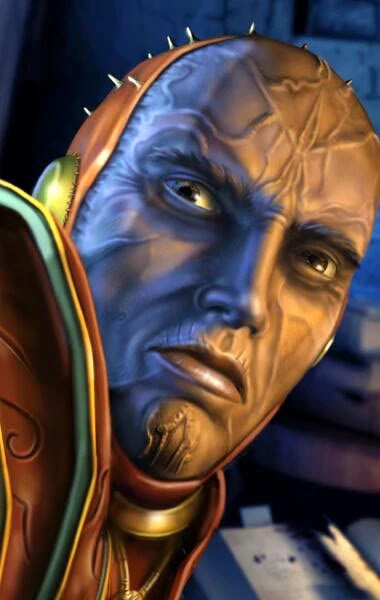
But I’ll forever associate him with the character “Jon Irenicus” of the computer role-playing game, Baldur’s Gate 2: Shadows of Amn.


Anyone who has ever played that game will recall his work for the lead villain. The opening lines will echo in my mind’s ear throughout the rest of my days:

Ahhh, the child of Bhaal has awoken.

It is time for more experiments...

RIP, Shattered One.


17 April 2022

No new Greyhawk setting book? Phew!

Every so often on the inter-tubes I encounter laments about the dearth of 5th edition (D&D) material for settings other than the Forgotten Realms.

Fair enough, I guess. But personally, I’m fine with the limited amount of material that’s been produced for the World of Greyhawk. There’s Ghosts of Saltmarsh, which includes some helpful material on southern Keoland, but not much information on the larger world. And there are some converted 1st edition (AD&D) adventures in the Tales from the Yawning Portal adventure collection. (The core “Saltmarsh” components, U1 – U3, of course, also are converted 1st edition adventures set in the world of Greyhawk.) 

Overall, I'm kind of grateful for the lack of “official” Greyhawk material. It means that WotC can't wreck the setting (a la 4e FR) or smother it with too much "official" detail (a la FR – all editions).

I prefer Gary Gygax's version of Greyhawk to later versions. (The original Darlene map alone is inspiring.) So, I am relying on the 1983 box set as my “setting bible” for my current campaign, adding things from later editions to taste. And I’m filling in the “gaps” and modifying things as I see fit (e.g., my “Mage of the Vale” is loosely inspired by the version found in Gygax’s “Gord” novels, and hence is entirely different from the "official" version). 

The 5th edition Greyhawk material that has been published has been quite easy to "plug in" directly, as are the 5th edition updates and expansions from Goodman Games, namely, Expedition to the Barrier Peaks and the Temple of Elemental Evil (the latter of which I’m using right now for my campaign). Of course, since most of that material was designed for 1st AD&D, much of it by Gygax himself, it’s not surprising that it all meshes readily with classic Greyhawk.

With PDFs (and in many cases print-on-demand books) available for pretty much all the older material, as well as the Greyhawk Wiki (and this resource that draws upon Gygax’s “Gord” stories), I frankly have more Greyhawk material than I know what to do with. 

By Boccob, when it comes to the Oerth, I’m laughing with good old Zagyg.


23 August 2021

Steve Perrin, RIP


Influential game designer Steve Perrin passed away recently at the age of seventy-five.

In addition to RuneQuest, Perrin authored or contributed to numerous other role-playing games, including two of my all-time favourites: Stormbringer and Call of Cthulhu. And RQ's system, of course, informed all subsequent Basic Roleplaying (BRP, or “d100”) games. He also authored the influential AD&D module, Under Ilefarn, which was the first original adventure for TSR’s Forgotten Realms setting. 

Arguably, Perrin’s influence on RPG design was second only to that of the genre’s creators, Gary Gygax and Dave Arneson.

Shannon Appelcline provides a nice overview of Perrin’s work here.


16 August 2020

A return to Icewind Dale

As I’ve mentioned before here, when it comes to classic Dungeons and Dragons settings, I’m much more of a “Greyhawk” person than a “Forgotten Realms” person. But I do like aspects of the Realms.

It’s a bit unfortunate what the Forgotten Realms setting has become over the past few decades. Decisions made during the era of fourth edition Dungeons and Dragons especially were quite misguided. (The “Spell Plague”? Blech!) The original “grey box” version was (in my view) quite good. Nonetheless, even now, after all these years and missteps, there are potions of the Realms that I continue to like. I still think that the Moonshae Islands, the Sword Coast, and Icewind Dale are cool regions with lots of potential for interesting adventures.

One of the reasons why I remain fond of the Icewind Dale region is the classic computer role-playing game set there, for which there is an ‘Enhanced Edition’ version. I still play it occasionally, especially when I’m too busy with “adult life” to get a proper role-playing game campaign together. In fact, I’ve been playing IWD EE lately—improved with some fun new ‘mods’ to keep it fresh. 

 [The party in the village of Kuldahar]

[Some rest and relaxation in the "Whistling Gallows" inn of Lonelywood]

So, I am somewhat intrigued by this forthcoming product: Icewind Dale: Rime of the Frostmaiden. I’ll pick it up for nostalgia reasons alone. (I thought that the “D&D Next” module/mini-campaign setting, Legacy of the Crystal Shard, was quite good.) The art alone looks gorgeous. 

Finally, also related to the Forgotten Realms, check out these early maps by Ed Greenwood.


Okay, that’s enough Realms stuff for now. I have a few things about Greyhawk that I hope to post in the near future (in addition to my final campaign notes for my Adventures in Middle-earth Mirkwood campaign.) Stay safe and healthy!

30 November 2019

Eye of Vecna coming to the big screen?

The possibility of new Dungeons and Dragons film has popped up from time to time for years now (I last mentioned it here in February 2016). But it now looks like a new D&D film will be released in the summer of 2021. Interestingly, according to this report at ComicBook-dot-com, it will feature the infamous artifact 'The Eye of Vecna':
"ComicBook.com can exclusively report that the upcoming Dungeons & Dragons movie currently in development by Paramount will focus on a group of adventurers looking for the Eye of Vecna, a powerful artifact that dates back to the earliest days of the game. Vecna is a powerful lich turned god whose hand and eye (remnants from when Vecna was a mortal) grant unspeakable power. Both the Hand and Eye of Vecna come with a terrible cost - in order to use either artifact, the user must remove their existing eye or hand and then replace it with the artifact.
[...]
Vecna was a major entity in the Greyhawk campaign setting [...]"
The movie, alas, will be set in the Forgotten Realms setting rather than the world of Greyhawk, although I suppose that's to be expected given the centrality of the Realms for contemporary D&D.

I don't have high hopes for this film but perhaps I'll be pleasantly surprised. At the very least it can't be any worse than the 2000 one.

Here's the description of the Eye of Vecna from the 1st edition Dungeon Master's Guide:


The Hand and Eye of Vecna were among the artifacts that most excited (and corrupted?) my young imagination decades ago!

(Thanks to C. Robichaud for the link to the ComicBook-dot-com article.)

06 June 2019

Baldur’s Gate III is coming (and other BG news)

I came across this promo trailer for Baldur’s Gate III this morning. The game is being produced by a company called Larian Studies. (I don’t know anything about them, but then I haven’t really followed the computer role-playing scene for the past fifteen years or so.) I hope that it has nothing to do with Bhaal (the Realms’ ‘god of murder’) or the Bhaalspawn—that vein was exhausted by the original series. Perhaps (based on the trailer) it concerns a plot against the city involving mind flayers? That would be interesting.

I’ve expressed my fondness for the Baldur’s Gate series before here. I don’t enjoy most CRPGs that I’ve tried, but there was a batch of these games produced two decades ago—the ‘Infinity Engine’ games: BG, BG2, Icewind Dale, and Planescape: Torment—that were so amazing that I’ve returned to them time and time again over the years (my flagging interest boosted by the recent ‘Enhanced Edition’ versions of the games, as well as the plethora of ‘mods’ that are available for them, especially BG and BG2).

Anyhow, it’ll be interesting to see what happens with this. I don’t think the world ‘needs’ a BG3, but perhaps I’ll be pleasantly surprised.

[Picture of Viconia by Lius Lasahido from Heroes of Baldur’s Gate]

Also in Baldur’s Gate news: this impressive campaign setting and adventure sequence, covering levels 1-6, called Heroes of Baldur’s Gate (written by James Ohlen, lead designer of BG1 and BG2). While it uses the 5th edition D&D rules, it’s set right after the original game (1369 Dale Reckoning), and features many of the key companions, NPCs, and organizations from it: Imoen, Minsc, Viconia, Edwin, the Zhentarim, the Shadow Druids, and so forth. To be clear: the player characters are assumed to have no connection to the original campaign.

Finally, there is the forthcoming Wizards’ campaign set in Baldur’s Gate: Descent into Avernus.

[The alternative cover for Descent into Avernus]

I much prefer Greyhawk over the Forgotten Realms for my D&D games these days (for reasons I hope to explain in a future post). So I was delighted to find that Ghosts of Saltmarsh is explicitly set in the world of Greyhawk. But I have a real soft spot for the city of Baldur’s Gate and the surrounding Sword Coast—pretty much entirely due to those classic Infinity Engine CRPGs. If I ever run a Forgotten Realms D&D campaign again, I’ll almost certain use Heroes for it. (Nostalgia: it’s a hell of a drug!)


26 December 2018

Two Decades of Baldur’s Gate

There is a decent article at PC Gamer on the 20th anniversary of the classic computer role-playing game (CPRG) Baldur’s Gate (BG).

I must confess that BG—and the other ‘Infinity Engine’ (IE) AD&D-based CRPGs, including Baldur’s Gate II (BG2), Icewind Dale (IWD), and Planescape: Torment (PST)—have given me a surprising amount of joy since 2000 (when I first played BG). This is despite the fact that these games almost derailed the completion of my PhD 2000-2002.

[A map of the region covered by the original Baldur's Gate game.]

I’m not a fan of CRPGs or video games in general. I’ve never played any massive multi-player online role-playing games (MMORPGs), like the World of Warcraft. With respect to computer games, I played far too much Civilization during the 1990s. However, I only dabbled with Diablo during that decade, and simply couldn’t get into it. The same applies to most other CRPGs that I’ve tried over the years. But—aside from Neverwinter Nights (NWN)—BG, BG2, PST, and IWD are the exceptions. 
(I like Neverwinter Nights, and I’m glad that there is now an ‘Enhanced Edition’ version that I can play on my Mac. I especially appreciate the wide range of fan-produced modules for NWN, some of which are superior to the original, rather lacklustre campaign. But I never found NWN as engaging as the IE games. One reason is that I find it far less visually impressive, despite being ‘3-D’ [I’ve never understood the appeal of 3-D in anything: movies, games, etc.]. Another reason is that NWN employs the 3rd edition D&D rules, which I like less than AD&D. But enough of NWN…)

There are a few reasons why I find the classic IE games like Baldur’s Gate to be special. One reason is aesthetic. The music is magnificent. And visually, I find these games beautiful to look at. The screenshots below (with the ‘game information sections’ cropped out) don’t really do justice to how great the games look on a large computer screen:

[The player character in BG is from Candlekeep. Towards the end of BG, the party returns to Candlekeep. Here is the party and some Seers.]

[The party discovers a dragon mural in a dungeon during the Siege of Dragonspear.]

[The party at the top of the Iron Throne headquarters within the city of Baldur's Gate.]

[The symbol of Bhaal burnt onto the surface of the Boareskyr Bridge.]

Another reason why I’m a fan of the IE games: their stories and characters. The BG series and (especially) PST have engaging overarching storylines, with multiple paths to success, including different routes for ‘good’, ‘neutral’, and ‘evil’ inclined characters (as well as for characters of different classes, etc.). To a great extent, the settings in these games are genuine ‘sandboxes’: they have maps with loads of optional encounters, quests, and areas (to be explored or ignored as you wish). Since they have overarching plots, though, there are some ‘necessary’ areas and encounters, but these often can be resolved in different ways.

The IE games also have some wonderful NPCs—both characters that can join your party, as well as minor characters with whom you can interact. Here is one exchange between two party members—Jan Jansen (an irreverent gnome illusionist/thief) and Keldorn (a serious paladin of Torm)—that I think is quite funny:


And since I teach philosophy in the real world, I find amusing this exchange in the town of Trademeet in Baldur’s Gate II:


With respect to the settings for these games—the Sword Coast, Amn, and Icewind Dale of the Forgotten Realms (BG, BG2, and IWD), and the torus city of Sigil within Planescape (PST)—I delight in the ways that they embrace the ‘stew’ of disparate elements that make up ‘D&D’—and somehow make them work. By this I mean such elements as ‘Vancian’ magic-users, Scottish dwarf fighters, ‘Christian-not-Christian’ paladins who associate freely (often in the same adventuring party) with ‘paganistic’ druids, the Great Wheel cosmology, the Blood War (the eternal conflict between Chaotic demons and Lawful devils), and so forth. This all somehow makes sense in these games—and in fact is one of the reasons why I returned to D&D for some of my tabletop gaming after a long absence (most of the 1990s).

And then there are the ‘mods’ (which I believe is short for ‘modifications’, although it may also be short for ‘modules’). The ‘modding’ community—which has been reinvigorated in recent years thanks to Beamdog’s release of ‘Enhanced Editions’ of the IE games—has helped make these games, and especially the Baldur’s Gate series, highly re-playable. Mods can provide new NPCs (including characters to join your party), additions for existing NPCs (e.g., expanded dialogues for party members in BG1), new magic items, new encounters, and even entirely new adventures for your games. Install enough mods and your next BG2 game will be quite different from all previous ones! 

Finally, while I prefer playing tabletop RPGs to CRPGs, there have been times in my life when this wasn’t possible, and the IE games (as well as NWN) were there to fill the void. Even when I am lucky enough to have a regular group, adult life makes getting together for games rather difficult (adulting is tough!). Thankfully, I can ‘dip into’ my Baldur’s Gate, Planescape: Torment, or Icewind Dale game for an hour whenever I like. 

So, to Baldur’s Gate I say: happy birthday old friend!

20 October 2013

Why AD&D now? How to play online?

So, I just posted some house-rules for AD&D/OSRIC here!

Why did I do this, given my ongoing focus on various d100 games -- namely, RuneQuest 6, OpenQuest 2, Call of Cthulhu, Renaissance, Magic World, etc. -- my house rules for Swords and Wizardry, and my contributions to Crypts and Things?  Why go to AD&D now (albeit it with some tweaks to the rules that, no doubt, would infuriate certain kinds of grognards)?

Well, I haven't lost any of my enthusiasm for those other games.  Quite the contrary!  I would love to get a RQ6 or CoC campaign (or 'Dark Streets' or...) campaign up and running in the near future.

However, I'm trying to start up an online campaign with a couple of old friends, and we agreed (for reasons of unabashed nostalgia) to play some AD&D.  This would give me a chance to run some classic AD&D modules, ones that I either haven't run in decades (the wonderful U1-3 series), or that I have never run, but have long wanted to (e.g., UK4).

And I chose the Moonshae region of the Forgotten Realms (the 1st edition version, of course!) as the setting, because I rather like the 'Vikings-versus-Celts' feel of the place.  Essentially, the Moonshae Islands are a fantasy version of 10th Century Ireland and Scotland.  The region reminds me a bit of Jack Vance's Lyonnesse -- or at least that is how I interpret it.  And since I recently played through the classic CRPGs Icewind Dale and Baldur's Gate (I'm old school even when it comes to my computer games!), I have been reminded of the main elements of the Forgotten Realms world.  (I'm ambivalent about the Forgotten Realms overall, but there are parts that I quite like.)


Since I'm trying to run this game online, and have never done anything like this before, I'd be grateful for any tips that you gentle readers might have.  I've looked at Roll20, and it strikes me pretty good, though I have yet to try it out.  Do others recommend it?

19 October 2013

House-Rules for Advanced Dungeons and Dragons


Akrasia’s House-Rules
For AD&D (1e) or OSRIC
Part I: Character Creation, Races, and Classes

General Points

  1. The page references are to OSRIC, as it is available online for free.  However, all of the rules are useable with AD&D (1e).
  2. The rules were designed for a very small group (two players with two characters each).
  3. These rules were written for a campaign set in the Moonshae Islands, which is a 'Celtic' region of the Forgotten Realms, hence the references to the 'Ffolk,' various FR deities, and so forth.  But the rules should be useable in any AD&D game.


Character Creation

  • Choose the character’s race
  • Determine initial ability scores by rolling 4d6, dropping the lowest die
    • Replace the lowest roll with ‘15’
    • Assign scores in any order
  • Apply racial modifiers to ability scores [see OSRIC, pp. 3-7]
  • Ensure that the character’s ability scores fall within the acceptable range for his/her race (e.g., a dwarf must have a strength of 8-18, dexterity of 3-17, etc.)
  • Human characters can add a total of 1 point to one of their ability scores, either +1 to two different ability scores (e.g., +1 to Strength and Intelligence), or +2 to one ability score (e.g., +2 to Dexterity)
    • No ability score can be raised above 18 this way
  • Non-human characters can add 1 point to their ability scores
    • No ability score can be raised above the character’s racial limit this way
    • (E.g., a halfling could not raise his strength above 17, an elf could not raise her dexterity above 19)
  • Human characters select their ‘background professions’ (see my article). 
    • Either: 
      • Choose one profession from Chart I
        • Or
      • Choose two professions from Chart II 
  • If the character is a halfling, half-elf, or half-orc, choose one profession from Chart II
  • Dwarves, elves, and gnomes have no background professions


  • Choose the character’s class and alignment
  • No evil characters permitted (thus no assassin characters)
  • No monks permitted (at least initially — they are foreign to the region)
  • It is advisable that classes from the following four categories be covered:
    • Warrior (fighter or ranger; paladins are rare, though permitted)
    • Thief (assassins not permitted)
    • Arcane spell-caster (illusionist or magic-user)
    • Divine spell-caster (cleric or druid)
  • At least one druid, ranger, or bard should be in the party
  • Paladins will not adventure (at least for a prolonged period of time) with characters of Neutral or Chaotic Neutral alignment 
  • Bards play an important role in this setting, so players may want to consider that class (even though bards do not fit neatly into one of the above four categories).
    • The alternative Bard class (from Best of Dragon #3) will be used


Races and Classes (General)

  • There are no level-limits on non-human characters
    • Humans, however, enjoy the following benefits:
      • 1 extra point to assign to ability scores at character creation (humans receive 2 points at character creation; non-humans only 1 point) (see above)
      • Superior selection of background professions (see above)
      • Maximum hit points at both levels 1 and 2 (instead of only level 1) (see below)
      • A +1 to any ability score upon reaching level 6 (an ability score may not be raised above 18 this way)
  • Racially-determined class restrictions apply, except:
    • PCs of any race may be clerics
    • Half-elves and Halflings may be druids (single-class)
    • Half-elves may be druids and fighters, druids and rangers, or druids and magic-users (multi-class)
    • The following multi-class options are available to non-human characters:
      • Dwarves: (a) fighter/thief, and (b) fighter/cleric
      • Elves: (a) fighter/magic-user, (b) fighter/thief, (c) magic-user/thief, and (d) fighter/magic-user/thief
      • Gnomes: (a) fighter/illusionist, (b) fighter/thief, (c) illusionist/cleric, (d) illusionist/thief, and (e) cleric/thief
      • Half-elves: (a) cleric/fighter, (b) cleric/ranger, (c) cleric/magic-user, (d) fighter/magic-user, (e) fighter/thief, (f) magic-user/thief, (g) cleric/fighter/magic-user, (h) fighter/magic-user/thief, (i) fighter/druid, (j) ranger/druid, and (k) magic-user/druid
      • Halflings: fighter/thief only

Hit Points

  • 1st level characters receive maximum hit points.
  • Human characters also receive maximum hit points upon reaching level 2
  • When rolling for hit points (levels 2+ for non-humans, levels 3+ for humans), characters take either the roll of the die, or half the die’s maximum, rounded down (so magic-users roll 1d4, and take 2 if they roll 1; fighters roll 1d10, and take 5 if they roll 1-4; etc.)

Bards

  • We will be using the ‘alternative’ Bard class from Best of Dragon #3
  • Bards play an important cultural role within the setting
    • The bards of the Ffolk serve many functions: historians, entertainers, poets, heroes, and spies
  • Most Bards are Neutral or Neutral Good in alignment


Clerics

  • Northman (human) clerics typically worship the god Tempus (the ‘Lord of Battles’, ‘Foehammer’)
    • Clerics of Tempus generally are Chaotic Neutral, Neutral, or (rarely) Chaotic Good
  • Humans from the Moonshaes (both Ffolk and Northmen) may also be clerics of:
    • Azuth (patron of mages; LN)  
    • Deneir (God of literature and art; NG)
    • Lathander (God of Spring, Dawn, Vitality, Youth, Renewal, Self-Perfection; NG)  
  • Non-human clerics worship deities of their respective pantheons
    • Elves: Corellon Larethian, Solonar Thelandira, Hannali Celanil, Labelas Enoreth
    • Dwarves: Moradin, Clangeddin, Vergadain, Berronar
    • Haflings: Yondalla, Sheela Peryroyal, Avoreen, Cyrrollalee, Bandobaris
    • Gnomes: Garl Glittergold, Baervan Wildwanderer, Segojan Earthcaller, Flandal Steelskin
    • Half-Elf and Half-Orc clerics typically revere a ‘human’ god


Druids

  • Druids of all races within the Moonshaes revere the ‘Earthmother’.
  • Druids are common on each of the isles dominated by the Ffolk.  
    • There is a Great Druid on each of Gwynneth, Alaron, and Moray
  • Most druids are assigned a certain portion of one of their isles as their territory.  At the centre of this territory is a druidic grove.  
    • (PCs are assumed to be wandering druids, at least until they reach level 12, and thus do not have their own territories.)


Fighters

  • Only single-class fighters may specialize or double specialize in a weapon (multi-class fighters may not specialize or double specialize in a weapon)
  • Fighters may specialize in one weapon at level 1 (see OSRIC, p. 14)
  • Fighters may double specialize in that weapon (the same weapon with which the character already is specialized) at level 3+ (see OSRIC, p. 14)
    • No fighter may specialize or double specialize in more than one weapon


Rangers

  • Single-class rangers may specialize in one weapon at level 1 (see OSRIC, p. 14)
  • Multi-class rangers may not specialize in a weapon
  • Rangers (single-class or multi-class) may not double specialize in a weapon


Paladins

  • Paladins may not specialize (or double specialize) in a weapon


Magic-Users and Illusionists

  • Magic-users and illusionists are held in suspicion by most of the peoples of the Moonshaes, thus they generally try to hide their profession whilst travelling. 
  • Magic-users and illusionists with an Intelligence of 16+ may prepare and cast one additional first level spell each day
  • Material components for spells cost the cube of the spell’s level in gold pieces (e.g., the material components for a 1st level spell cost 1 g.p., the material components for a 2nd level spell cost 8 g.p., and the material components for a 9th level spell cost 729 g.p.).
    • Note which spells for which your character has the necessary components, and remove those components when the spell is cast (obviously this applies only to spells with material components)
  • Material components pouch = 20 gold pieces (holds material components for up to 20 spells; weighs 2 pounds when full)
    • 1st level magic-users and illusionists start with one pouch
  • Spell books are necessary for memorizing spells
    • 1st level magic-users and illusionists start with one ‘standard’ and one ‘travelling’ spell book
    • Both books may be assumed to contain the character’s starting spells (4 spells, including ‘read magic’, for magic-users; 3 spells for illusionists)


Thief Abilities

  • Thief characters may either:
    • Use the base thief ability percentages listed in the class description (OSRIC, p. 26)
      • OR
    • Distribute the following points amongst the thief abilities at each level — except Climb Walls, Hear Noise, and Read Languages (which follow the chart on p. 26)
      • 1st level = 130 points
      • 2nd level = 022 points
      • 3rd level = 022 points
      • 4th level = 022 points
      • [Etc.]
    • Racial and dexterity adjustments are applied after base skill percentages are determined


Blog Archive

About Me

My photo
I'm a Canadian political philosopher who lives primarily in Toronto but teaches in Milwaukee (sometimes in person, sometimes online).