Showing posts with label Middle-earth. Show all posts

22 September 2026

Happy Hobbit Day

Today is the birthday of those two most famous of all hobbits: Bilbo and Frodo Baggins. Hence, ‘Hobbit Day’. Also, yesterday (21 September 2026) was the 89th anniversary of the first publication of The Hobbit (1937). 

The Hobbit was the first ‘proper’ novel that I independently read all the way through as a child (that is, something that was not assigned in school and not a ‘children’s book’), so it has a special place in my heart. I’ve been a fan of Middle-earth for longer than I’ve played role-playing games. Together, they constitute two of my most enduring passions. But I must confess that I sometimes am nostalgic for the era (pre-movie trilogy) when Middle-earth was still not ‘mainstream’ and exploited for popular consumption.  

[Hobbit poster by J Cauty]

13 August 2026

Pete Fenlon on the Rise and Fall of Iron Crown Enterprises

Throughout most of the 1980s and 1990s, Iron Crown Enterprises was my favourite role-playing company. Of course, like most, I started out in this hobby playing Dungeons and Dragons, and I bought a lot of books and games from TSR during the 1980s – not just for AD&D (although that certainly was my focus), but other games as well, like Star Frontiers and Gamma World. Many of Gary Gygax’s classic AD&D books and modules I cherish to this day. I also was a fan of a few Chaosium games, and I had a strange fondness for Gamelords’ Thieves’ Guild products. I remember liking SPI’s Dragonquest as well (and still have the softcover rulebook – purchased forty-three years ago! – on my bookshelf). At some point in the late 1980s and well into the 1990s I became somewhat interested in GURPS, and was always impressed by their sourcebooks. But overall, well into the late 1990s (a time when I wasn’t gaming that often but always wished I was), I was most loyal to ICE’s Middle-earth Roleplaying (MERP) and (to a somewhat lesser extent) Rolemaster and Shadow World. (I also owned and liked the original Spacemaster but I never actually played it.) In fact, I followed ICE until it ultimately went bankrupt. (I also remained interested in what ICE produced when it was later resurrected – I bought Rolemaster Classic and Rolemaster Express two decades ago – but by that time I wasn’t really playing Rolemaster or MERP. My last, short-lived MERP campaign was in 1999.)


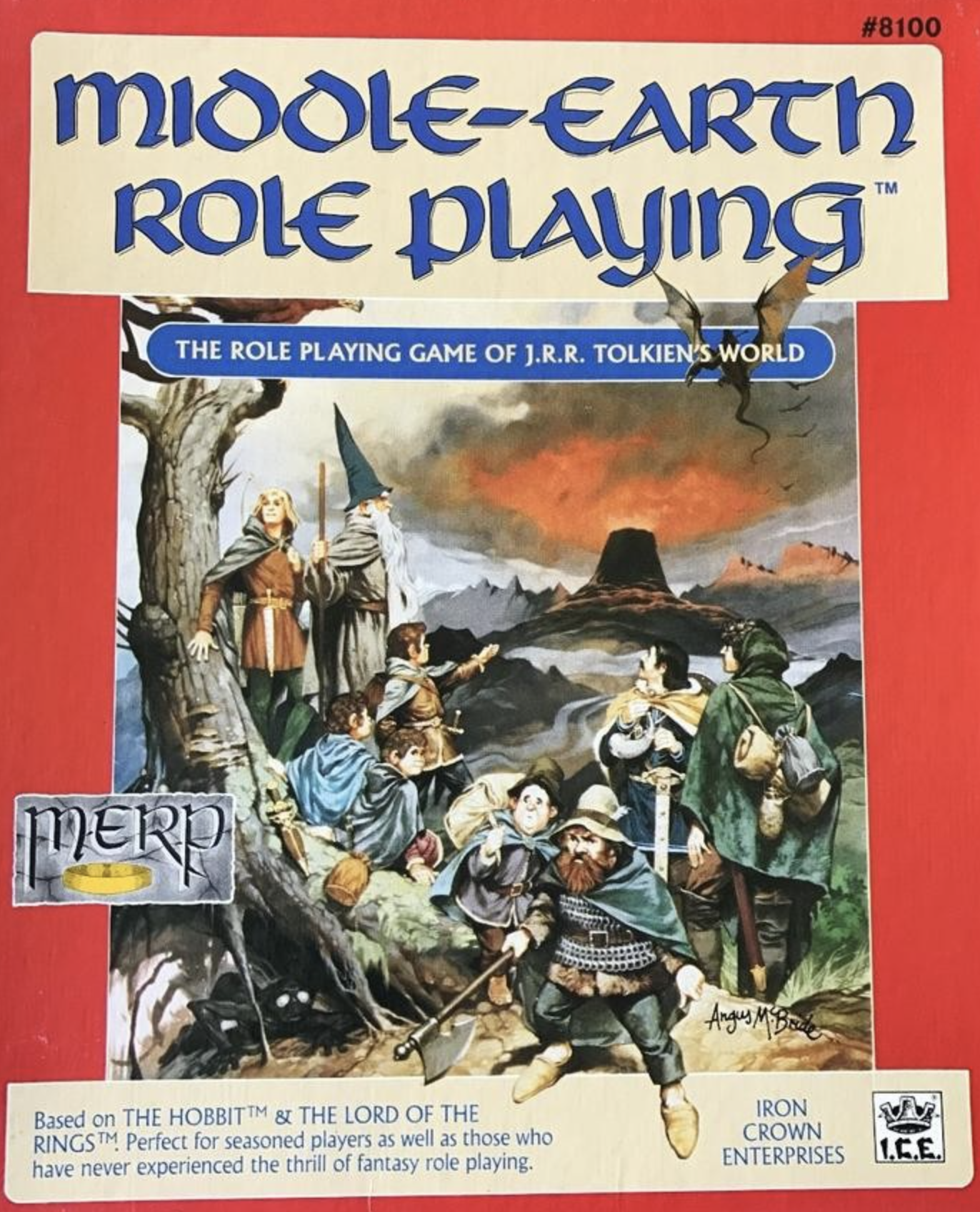
The driving force behind the original ICE was Pete Fenlon. In addition to running the company for about eighteen years, he helped to design Rolemaster – and of course he created all those beautiful Middle-earth maps! Indeed, Fenlon’s amazing mapwork earned him spot number four on my list of “top 5” fantasy role-playing artists. (Angus McBride’s wonderful covers for many of ICE’s MERP books earned him second place.)

Recently I discovered (thanks to a post by “Mankcam” at the RPG Pub) an illuminating interview with Pete Fenlon (by Wolfshield Games) on Youtube. It’s in three parts, with each part about 31-35 minutes long – so it’s a pretty informative and involved discussion.

Here is where you can find the three parts: 
  1. Part One: The Birth of Iron Crown Enterprises (link).
  2. Part Two: The Rise of Iron Crown Enterprises (link).
  3. Part Three: The Fall of Iron Crown Enterprises (link).
I was already familiar with some of the events described by Fenlon (e.g., the reasons for ICE’s financial troubles and the eventual loss of the Middle-earth license). But there was a lot of new information (for me, at least)!


Here are some of the things that came up that I found especially noteworthy:
  • Apparently TSR, and especially David Sutherland, were impressed by the early drafts of Arms Law (the combat system for Rolemaster) and the Vog Mur mini-setting (eventually part of ICE’s “Loremaster” series, and then Shadow World). But TSR could only offer a small amount of money at the time and so Fenlon (and “Iron Crown Productions”) declined. It’s probably a good thing that TSR failed to offer enough money to purchase that early version of Rolemaster. ICE needed to be the autonomous to properly create the game. But I can’t help but wonder how different the history of role-playing games would’ve been had TSR been able to make a decent offer at the time.
  • ICE acted fast when SPI lost the license to produce Middle-earth games. Even though TSR acquired SPI, Fenlon knew that Tolkien Enterprises (which controlled the license) had had a somewhat antagonistic relationship with TSR, thanks the use of “hobbits,” “balrogs,” and the like in early D&D products. So Fenlon judged that if they made a decent offer Tolkien Enterprises would be happy to pass the license on to ICE rather than TSR. 
  • ICE managed to make a deal with Dragon magazine that secured for them the full back cover of every issue (starting around number 67, I think) for their advertisements. They held that “space” for many years (certainly for as long as I read Dragon). I suspect that those gorgeous full-page ads helped MERP to become the second-best selling fantasy role-playing game during the late 1980s.
  • It seems that Fenlon never really stopped working on his detailed map of Middle-earth and now has somehow returned to a situation where he may be able to legally make it available. (The precise details are a bit unclear to me – I’d have to listen to the second interview again, and even then, I doubt I’d fully be able to follow the chain of events.) If this is so, this is extremely exciting news! The release of a full “Fenlonian” map of Middle-earth would be a dream come true.

Even if you weren’t a fan of ICE or MERP the interview is well worth listening, in my opinion, if you’re interested in the history of role-playing games. The history of TSR has been documented extensively in recent years (and rightfully so, given its central importance in the creation and development of the hobby). It’s great that we’re learning about some of the other important games and companies from the early years (I would say the “Golden Age”) of RPGs as well.

19 October 2025

To Do List: Middle-earth and Greyhawk campaign notes; a new Lyonesse character

I’ve sadly neglected this blog over the past two months. But I have not been (entirely) idle – indeed, I’ve been quite busy running my two campaigns. 

[The Witch-King by Liz Danforth]

One of them – Against the Witch-King – wrapped up two weeks ago. Or more precisely, it’s now on hiatus. A suitably epic conclusion – an audience with King Arvedui of Arthedain, following the completion of many important tasks – has brought things to an end for the time being. But the campaign will resume nine years later in “game time” – after a (hopefully not as long) break in “real time.” The final session of the current part of the campaign took place in the spring of 1965 of the Third Age; the campaign will resume (after the break) in early 1974. The characters all accomplished what they set out to do (a year earlier in game time; over two years ago in real time). But, as those of you familiar with the history of Middle-earth likely know, things become a bit “intense” in Eriador in 1974! So, while I need a rest from running this campaign, I’m determined to resume it at some point to see how Angmar’s final assault plays out.

Depressingly, I’ve fallen far behind in my campaign logs for both of the campaigns that I’ve been running over the past two-plus years, and especially for my Middle-earth one. Instead of writing entries as detailed as the first two for the Against the Witch-King campaign (1 and 2), I’ll try to write a brief overview of what happened, something like what I did when I encountered a similar problem (falling hopelessly behind) in my earlier Middle-earth campaign.

I really don’t like leaving my campaign logs unfinished! Even a truncated summary of what happened in the adventures is better than just leaving it incomplete – for my own future recollection, if nothing else, although I hope that at least a few other people might find the logs interesting. 

This thought reminds me that I never finished the log for the Greyhawk Classics campaign that I ran a few years ago. While running that campaign made me realize that I rather dislike the 5th edition Dungeons & Dragons system, the role-playing aspects of the campaign were nonetheless a lot of fun, and I really should explain how everything wrapped up – including why ultimately the characters never actually went into the Temple of Elemental Evil.

[A modified portion of Darlene's famous World of Greyhawk map.]

The Against the Witch-King group will soon be starting a new campaign, using the Lyonesse system and setting (the system is an adaptation of Mythras). I’m quite excited about this – not only because it’ll be nice to have the opportunity to be a player again (while still running my other campaign), but also because Jack Vance’s Lyonesse trilogy is one of my all-time favourites. I’m presently putting the final touches on a rather fun and intriguing character – a former apprentice of the dreadful wizard Tamurello. If you’re curious about the game, here is a brief interview with one of the authors (and my GM) Lawrence Whitaker. 

[The wizard Tamurello from the Lyonesse RPG book]

Vancian times ahead!


17 June 2025

Reflections on Middle-earth Roleplaying, Rolemaster, Against the Darkmaster, and Art

Back when I was a young lad and able to devote much of my time to role-playing games (late middle-school and high-school), I tried out a wide variety of different systems. Naturally, Dungeons and Dragons – and especially first edition AD&D – was a primary focus, given that it was the great colossus in the hobby during the 1980s, and everyone was familiar with it. But my friends and I also explored other games. We used our allowance money to try out alternatives like Dragonquest, Runequest, Thieves’ Guild, Traveller, Star Frontiers, and others. But our focus remained AD&D; it was the game with which we actually tried to play proper “campaigns” – usually failing for one reason or another, often with “total party kills” consciously or subconsciously engineered by tired or frustrated DMs. In contrast, we typically drifted away from the other systems after a couple of sessions. 

About halfway through high-school, though, my group – and especially me in my capacity as Game Master – shifted to Middle-earth Roleplaying (“MERP”). We still played other games – such as Call of Cthulhu and GURPS – but MERP became our main focus. My first “proper” campaign was one that I ran over a summer using MERP. The characters successfully completed a major quest and did some interesting things before my immaturity sadly led me to make some bad decisions that eventually caused the end of the campaign. Nonetheless, I remember it fondly, and parts of it vividly, even after all these years (almost four decades!).


Eventually we tried out Rolemaster as well. And although there were things about it that we liked, it proved less easy to use in play than the comparatively streamlined MERP. Sometimes we ‘mixed-and-matched’ things from the two systems, which was easy to do since MERP was a simplified “Tolkien-ized” version of Rolemaster (the relation between the two systems resembled that of Basic/Expert D&D and AD&D). In particular, the players used the individual weapon charts from Arms Law and spell charts from Spell Law, whereas I relied on the more general charts from MERP as GM. 

I continued to occasionally buy MERP and Rolemaster books even when I went to university and stopped playing RPGs regularly for a while. The Shadow World setting, by the highly creative Terry Amthor, especially intrigued me, although I never ran a campaign set in it. I bought the Rolemaster Companions as they were published and spent many hours daydreaming about the numerous options they provided (many of which, I recognized even at the time, were ill-conceived). However, the Middle-earth material remained my favourite. 

Given my longstanding interest in Rolemaster, I had known for many years that a new edition was in the works. This new version was ambitiously entitled “Rolemaster Unified” (“RMU”). It promised to “unite” elements of second edition Rolemaster (“RM2e”), the version that was dominant throughout the 1980s and into the early 1990s (later fixed up slightly and republished as Rolemaster Classic [“RMC”] around 2007) and Rolemaster the Standard System (“RMSS”), the even-more-complicated version that was published in the 1990s (a truncated version of which was later published in a single hardcover book, Rolemaster Fantasy Role-playing, with expansion books to cover the rest of system). I won’t delve into the edition differences here, most of which I have forgotten over the years. My perception is the RM2e/RMC remained more popular overall, but that RMSS had (and perhaps still has) strong advocates. Personally, after trying to GM some RMSS sessions about 25 years ago, I concluded that I preferred RM2e/RMC, and preferred MERP to both. 

In any case, given my gaming history, I was curious to see what the new version of Rolemaster – RMU – looked like. So, I recently checked out the products at DrivethruRPG. Alas, my curiosity was quickly extinguished. One reason was the price. Four PDFs are needed for the complete game, each of which is quite expensive. Given that I currently am quite happy with Against the Darkmaster (“VsD”) for this kind of game, and was simply curious about the new edition, my reaction was “no thanks.” (The complete rulebook for VsD in PDF is only one quarter the price of the four PDFs needed to play RMU.)

But just as much of a turn off as the price for RMU was the cover art. I would much prefer blank covers than ones graced with those pictures. I sincerely hope that the artist never reads this post, since I may come across as a bit mean here, but those covers are not ones that I would want to have to look at on a regular basis while playing a game every week.  

This made me reflect on the high quality of the art that characterized the main ICE (Iron Crown Enterprises) fantasy role-playing games – MERP and Rolemaster – during the company’s heyday from the mid-1980s to the early 1990s. That quality, for the most part, was due to the singular work of Angus McBride, whom I’ve praised many times at this blog in the past, including ranking him as one of the all-time greatest FRPG artists. 


That’s not to say that only McBride’s covers were excellent. The cover for the early UK edition of MERP was by Chris Achilleos and expressed a “metal” vision of Middle-earth better than anything else I’ve ever seen. (I remember seeing this cover in an advertisement in the UK gaming magazine White Dwarf back in the day and being bitter that I couldn’t purchase that version of the game in Canada.)

Also with respect to ICE’s Middle-earth line, the map artwork of Peter Fenlon was very important to me (and Fenlon is another artist whom I’ve praised here). Indeed, I spent hours just looking at Fenlon’s maps, thinking about how to detail the various locations on them (at least those that were not already described in the relevant Middle-earth setting books). I continue to cherish and use them to this day.


I actually started playing MERP before McBride started providing the covers for the line – although not before Fenlon started making the maps, as he was with the company from the start – so I don’t think my fondness for MERP was entirely due to the art. But I remember seeing McBride’s covers gracing the new MERP books and I can’t deny that they motivated me to buy a few more over the years than I would’ve otherwise. Certainly Middle-earth in my mind’s eye became infused with McBride’s vision of the world – and remains so even to this day.

I’ve mentioned before at this blog that I regard Against the Darkmaster (VsD) to be a worthy successor to MERP. It is not a “clone” – it changes too many things for it to be classified as such. But it is close enough to be readily compatible with MERP. I have had no difficulty in using elements of my MERP collection in both of my current VsD campaigns. 

In addition to its rules, VsD is also a worthy successor to MERP with respect to its art. The cover art for the core rulebook by Andrea Piparo is beautiful. 

The interior art for VsD is also of a very high quality. And I noticed an homage to one of my favourite McBride covers. (Unfortunately, I do not know which artist is responsible for the black and white picture below. The artists credited for the interior art are: Francesco Saverio Ferrara, Tommaso Galmacci, Rich Longmore, Heraldo Mussolini, Andrea Piparo, and Marcin Ściolny. The McBride picture was originally used for the Lost Realm of Cardolan module, and later used for the large Arnor book, which combined material from several earlier modules, including Cardolan.)


Well, this has been something of a rambling post. I guess that if I were to try to summarize my “key points” they would be:

  1. I liked MERP and Rolemaster (2nd edition) back in the day.
  2. Both MERP and Rolemaster, at least after the early days of ICE, benefitted from excellent cover art (primarily by Angus McBride). MERP also benefitted from amazing maps by Peter Fenlon. (The official RM setting, Shadow World, unfortunately did not enjoy as impressive cover or map art.)
  3. The cover art for the new version of Rolemaster (RMU) is not that great, in my view. The core rules also are quite expensive (even as PDFs). So I’m passing on RMU, at least for the time being.
  4. The rules for VsD are inspired heavily by MERP – and hence rock. The art for VsD is excellent as well. So I’m quite happy with the game overall – mechanically and aesthetically. 

Namárië!

28 March 2025

My 2 Campaigns in 2 Paragraphs

Over at the RPG pub (the only RPG forum I regularly visit these days) there’s an interesting thread asking people to describe their campaigns in one paragraph each.

So here are the paragraphs for my two campaigns (lightly edited from my post in that thread).

Game system: Against the Darkmaster.
Setting: The island-continent of Urdor (heavily inspired by the old ICE campaign module, The Court of Ardor) in my homebrew world of Ukrasia.

Premise: After some initial adventuring in the “Cursed Lands,” the adventures (a Dwarf animist and a Green Elf rogue) ally with the “Company of the Morning Star” (which is based in the Cursed Lands) and the “Guild of Elements” (which is based in the elvish realm of Taaliraan) in order to oppose the “Court of Urdor.” The Court is an ancient cabal of powerful “Night Elves” who wish to use the eldritch “Stones of Unlight” to bring about the return of Queen Everekka – the “Pale Queen of Mists”. Complicating matters is the involvement of Zepheus the necromancer, an ally of convenience to the Court but someone with his own dark agenda.

[The "Cursed Lands" in central Urdor.]

Game system: Against the Darkmaster.
Setting: Eriador in Middle-earth, the year 1964 of the Third Age (the first year of the reign of King Arvedui of Arthedain).

Premise: Driven together in order to pursue a variety of personal quests, a fellowship of diverse heroes – a Dúnedan champion and lady of Fornost, a Dwarf sage from the Blue Mountains, two Lossoth brothers (one an animist who can change into a polar bear and the other a charming rogue) from the far north (the Forodwaith), and a Sinda Elf champion and noble from the Grey Havens – has become enmeshed in a plot involving a new ‘king’ of Rhudaur. It is clear that the royal pretender is a pawn of the Witch-King of Angmar (whether witting or unwitting is not known). These events unfold while the shadow of the north darkens over Arthedain, Breeland, and Rivendell.

[Rhudaur, 1964 of the Third Age.]

[Both of the above maps are by Peter Fenlon, created for ICE's Middle-earth line of campaign modules. I've inserted some additional locations and notes into both of them.]

29 January 2025

The Lord of the Rings film trilogy with live music

This was one of the most enjoyable experiences I’ve had in recent years: watching Peter Jackson’s film trilogy, The Lord of the Rings, accompanied with live music -- in the case of The Return of the King, the FILMharmonique Orchestra, along with the Amadeus Choir, the Bach Children’s Chorus, and soloist Kaitlyn Lusk -- at Meridian Hall in Toronto. One film was shown each January over the past two years (The Fellowship of the King in 2023, The Two Towers in 2024, and most recently The Return of the King in 2025).  

Although I have my criticisms of specific aspects of the films (the portrayal of Denethor especially rankles), overall, they do a great job of capturing the look and feel of Middle-earth, and the spirit of the novels. Visually and musically, they are amazing -- the Howard Shore score is singular. It’s hard to describe just how much live music added to the experience.


Some people were dressed up as characters from the films. A few people complimented me on my "I survived Helm's Deep" hoodie.

27 November 2024

Open Ended Games 2024 Q&A

I’m currently running two campaigns using the Against the Darkmaster ("VsD") fantasy role-playing game, one set in my homebrew setting of Ukrasia, the other in Middle-earth (for both, I am making use of some of my old ICE Middle-earth Roleplaying material, which is easy to do, given that VsD draws heavily upon MERP). So, I’m obviously a big fan of the game!

Hence, I was interested to watch the "Question-and-Answer" episode for 2024 with Open Ended Games (the folks behind VsD). It can be found on YouTube here.  

A few interesting announcements were made by OEG:
  • The most significant is that a space-based version of VsD will be coming out at some point, called Against the Star Master. (The mention of “star blades” makes me think that it will resemble Star Wars in some ways.) It looks like the playtest “quick start” rules should be available sometime in 2025, although the full game likely will not be finalized for a while.
  • A companion to cover higher-level (“mythic”) characters is going to be produced at some point (although almost certainly not in 2025).
  • A couple of new adventures will be coming out for VsD (probably available in 2025).
  • A new “deluxe edition” version of the core rules – with a new (hopefully sturdier) GM screen – will be coming out soon-ish.
I’m glad that VsD is doing well. It’s tied with Mythras as my favourite RPG these days. I look forward to all these future products.  

05 October 2024

The Main Problem with the Rings of Power series


So, the final episode was a mixed bag like the rest of the series. 
  • The “Wizard” storyline ended pretty much as I expected (disappointing, lazy, and predictable). The story of the Istari belongs to the Third Age. There is no narrative reason for the writers to cram them into the Second Age (especially given that they already have too many other storylines to properly unfold). (But it looks like the proto-hobbits won't be around for next season? Or is that too much to hope?) 
  • The Durin III conclusion made no sense. (He single-handedly managed to bury the balrog with a swing of his axe? And since the dwarves now know that a balrog lies beneath Khazad-dûm, why would they later “dig too deeply” and release it in 1980 of the Third Age?)
  • The Númenor storyline feels forced and under-explained. (You would have no idea of the central role that the “fear of mortality” vs “faith” plays in the conflict between the “Kings’ Men” and “the Faithful.”) 
  • The Adar story was a surprise and I found it moving. 
  • A solid ending for Celebrimbor. (I like how he manipulated Sauron into killing him, thereby ending his torment.)
  • Sauron/Annatar is a joy to watch whenever he's on the screen (the actor Charlie Vickers really captures the essence of the character). 
  • And … how the hell is Gil-Galad the High King of the Elves? He’s portrayed as an indecisive doofus in the series.
Taking a step back and considering the series overall (both seasons), the MAIN PROBLEM with it is that it comes across as something written by people who are only familiar with the Peter Jackson films but have been given some notes and lines to use from the novels. It’s as if a group of people thought about what a cool “prequel” to the movies would involve, and, almost as an afterthought, were given a sheet with a list of things from the Second Age to mention as well. 

Sadly, The Rings of Power is not what a series that aimed to tell a story about some key events of the Second Age – as described by J.R.R. Tolkien – would look like. It is no wonder that people who actually like the writings of Tolkien find it so disappointing.

Finally, I assure you that this almost certainly will be my last post on this frustrating television series for some time (at least until the third season is imminent).

02 October 2024

Rings of Power Season 2 Thoughts


Season 2 of The Rings of Power is definitely better overall than season 1. But the series remains, on balance, disappointing.

Below are some quick thoughts on RoP season 2.

Positive:
  • The sets in both seasons are great. Ost-in-Edhil, Númenor, and (especially) Khazad-dûm look amazing.
  • Many of the actors are quite good and are well cast for the characters they represent (e.g., Elendil, Annatar, Celebrimbor, Durin IV, Elrond, Miriel, Ar-Pharazôn). 
  • I like the new character Adar and the nuance that he brings to the condition of orcs in Middle-earth (a topic with which Tolkien himself struggled throughout his life).
  • The original character Arondir also is cool (and well-acted).
  • The relationship and interactions between Celebrimbor and Annatar this season are quite compelling. Annatar’s “gaslighting” of Celebrimbor is well done overall, I think. (But I’m annoyed that the relationship unfolds over a period of months instead of decades.)
  • The portrayal of Sauron (Annatar) this season has been excellent. 


Negative
:
  • I’m still really annoyed by the grossly compressed timeline. Smashing together events from the middle of the Second Age – the forging of the rings and the war of Sauron and the Elves – with events near the end of the Second Age – the fall of Númenor – irritates me to no end. 1700 years reduced to … 170 days?
  • Not only does the compressed timeline make a mess of the history of Middle-earth, it creates too many storylines, none of which are adequately developed. E.g., Why is Númenor split between the Faithful and the King’s Men? Watching the show, you’d have no idea (aside from the prospect of “elves stealing jobs”!?!). 
  • The “Wizard and proto-hobbits” storyline is terrible and pointless. It doesn’t even have a minimal connection to anything that Tolkien wrote. It’s an attempt by the writers to ram into the series a “Gandalf and the Hobbits” origin story. There already are too many storylines in the show and it definitely does not need this one. (The actor who plays the Wizard is quite good, though.)
  • The scripts, especially dialogues, are often quite bad (albeit slightly improved from last season).
  • Middle-earth feels too “small” in the series. Characters pop around the vast land (from Lindon to Ost-in-Edhil to Khazad-dûm, or from Pelargir to Ost-in-Edhil) far too quickly. (A great virtue of the original Peter Jackson trilogy was that it conveyed a real sense of the enormity of Middle-earth, the far distances and wildlands of the world.)
  • Related to the previous point, the pacing always feels off, too rushed. 

Overall, I stuck with the second season primarily because of the Annatar-Celebrimbor storyline. While not perfect, I found it compelling enough to want to keep following it (in part because the actors are excellent). I also think that Elendil is a great character, but the Númenor storyline has been underdeveloped this season (and wastes time with silly tangents like the “sea worm” trial). I’ll reserve final judgement until after the final episode (this week), but so far, I’d give the second season a 6.5/10.


30 September 2024

My grievances concerning 5th edition Dungeons and Dragons: a final statement


Let me start with some background about what “fantasy” means to me and hence what I generally look for in fantasy role-playing games (FRPGs).

I saw The Lord of the Rings animated movie when I was 9 or 10 at a repertory theatre. Then I read The Hobbit. That got me really interested in fantasy stuff. It’s what motivated me to then ask my parents for the Dungeons and Dragons Basic Set for my birthday. (It was the one written by Dr. Holmes – hence it had those annoying chits instead of dice.)


As an adolescent I became interested in other works of fantasy – especially, in the early-mid 1980s, Michael Moorcock and Robert E. Howard (along with a lot of related pastiche “Conan” stories) – because of D&D and AD&D. The “Melnibonéan Mythos” in the Deitites and Demigods was one of my favourites in the book even before I read anything by Moorcock. 
 

Given these influences, I would say that Tolkien, Moorcock, and Howard had the most influence in shaping how I interpreted D&D/AD&D when I got into FRPGs in the early-mid 1980s. (I eventually would go on to play games directly based on the writings of Tolkien and Moorcock; indeed, these eventually supplanted AD&D in my high-school group.) Perhaps this is why – more than any particular set of rules – the more recent Wizards of the Coast versions of the game leave me cold. Over the past 25 years the game has felt more like “fantasy superheroes” than the kind of fiction that I had associated with it – and, I suppose, still do, when I think of “classic D&D.”

Turning to my experience running a “World of Greyhawk” campaign using the fifth edition rules – and leaving aside the game’s overall “ethos” and “aesthetics” (including its unfortunate recent turn towards “twee”) – there are three elements of the game that especially came to vex me:

a. Its “superhero” “no-wounds-are-serious” system of rest and recovery; 

b. Its “unmagical” magic system; and

c. Its flavourless, often tedious combat system.

(For further explanation of each of these points, go to the posts to which I’ve linked above.)

I recently managed to sell most of my WotC 5e D&D collection (I kept the core rules and a few books I liked, such as Saltmarsh and Yawning Portal). I used a local used bookstore for the sake of convenience. It felt good to free up the shelf space. I don't know why I bothered getting most of those books originally – even when I was playing 5e, I barely used most of them. (I stopped buying WotC stuff years ago when I realized this, as well as the declining quality of the line.)

I will say this for 5e D&D: it’s far better than 3e was. I mean, if 5e D&D were the only FRPG available, I would play it – whereas I would just abandon the hobby if 3e was the only option. And I would not rule out occasionally playing 5e D&D in the future (say, running a game for a friend’s kids or something like that). And I would be happy to play the Middle-earth variant, The Lord of the Rings RPG (indeed, I greatly enjoyed that game’s predecessor, Adventures in Middle-earth, having run a successful campaign about seven years ago).

But as for my “main” FRPG, I’ll never use 5e D&D again. Hence, I don’t have any interest in the new 2024 books. There are just too many superior alternatives (including, of course, earlier editions of D&D/AD&D, and related “retro-clones” and “near clones”).


15 August 2024

On the Trailers for Season 2 of the Rings of Power


There have been two recent trailers for the next season of Amazon’s The Rings of Power series. One from Comic Con a couple of weeks ago (link) and the final one released before the second season starts on August 29th (link). 

For illuminating discussion of both, I recommend the commentaries posted by the “Nerd of the Rings” (here and here). I don’t watch that much on YouTube (or anywhere, really), but I do follow the NotR and have enjoyed many of his videos about Middle-earth history. I think that he’s been pretty fair about the series – he gave the first season a 6/10 (see his review here), which strikes me as about right. 

I had planned to post a proper review of season one myself, but I never got around to it. Suffice to say that I found it to be very much a “mixed bag.” The sets and scenery were top-notch: Númenor, Khazad-Dûm, and Ost-in-Edhil all looked absolutely amazing in my opinion. And some of the storylines were compelling (e.g., the Elrond-Durin relationship; the character “Adar”). But others were terrible (e.g., the whole “mithril-cures-Elf-cancer” storyline that the writers pointlessly invented; the portrayal of Galadriel’s character throughout the series). The writing was often disappointing if not cringe-inducing (e.g., Pharazôn’s “Elves-will-steal-our-jobs” speech), and the conclusion – with the lacklustre creation of the three Elven rings before any of the others – was not especially promising for the series’ future. Finally, the cavalier attitude of the writers towards Middle-earth canon – especially the compression of 1700 years of history into a few years for the sake of the series – still grates on me.

But I have to say that the two trailers (to which I linked above) have me somewhat excited to see how the second season turns out. A proper “Annatar-Celebrimbor” relationship would be great to watch (even if it unfolded absurdly quickly compared to Tolkien’s timeline). And I retain (probably a fool’s) hope that the “Stranger” will turn out to be a Blue Wizard rather than Gandalf. 

Even though the second season starts on August 29, I probably will not be able to watch any episodes until mid-September, as I’ll be busy with travel and work. But I’ll post my thoughts here one I manage to watch a few episodes. 

10 July 2024

Trampier and Amthor inducted into the Gaming Hall of Fame

There is something called “The Academy of Adventure Gaming Arts and Design Hall of Fame.” It has existed since 1974 and includes many important game designers and artists. 

Since the Hall of Fame encompasses contributors to wargames, card games, and boardgames, as well as role-playing games, a lot of the people listed at the AAGAD Hall of Fame website are unfamiliar to me. But within the RPG world, there are many true legends.

In 2024, two people who have had a lot of influence on me during the many decades I’ve been involved in RPGs were inducted.

David Trampier – my favourite FRPG artist of all time (rivalled only by Angus McBride) – is now a member of the AAGAD Hall of Fame.

 
And Terry Amthor – a key contributor to the Middle-earth Roleplaying, Rolemaster, and Shadow World lines of Iron Crown Enterprises (Amthor was the primary author and creative force behind Shadow World, to which he contributed until his death) – also is now a member. (My current Ukrasia campaign draws heavily upon an early work of his, The Court of Ardor.)


Sadly, both Trampier and Amthor have passed away. But their contributions live on, and I am profoundly grateful to both of them for what they accomplished. 

06 June 2024

Against the Witch-King: Chapter 2

Strange Events in Bree

The first chapter of our saga covered the initial events involving the newly formed fellowship of Almarian (a Dúnadan ranger fom Fornost), Arpet (a Lossadan shaman from the northern village of Mulkan), Doffa (Arpet’s brother), Celebrin (a Sinda Elf of Lindon), and Turuk Larr (a Dwarven sage from the Blue Mountains). 

[Central Arthedain and Breeland]

These events involved: 
  • The receipt of advice from the Fornost scholar (and uncle of Almarian) Thindparv; 
  • The acquisition of vital information from the eccentric seer Telemnar (who dwells in the northern observatory of Ro-Malborn); 
  • Measures taken by the party against the treacherous Riverman Wulfgli and his bandit allies; 
  • The observation of many malevolent gorcrows; 
  • And a brief interaction with a mysterious albino Dúnadan, who seemed determined to obtain Almarian’s legendary spear “Orcspite” (but instead departed Fornost with a different polearm, a copy of Orcspite, crafted by Turuk).

21 Narbeleth (October) 1964

The adventurers rest and confer at the manor of Thindparv. They decide to help Arpet and Doffa on their quest by first travelling to Bree. There, they plan to consult with the Hobbit Tobric about the location of the great oak and the “tree halflings.” Turuk recalls that he has a Hobbit friend in Bree, Coldomac Tunnelly, and also that there is an “autumn fair” in the town at this time of the year. Almarian recalls that her friend, the ranger Helvorn, frequents Bree when he is not in the wilds scouting about, hunting brigands and orcs. 

Almarian, Arpet, and Celebrin visit the home of Nenereth (Almarian’s mother). There they meet once again Ohtar and his family. The refugees from Arthedain’s troubled borderland thank Almarian and Nenereth for their benevolence. 

The Lossoth brothers obtain some silver coins from Thindparv in exchange for a few high-quality northern furs. The party then does some shopping in Fornost. Arpet and Doffa obtain suitable “southern” clothing, as well as some other equipment. Doffa purchases a superior dagger. Turuk purchases some crafting equipment (an anvil, a set of tongs, a small hammer, and the like). Celebrin acquires a number of minor useful items.

The fellowship then enjoys a pleasant lunch back at Thindparv’s manor. The scholar gives his niece a book: A Speaker’s Guide to Kuduk. He suggests that it may help her communicate with the “wild Hobbits” they seek. While the Hobbits who now dwell in Bree and the Shire speak “Westron” and have largely forgotten about “Kuduk,” their less civilized cousins may still rely on the tongue of their nomadic ancestors. 

After lunch the party departs Fornost and heads south on the Greenway towards Bree. They have a cart – filled with the Lossoth brothers’ furs, Turuk’s crafting equipment, and other sundries – pulled by a stoic pony. 

22nd – 24th Narbeleth 1964

During the journey south to Bree takes the following things happen:
  • Turuk finds some helpful herbs (“Tulaxar”) growing alongside the road. The blue leaves are added to the party’s supplies.
  • The adventurers encounter a band of Hobbit pipe-weed traders from Bree: Nimbo, Sammy, and Fredigar Brooksigh. They are on their way to Fornost. Doffa and Arpet are introduced to the halflings’ leaf and seem to enjoy it. Arpet confirms to himself that the beings in his dream were indeed Hobbits.
  • The party stops in the towns Ringmet and Galadhal. In the latter town they stay at The Green Stone inn. There is a small forest to the west of the town. Iffly the innkeeper recalls that, according to legend, the area was once a grand woodland, until the trees were felled by the Númenóreans during the late Second Age.
  • The fellowship notices a murder of gorcrows following them. Almarian instructs her goshawk Seerwing to try to scare them away. The gorcrows disperse to the east and south. Towards the evening of the 24th, though, a great black hawk is spotted tracking the party for a few hours. Almarian broods. 

25th Narbeleth 1964

Shortly after noon, the party reaches the gates to the town of Bree. In response to a query from Almarian, the gate wardens report that they do not recall seeing any “albino travellers” passing through the town in recent days.


While at the King’s Rest Inn, Almarian and Celebrin notice that a rather slovenly, shifty looking Breelander seems to be observing them. They learn that his name is Hal Broadleaf, and that he has an unwholesome reputation throughout Breeland. Celebrin follows him out of the inn later. Hal goes to the hedge wall at the edge of the town and seems to do something there before leaving. Approaching the hedge wall afterwards, the Elf cannot figure out what Hal had been up to.


[Central Bree]

Doffa and Arpet wander around the town, asking any Hobbits they see whether they know of Tobric. The Lossoth brothers learn that Tobric lives not in Bree but in the nearby hamlet of Staddle. They then go to the King’s Rest Inn and join Almarian and Celebrin there.

Later, the ranger Helvorn enters the inn, limping badly. Almarian learns from her old friend that he recently was wounded by a warg. The vile beasts have become more common of late. The ranger tells Almarian, Celebrin, Doffa, and Arpet that great murders of crows have been seen in the Chetwood over the past several months. Almarian asks Helvorn if he has encountered an albino Dúnadan recently; the ranger recalls meeting one only a couple of days ago on the Great East Road. The Dúnadan had been travelling with a bundle of weapons and claimed that he was en route to Tharbad. Arpet asks Helvorn if he knows anything about “tree Hobbits.” The ranger recalls a tale of a tribe of wandering halflings who settled in a great tree centuries ago after the fall of Rhudaur, but knows nothing more.

Turuk purchases a wooden box from Duffy Nobwood, the town carpenter, and learns where his old friend Coldomac lives. He then goes to the smial (“Hobbit hole”) of Coldomac Tunnelly. The halfling – who had visited Nan-i-Naugrim years ago – greets Turuk warmly, and insists that he and his friends stay with him in his smial. The Hobbit is alarmingly excited by the prospect of hosting the fellowship.

[Coldomac Tunnelly]

The party enjoys a delicious meal at Coldomac’s smial. The Hobbit is quite enthusiastic and verbose. While he wears on some of the fellowship’s nerves, they cannot deny the little fellow’s generosity. 


26th Narbeleth 1964

Coldomac accompanies the party to Staddle; there he introduces them to his “old friend” Tobric Staddleson. 


After swearing an oath not to reveal the location of the great tree, Tobric tells the adventurers that he knows where it is and indicates its location on their map. He had spent some time there years ago. The great tree is known as the “Durmast Oak,” and the Hobbits who live there are Fallohides who chose not to settle in Bree in the fifteenth century. Tobric explains that they do not speak Westron, but instead still employ the ancient halfling tongue of Kuduk, although a few know Sindarin as well, since they trade occasionally with Elves and Dúnadain. Their leader is Smorgo Petraeas and there are many skilled craftsmen and herbalists in their small community. 

Drawing upon A Speaker’s Guide to Kuduk (given to her by Thindparv), Almarian tries to say a few words in Kuduk. Tobric is so upset by her mispronunciations that he agrees to accompany the party on their journey. He decides that it has been too long since he has travelled, and he has fond memories of the tree folk. The party agrees to return to Staddle in two days; at that time, they will begin their journey east. 

[Tobric Staddleson]

Coldomac also expresses interest in taking part in the endeavour, but the party diplomatically dissuades him from doing so. The fellowship returns to Bree with their earnest host.

In the late afternoon, Almarian, Doffa, and Apret decide to investigate the reports of large numbers of gorcrows in the Chetwood. They travel to the woodland hamlet of Archet. There they stay in a hunting lodge for the night. The local hunter Briff tells them that both wolves and crows have become quite common in the Chetwood over the past year.


Back in Bree, Celebrin and Turuk go to the Autumn Fair at the top of Bree Hill. There the duo purchase some nice knives and a bronze tea set – gifts for their host, Coldomac. 


Celebrin is encouraged by the local youths – who are amazed to see a real Elf at their fair – to take part in the archery contest. The skilled Sinda wins first place, and is awarded with a silver tankard, which he comes to oddly cherish. While the contest takes place, Turuk notices a scoundrel picking the pockets of the audience. He confronts the thief – Braith “the Tinker” – and earns the gratitude of the locals for doing so. The dwarf and elf subsequently are fêted in the King’s Rest Inn before they retire for the night in Coldomac’s smial.

27th Narbeleth 1964

A light, cool rain falls upon the Chetwood as Almarian, Doffa, and Arpet head into the forest. They notice a gloomy murder of crows to the north. Doffa climbs up a tree and succeeds (outstandingly so!) in surveying the region. He spots a clearing nearby, in the middle of which stands a massive monolith. The Lossoth scout also notices two figures near the monolith, standing beside a sputtering fire.

The trio stealthily approach the clearing from the east. They observe the two figures while concealed in the verge. One is tall Dúnadan woman wearing a beautiful black cloak. She examines the monolith and observes the many crows flying above her with manifest approval. The other figure is a rough looking Riverman. His eyes scan the edges of the clearing – but he does not spot the adventurers.

After a few hours, Hal Broadleaf arrives and speaks with the two figures. Following a brief discussion, the three collect some things and leave to the west. The trio of Almarian, Doffa, and Arpet follow the trio of Hal, the Dúnadan woman, and the Riverman thug. Eventually the group leaves the Chetwood and starts travelling south towards Bree. The woman removes her black cloak and puts on an Arthedan travelling cloak. Almarian, Doffa, and Arpet return to Archet – in order to pick up some pies from Dorit the baker – and then travel back to Bree.

Meanwhile, in Coldomac’s smial, Celebrin finds a remarkably helpful tome in the library. It describes a great battle at the place where the rivers Mitheithel and Bruinen meet! The battle took place during the terrible War of the Elves and Sauron in the middle of the Second Age. Following the fall of Eregion, Elrond led refugees north. But during this retreat, Elvish forces clashed with pursuing orcs at the southern edge of what is now known as the “Angle” (En Egladil). There, many noble Elvish warriors fell, before the orcs were distracted by Dwarvish forces out of Khazad-Dûm. Perhaps Celebrin’s dreams concern one of these warriors?

Celebrin also learns from a different book in Coldomac’s surprisingly impressive library that the tribe of Fallohides that settled in the great Durmast Oak centuries ago interacted with Elves of Rivendell. Perhaps these relations continue to this day?

Turuk’s research is less successful, although he does find some notes on the ancient Kuduk language.

That evening, the entire group enjoys several excellent pies. Coldomac is especially delighted by the tasty treats – and is grateful to Celebrin and Turuk for the tea set and knives. Afterwards, the fellowship goes to the King’s Rest Inn for some further drinking. There they spy Hal Broadleaf – but not the two suspicious individuals from the Chetwood monolith. Almarian asks the innkeeper, Ham Rushy, to keep an eye out for the tall Dúnadan woman. 

28th Narbeleth 1964

The company enjoys a fine breakfast served by Coldomac. Almarian charts a possible route to the Durmast Oak. She then speaks with the ranger Helvorn, updating him about the suspicious meeting in the Chetwood the previous day.

After bidding their excitable host Coldomac farewell, the fellowship journeys to Staddle with their cart and pony. There they meet up with Tobric and head out on the next part of their journey.

[Eastern Arthedain and northern Rhudaur]

Credits

All maps are from the ICE Middle-earth modules Rangers of the North and Bree. The beautiful regional maps are all by Peter Fenlon. The picture of the Bree guard is by Charles Peale (from the Bree module). The pictures of Coldomac and Tobric are from a “mod” of the Baldur’s Gate CRPG (unfortunately, I don’t know the artists).

Link: The master-page for the “Against the Witch-King” campaign.

Blog Archive

About Me

My photo
I'm a Canadian political philosopher who lives primarily in Toronto but teaches in Milwaukee (sometimes in person, sometimes online).