Showing posts with label Call of Cthulhu. Show all posts

23 July 2026

My Top-5 Roleplaying Games of All Time

Over at the “RPG Pub” there is a thread asking people to post their top-five favourite role-playing games of all time.

Here’s my list. Reflecting on the role-playing games that I’ve played over the past forty-five years or so, I’d say that my top five have to be the following:

Middle-earth Roleplaying (MERP)/Against the Darkmaster (VsD)


My first “real” campaign involved MERP and ICE’s beautiful maps and detailed campaign modules. MERP – and its descendant VsD – captures what I like the most about Rolemaster – the flexible class-based character development system; the detailed, vivid critical hit charts; the overall coherent rules framework – but without the large volume of charts and details that (IME) bogged down RM in actual play.

Some of my fondest memories of playing RPGs involve MERP and my two favourite campaigns of all time as GM (one still ongoing) use VsD.

Mythras 


I started playing this in 2011 – back when it was still being published by Mongoose and was called RuneQuest II (i.e., MRQII) – and haven’t stopped since. I’ve played in campaigns set in the Young Kingdoms (“Elric”), Mythic Britain, Mythic Babylon, Beyond the Mountains of Madness (the CoC campaign adapted to Mythras), and now Lyonesse, as well as in several “one-shots” or short campaigns (Mythic Greece, Luther Arkwright, Meeros, etc.). A really excellent system overall.

Call of Cthulhu


I haven’t played CoC since 2017 and I’m in no rush to do so again soon. But I’ve run a lot of CoC over the years – almost always as GM (er, “Keeper”) – and I’ve always really enjoyed it. I’m pretty sure it’s the game I’ve run the third most often (after MERP/VsD and AD&D). The scenarios are generally excellent (although some needed work). My only regret is that I have yet to run one of the “classic” campaigns for it (although I did play through BMoM using Mythras).

Dungeons & Dragons/Advanced Dungeons & Dragons (TSR era)


Like most RPGers, I started with D&D and spent a lot of my early gaming days (the early 1980s) playing and running AD&D (and I’ve returned to it from time to time since then). Reading Gygax’s hardbound volumes not only improved my vocabulary as a wee lad, but also sparked my imagination. They were the works of a disorganized creative genius. I still treasure the classic modules from that era as well. Although aspects of the system never failed to frustrate me, the game will always have a special place in my heart.

Stormbringer/Elric!/Hawkmoon/Corum 
(i.e., BRP “Eternal Champions” games)


I don’t really have any interest in running these BRP RPGs now – Mythras has largely filled that space for me – but I still have these books and really enjoyed these (closely related) games back in the day. 

There are other games that I like and other games I hope to try – but these are the games that I consider my all-time favourites.

Feel free to post your "top-5" lists in the comments, if you like. I'd be curious to learn what games have stood "the test of time" for you.


03 March 2026

What roleplaying games are you playing now? What games do you want to play?

I've been writing this blog for almost seventeen years now. Yet I've rarely addressed any questions to you, the human beings who look at these posts from time to time. But I'm curious about who actually visits this place (aside from the bots). I'm interested to know what game(s) you play. 

As I explained in my previous post, the roleplaying games that I've been playing have shifted over the past two decades. Early on, I was focused primarily on "Old School Renaissance" games like Swords and Wizardry (and developed some house rules for it, many of which were later integrated into Crypts & Things, which I also played back in the day) and 1st edition Advanced Dungeons & Dragons/OSRIC. I also occasionally ran Call of Cthulhu. 

Then, in spring 2011, I started playing in a "Young Kingdoms campaign" that used the Runequest II (MRQII) rules. (How could I refuse? The Gamemaster was one of the co-authors of the system!) This started a long period -- continuing to this day with Lyonesse -- of playing versions of the game that is now called Mythras (MRQII and Runequest 6 were the immediate ancestors of Mythras -- all written by Lawrence Whitaker and Pete Nash). I also continued to run Call of Cthulhu from time to time (winding up a sporadic campaign in 2017). And in 2017-2018 I ran an Adventures in Middle-earth campaign.

For a few years I ran a campaign using Dungeons & Dragons 5th edition in the "Gygax version" of the World of Greyhawk. (I eventually switched to the 5e-based Into the Unknown system, but ItU is close enough to 5e that I regard the whole campaign as my "5e" one.) I wanted to properly "try out" the current version of D&D and we ended up continuing until the characters reached 6th level. While that campaign was fun, I realized by the end of it that I had no desire to ever run 5e D&D again, at least for an extended period of time (I did run a couple of sessions of 5e for some kids last fall -- one of my few "charitable acts" as a RPGer).

Over the past few years, as GM, I've primarily run Against the Darkmaster. One campaign, set in Middle-earth, wrapped up a few months ago (although I have a "epilogue" set of adventures planned for the same characters sometime in the future). The other, set in my homebrew world of "Ukrasia," is still going strong. 

So these days, I mainly GM Against the Darkmaster and I mainly play Mythras (I'm leaving out various "one shots" of different systems here). I would like to try out Dragonbane sometime, as it strikes me as similar to Mythras in many ways but is much "lighter" in terms of both rules and tone (the similarity shouldn't be that surprising, since both games are descendants of the "Basic Roleplaying" system created by Chaosium almost five decades ago). 

What about you? What games do you play these days, either as GM or player? What game(s) do you want to play?


28 February 2026

There and Back Again: My Circular Role-playing Journey

I’ve talked about my personal history with the ‘Old School Renaissance’ or ‘Old School Revival’ (OSR) in the past at this blog (e.g., see this post from 2022). But some reflection on the games that I’ve been playing in recent years has prompted me to scribble some further thoughts. (My apologies for being a bit self-indulgent here …)

[Saruman by Angus McBride]

It’s been an interesting journey. I was ‘floating around’ at various role-playing games fora during the early days of the OSR over two decades ago. Disappointment with 3rd edition Dungeons & Dragons – and nostalgia for my early days of gaming – led me to dig out (and in some cases repurchase) my old Advanced Dungeons & Dragons, Basic/Expert Dungeons & Dragons, Rules Cyclopaedia D&D, and other out-of-print RPG books. I was excited – and later disappointed – by Castles & Crusades in its early days. (I wrote positive reviews at RPG.net of both the C&C box set and Players’ Handbook, but eventually came to find the atrocious editing by Troll Lord Games intolerable.)  

I started this blog in 2009 in order to post some rules ideas for Swords & Wizardry (S&W). Some of my ‘swords and sorcery’ house rules for S&W appeared in early issues of Fight On! and Knockspell. Eventually, many of those rules were incorporated into Crypts and Things. So I guess that I contributed – albeit in a small way – to the creation of OSR “stuff,” at least early on. 

But I haven’t really been that engaged with the OSR for about a decade now. I still follow it to some extent. I mean, I have Dolmenwood and Shadowdark, as well as the more recent versions of S&W, and a few other things. I’ve backed the forthcoming ‘3rd edition’ of OSRIC (the original “retro-clone,” in this case of 1980 AD&D). While I regret some of my purchases, overall I find that there are still interesting things being produced. But I don’t really use any OSR (by which I mean here ‘TSR D&D-derived’) systems anymore, and haven’t for years. They just don’t appeal to me that much these days. I think that, given my tastes, there are superior alternatives available. I guess I shouldn’t be surprised by this. I sort of thought the same thing about AD&D/D&D around 1985.

Almost all my gaming these days involve either Mythras or Against the Darkmaster (but sometimes my groups will play ‘one shots’ of other things, e.g., Mothership or Delta Green, and I’d like to run some Dragonbane someday). I find these systems more satisfying overall than any version of D&D (TSR, OSR, 3e, 5e, whatever). I guess I’m not a ‘rules lite’ person after all. In retrospect, I think that I thought that about myself only because I found running 3e D&D to be such a tedious chore. 

Of course, both Mythras and Against the Darkmaster are descendants of other ‘old school’ systems: Chaosium’s Basic Roleplaying (Runequest, Stormbringer, and the like) in the case of Mythras, and Iron Crown Enterprise’s Middle-earth Roleplaying (itself a simplified version of 2nd edition Rolemaster), in the case of Against the Darkmaster. So, I guess they're kind of ‘OSR’ systems as well (but not if we adhere to the “OSR = derived from TSR AD&D/D&D” definition). 

I can’t help but be struck by the extent to which my personal gaming history has repeated itself: dissatisfaction with AD&D/D&D led me to move to Middle-earth Roleplaying (MERP) and Basic Roleplaying (BRP), including Call of Cthulhu, Hawkmoon, and Stormbringer, in the mid-late 1980s. And about three decades later the same thing happened with OSR D&D and 5e D&D. Hopefully I've learned my lesson and won’t go through this cycle again.

As an aside, one thing that makes me think of the old MERP campaign modules as "old school" in nature is that – whatever their other faults – they were effectively “sandboxes” (as I explain here). They described a number of locations, some in detail, and provided advice for GMs on how to provide "hooks" for players. There were a few “adventure modules” for MERP – books with 3 adventures (usually aimed at levels, 1, 3, and 5) – but even those were pretty loose for the most part (generally they provided a setting and a situation), not “railroad” adventures. So, after my first several years with AD&D, a lot of my GMing involved using and running Middle-earth “sandbox” campaigns, although of course that term was not used in those days (at least to my knowledge). Indeed, I vividly recall comparing my MERP modules to TSR's Dragonlance series around 1986 or 1987, and noting how little room for improvisation or player freedom the latter allowed.

Anyhow, to the extent I was still involved in the hobby during the 1990s, the games I followed were those that came out earlier, especially MERP and Stormbringer (the latter revised and renamed Elric! during that decade). I remember visiting gaming stores in the 1990s and being a bit baffled and even put off by all the “goth” stuff. I never got into Vampire and the like (just as I never got into the Magic craze.) When D&D 3e came out, I was excited by it because it seemed to “improve” D&D by including certain things from other systems that I liked (e.g., skills). In play, though, I came to loathe the system after two year-long campaigns, and so was primed for the OSR when it happened.

Of course, had I been sensible, I would’ve just kept playing MERP, Call of Cthulhu, Stormbringer, and similar older games – and just ignored the hype around 3e D&D and the “d20” universe in the early 2000s. These days, for the most part, I’m happy to stick with my “d100” games, Mythras and Against the Darkmaster. Wisdom, I hope, comes with age.

01 November 2025

Mystery surge of blog visits in August 2025

Over the course of this blog’s sixteen years of life, it typically has received in the range of 5,000 – 10,000 page visits per month. A handful of times a particular post has generated a lot more visits in a single month (the highest until recently was almost 45,000 visits in August 2023). But the tendency towards the 5-10K range has been surprisingly consistent. 

To a great extent, ongoing page visits have been driven by my Swords and Sorcery house rules (which were written for Swords & Wizardry, but can be used with most versions of TSR/OSR D&D). Also popular have been some of my writings on the Call of Cthulhu roleplaying game. I’m gratified that people continue to find these posts interesting. (My own gaming interests have drifted in a different direction in recent years. But I still like both games very much and expect that I’ll play them again sometime in the future.)

Every so often I’ll check the stats for this blog. When I did so recently, I was surprised to see that total visits to this blog had exceeded two million (at the time of this writing, 2088800), and that was in part driven by a huge surge last August. In that month alone, the blog received 183055 visits – more than four times the number of visits of my previous most popular month.  And most of those visits were to my only post that month, which simply noted that playtest materials for the Against the Starmaster (VsSM) game were now available. 

Given that I’m a huge fan of Against the Darkmaster (VsD), I certainly hope that its forthcoming science-fiction counterpart is a great success. But VsD is a pretty obscure game, and VsSM is still in its playtesting stage. So I’m baffled as to why this rather minor post attracted so much traffic. There was an Activision game (for the Atari 2600) called “Starmaster” back in the early 1980s. But surely that can’t explain what happened last August.

Hmm…


16 February 2024

My RPG Foci: Fantasy and Eldritch Horror

Recently someone over at the RPG Pub asked what genres people preferred in their gaming. Reflecting on this question, I realized that over the past twenty-five years or so, almost all of my role-playing activity has been focused in two genres: fantasy and horror. 

Fantasy

Perhaps unsurprisingly, the vast majority of my gaming has involved various flavours of fantasy, especially the following sub-genres.

High Fantasy

By “high fantasy” I mean the kind of fantasy that you find in the writings of J.R.R. Tolkien and the like. High fantasy worlds have a clear distinction between “good” and “evil” – even if there are morally ambiguous characters and difficult situations between the two extremes. 

I’ve mentioned before here that I was an avid player of Middle-earth Roleplaying back during the 1980s. Indeed, I probably played as much MERP as I did AD&D during my high-school days (it eventually became my group’s “main game”). And when I first started playing RPGs semi-regularly again, around 1999, I naturally started with MERP (before, unfortunately, moving to the Rolemaster Standard System, which despite its obvious mechanical relation to MERP [MERP was derived from an earlier version of Rolemaster], was not nearly as smooth or fun to use in practice).

A lot of the games that I’ve run over the years have been in this subgenre, including past and present Middle-earth games. My current “Court of Urdor” also falls within this category. 

The brilliant Against the Darkmaster FRPG – which is heavily inspired by MERP – is designed for precisely this kind of fantasy campaign. Indeed, it builds the “Darkmaster” conceit into some of its core mechanics. As the name indicates, the struggle against the Darkmaster is assumed to be a central feature of any campaign, even if only in the background. 

Swords and Sorcery 

Another familiar sub-genre. Robert E Howard’s Hyborea and Atlantis, Michael Moorcock’s Young Kingdoms (and “multiverse” more generally), Fritz Leiber’s Nehwon, Karl Edward Wagner’s “Kane,” and the like, are all exemplars of this sub-genre. I would include Jack Vance’s Dying Earth corpus, and many of Clark Ashton Smith’s stories (especially those set in Zothique, Averoigne, and Hyperborea), as members of this family as well.

After rereading REH’s Conan stories – and reading for the first time his Kull and Bran Mac Morn tales – fifteen years ago (when they were republished in nice volumes by Ballantine), I came up with a number of house rules for Swords & Wizardy in order to run some “swords and sorcery” flavoured games. Those house rules are still available here – and seem to attract regular visits to this day. Many of them were later integrated into D101 Games’ Crypts & Things role-playing game, which I highly recommend. 


In addition to running my modified version of S&W (and later C&T), I also was a player in a wonderful campaign set in the Young Kingdoms (of Moorcock’s Elric tales), using the Mongoose Runequest II system (the grandfather of the excellent Mythras RPG). 

Dungeons & Dragons

Blend the above two sub-genres together – and add some quirky monsters (e.g., beholders, mind flayers), novel twists on old ideas (e.g., drow elves, planar cosmology), and some innovations (e.g., dungeon-delving, wandering monsters) – for the singular “Dungeons and Dragons” sub-genre. I regard “D&D fantasy” as its own thing, even though it obviously draws heavily on a wide range of sources (not just fantasy). 

However, my experience running and playing post-TSR D&D has not been that great. I ran two 3rd edition games – one 3.0e and one 3.5e – just over two decades ago. The system was new and shiny, and seemed to “fix” all the purported “problems” with the earlier versions of the game. Both campaigns lasted about a year but became quite tedious to run once the characters reached 3rd or 4th level. I came to find that being a DM for 3rd edition D&D was simply a chore. After the second campaign, I vowed to never run the game again. I subsequently ran a few sessions of Castles & Crusades, AD&D, and played a bit of the Warhammer RPG (2nd edition). All of those games I enjoyed far more than 3rd edition D&D (although I probably would only bother with AD&D again today).

I skipped 4th edition D&D altogether. After reading halfway through the Player’s Handbook in fall 2008, I realized that it was just not for me. 

Years later, I ran a few one-shots of 5th edition. At first, I thought rather highly of it – at the very least, it seemed to be a vast improvement over 3rd edition. I quite liked some of the books that were published for it (namely, Tales from the Yawning Portal, Ghosts of Saltmarsh, and Goodman Games’ updated versions of classic TSR modules – not coincidentally, books that all contained a lot of “Gygaxian" Greyhawk material). 

More recently, I ran a campaign set in the World of Greyhawk, much of which took place in the legendary area around the village of Hommlet. It was great fun! But it was fun despite the system (at least for me as the Dungeon Master). The ubiquitous, often “free” magic, and almost absurd “superhero” quality of the characters, came to grate on my nerves. I’ve explained some of my problems with 5th edition D&D before (see here and here) so I won’t say any more about that here.  
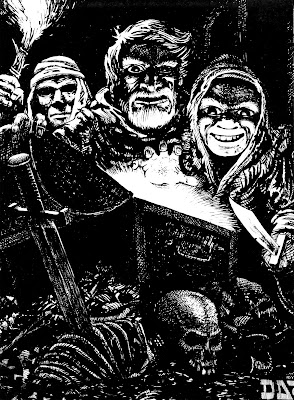
After these experiences, I conclude that I definitely prefer “old school” D&D within this genre – specifically, the more challenging and flavourful 1st edition Advanced Dungeons and Dragons and Basic/Expert Dungeons & Dragons (and related “clone” systems, like OSRIC and S&W). I like magic to be at least somewhat rare and at least somewhat costly to use. (Endless cantrips and ritual spells? No thanks!) It’s clear to me that the post-TSR versions of the game just are not my thing. I certainly have no interest in the recent offerings from the Wizards of the Coast.

There is one honourable exception regarding 5th edition D&D: the Middle-earth adaptations of the 5e system, as presented in Adventures in Middle-earth and The Lord of the Rings RPG. I thoroughly enjoyed the AiME campaign that I ran a number of years ago. But those games don’t feel like “D&D” at all – the magic system is entirely different, the classes are entirely different, etcetera. They also import a number of mechanics from The One Ring RPG. And of course, those games belong to the “high fantasy” genre discussed earlier.

Historical Fantasy

As a player, the bulk of my gaming over the past decade has been in historical fantasy settings. I suppose that this is unsurprising, given that I’ve played a lot of Mythras (and its predecessors, RuneQuest 6 and MRQII) during this time.  So, I’ve played in long-running Mythic Britain and Mythic Babylon campaigns, as well as some one-shot sessions in other settings. 

Both Mythic Britain and Mythic Babylon are excellent and highly recommended!

Horror

After fantasy, I’ve mainly run and played in “Horror” games. But in this category, it’s been exclusively “Lovecraftian” horror, that is, “Cthulhu Mythos” stuff. 

I’ve run a couple of short Call of Cthulhu campaigns set during the “classic” period, in Toronto and Massachusetts, as well as a number of one-shots. I have material for other eras (e.g., Rome, medieval, and modern, including “The Laundry”) but have never run a campaign or even a one-shot outside of the default 1920s-30s period.  

As a player, I recently took part in a long-running Mythras campaign, using the classic Beyond the Mountains of Madness sourcebook. (Our last session was today. My character survived – and was even more-or-less sane!) I’ve also taken part in one-shots of Trail of Cthulhu, Delta Green, and other related games over the years. 


Other genres?
 
I took part in a few Mythras sessions years ago set in the Luther Arkwright universe. I’m not sure how to categorize that setting (“science fantasy”?). They were fine but not the kind of thing I’d likely run myself. I also have played a few other one-shots here and there, but nothing really worthy of mention.

I haven't been remotely interested in playing in a “superheroes” game in recent decades (unless you count 5th edition D&D – I joke). It’s a genre that simply doesn't appeal to me. I’d be open to a “modern” game (say, espionage) but I have no idea how to run one myself. Likewise for science-fiction.

Back in high-school, my group tried all kinds of different games – including superheroes (Villains & Vigilantes, Marvel Superheroes), historical (Gangbusters, Bushido), and especially science fiction (Traveller, Star Frontiers, and even Space Opera – or at least I bought and tried to read Space Opera). We had a lot of time and energy back then!

Wrapping up...

These days, now that I’m an old man, I generally try to stick to what I know I like. So, I guess I’m a pretty limited gamer: I play and run almost exclusively fantasy and horror games. Maybe I’ll broaden my horizons when I retire. 

Looking back, I regret all the time I spent trying to get myself to like 3rd and 5th edition D&D. I should’ve just spent that time playing MERP or Stormbringer or Crypts and Things or whatever. At least I’ve learned my lesson: life is too short to try to force myself to like a game when there are other games available that I much prefer. So these days I’m happy to focus on Mythras and Against the Darkmaster – although, of course, I still pick up the occasional new system that catches my eye. 


Art credits (from top to bottom): Angus McBride, Andrea Piparo, Michael Whelan, Dave Trampier, David Benzal, Erol Otus, Angus McBride (again).

15 July 2023

The Laundry Files 2nd Edition is coming

It looks like Cubicle 7 is coming out with a second edition of their (now out-of-print) The Laundry Files RPG. (Flashback: here’s my post on the first edition from March 2010, including a brief note about the time I met author Charles Stross.)

Unlike the first edition, the new edition will not use the “d100” Basic Role-playing system (familiar from The Call of Cthulhu RPG). Instead, it will use something called “C7D6” – obviously a “d6” system of some sort. (Cubicle 7’s “clone” system for 5th edition Dungeons and Dragons currently goes by the codename “C7D20.”)

Over the years I’ve read the first six novels of Stross’s “The Laundry Files” series (as well as the stories, “The Concrete Jungle,” “Equoid,” and Overtime”). I last read one about five years ago (The Annihilation Score). Apparently, there are now thirteen novels in the series! Since I enjoyed (to varying degrees) the ones that I’ve read so far, so I hope eventually to read the others. 

The novels’ setting is a good one for a Mythos-themed RPG, I think, as the characters are agents working for the secret British government organization “Q-Division” (“The Laundry”), and hence charged with protecting the UK (and the world) from occult and Mythos threats. However, the novels contain a fair amount of dry humour, which I suspect may be difficult to translate into the game (probably best just to let any humour emerge organically in play).

I ran a fair amount of Call of Cthulhu back during “the teens,” including two short campaigns and a few one-shots (see here and here). My focus and interest have drifted away from Lovecraftian stuff in recent years, but perhaps they’ll drift back again in the future. In any case, I’ll definitely check out the new edition of The Laundry Files once it’s available. 


26 August 2022

Fictional worlds and the RPGs that I would use for them

Below I list some of my favourite settings from fantasy fiction that I think could serve as viable RPG settings and the rules that I would use if I were to run adventures in them. 


Fictional setting: Middle-earth (as described by JRR Tolkien in The Hobbit, The Lord of the Rings, The Silmarillion, Unfinished Tales, and so forth).


System: Adventures in Middle-Earth (a 5th edition D&D variant, heavily revised with ideas from The One Ring RPG) for the Third Age (I had a very positive experience using the system).

Possible alternative: Against the Darkmaster (VsD)—for earlier eras or if I'm drawing a lot on my old Middle-earth Roleplaying (MERP) collection, since it’s easy to convert MERP stats into VsD.

(Why not MERP? In my view, VsD keeps everything that is great about MERP and makes some helpful improvements.)


A further thought on Middle-earth: I'd like to try The One Ring (2nd edition) system sometime—I have the book and box set, and they’re gorgeous. I played a couple of games of 1st edition TOR years ago and didn’t care for it—something about it just didn’t “click” for me. But that may have been because I didn't really understand the system (or I was just too tired or something). AiME imports a lot of ideas from TOR, so there must be something there.


Fictional setting: The Elder Isles of Jack Vance’s Lyonesse trilogy.


System: The Lyonesse RPG (a version of Mythras).

One of my favourite FRPGs (Mythras) adapted specifically for one of my favourite fantasy settings—what more could I ask for?

(I think that this system also could be used for a “Cugel-level” Dying Earth campaign.)


Fictional setting: The Eternal Champion multiverse, including especially the worlds described in Michael Moorcock’s Elric (the “Young Kingdoms”) and Corum stories.


System: Mythras, especially with the (now out-of-print) RuneQuest II (MRQII) Elric supplements. Since Mythras is a direct descendant of MRQII, conversion would be a non-issue. (I played in an excellent Young Kingdoms campaign using MRQII a decade ago.)


Fictional settings: The Hyborian Age (as described in Robert E Howard’s Conan stories) and the Atlantean Age (as described in REH’s Kull tales).


System: Crypts and Things if I want something fast and furious; Mythras for detailed bone-crunching action.


Fictional settings: Clark Ashton Smith’s “Averoigne,” “Hyperborea,” and “Zothique.”


Systems: Again, either Crypts and Things or Mythras, depending on what style of game I want to run.


Fictional setting: The “First Law” world, as described in Joe Abercrombie’s original trilogy, and the post-trilogy stand-alone books (I think that the regions covered in Red Country and Best Served Cold would make excellent campaign settings). (Note: I haven’t read the “Age of Madness” trilogy yet.)


System: Either Mythras or Against the Darkmaster.  


Fictional setting: The “Cthulhu Mythos” universe (as described by HP Lovecraft and others).


System: Call of Cthulhu (naturally)—or possibly a modified version of Mythras (I'm playing in an excellent Mythras “Return to the Mountains of Madness” campaign now).


23 August 2021

Steve Perrin, RIP


Influential game designer Steve Perrin passed away recently at the age of seventy-five.

In addition to RuneQuest, Perrin authored or contributed to numerous other role-playing games, including two of my all-time favourites: Stormbringer and Call of Cthulhu. And RQ's system, of course, informed all subsequent Basic Roleplaying (BRP, or “d100”) games. He also authored the influential AD&D module, Under Ilefarn, which was the first original adventure for TSR’s Forgotten Realms setting. 

Arguably, Perrin’s influence on RPG design was second only to that of the genre’s creators, Gary Gygax and Dave Arneson.

Shannon Appelcline provides a nice overview of Perrin’s work here.


22 October 2020

My Favourite Games these days

In case anyone is curious, here are my current favourite role-playing games (in no particular order):


Mythras (including Lyonesse). 

I’m playing in a Mythic Babylon campaign right now, and look forward to digging into the (very thick) Lyonesse tome over the next couple of months. I have some ideas for a Lyonesse campaign that I might sketch here. (I should also mention that one of the best campaigns in which I ever played used the Mongoose RuneQuest II system, which is an earlier incarnation of Mythras [very similar in terms of core rules]. Here is my log of about two-thirds of that campaign.)

Crypts and Things. 

This excellent game draws upon my Swords & Wizardry house-rules.

Advanced Dungeons & Dragons (and OSRIC).

The old reliable warhorse.


Dungeons and Dragons 5th edition (including the Adventures in Middle-earth variant system). 

I hope to return to my Greyhawk campaign using D&D 5e soon, as well as finish up the log of my recent epic Middle-earth campaign.


Against the Darkmaster
. 

This is a quasi-clone of MERP, ICE’s old Middle-earth Roleplaying game. It has been shorn of MERP’s explicit Tolkien references, and introduces some rather cool refinements and additions to the system. I plan to write something about this exciting new game very soon!


Call of Cthulhu. 

Yeah, “old reliable.” My favourite system for one shots and short campaigns. Alas, I haven’t played it in over two years. I would like to run either a Cthulhu Invictus or a Dreamlands campaign someday.  

(I’ll add a new section on the right with links to these games in the next day or two.)


27 January 2020

A Lovecraft Cinematic Universe?


H.P. Lovecraft’s classic story, “The Colour Out of Space,” is one of my all-time favourites. So I’m relieved to see that the reviews for the new film based upon it, directed by Richard Stanley and featuring Nicolas Cage, have been generally positive. It’s at “84% fresh” right now at Rotten Tomatoes.

I don’t know when I’ll be able to see it myself — the film doesn’t appear to be in wide release, and is not currently playing anywhere in Milwaukee — but see it eventually I shall!

(Alas, the film title uses “Color” not “Colour” in its title. Pity. I’ve always found amusing Lovecraft’s adamant use of British spelling in all his works, despite being American himself. And as a Canadian, “Color” just looks wrong.)

This review at Ars Technica, in addition to including a nice slideshow of stills from the movie, has a brief explainer called, “Why Aren’t There More Lovecraft Movies?” But it looks like we will be getting at least two more, including The Dunwich Horror. This in particular looks intriguing:
“With Dunwich Horror, we'll go on campus and get back to Miskatonic University… We'll also get to deal with the Necronomicon, the black book at the core of the mythos.”
I really hope that this new “Lovecraft cinematic universe” does not disappoint fans of the original tales!

17 March 2019

Larry DiTillio, RIP

According to RPG.net, Larry DiTillio has passed away.

Within the role-playing games community, DiTillio is probably best known as the co-author of the classic Call of Cthulhu campaign, Masks of Nyarlathotep.

Masks one of those amazing campaigns that I've read and read about -- and want to run someday...

Sad news. RIP Mr. DiTillio.


05 January 2019

Temple of the Flayed Lord


In case you need some inspiration for a new Cthulhu Mythos style cult (also eminently useable for fantasy and historical role-playing games):
Mexican experts say they have found the first temple of the Flayed Lord, a pre-Hispanic fertility god depicted as a skinned human corpse.
[...]
The institute said experts found two skull-like stone carvings and a stone trunk depicting the god, Xipe Totec. It had an extra hand dangling off one arm, suggesting the god was wearing the skin of a sacrificial victim.
Priests worshipped Xipe Totec by skinning human victims and then donning their skins. The ritual was seen as a way to ensure fertility and regeneration.
The Popolocas built the temple at a complex known as Ndachjian-Tehuacan between AD 1000 and 1260 and were later conquered by the Aztecs.
More information on the charming Xipe Totec and his ancient Popolocas followers can be found here.

24 October 2018

Ancient ship = Eldritch horrors


“More than a mile beneath the surface of the Black Sea, shrouded in darkness, an ancient ship sat for millennia unseen by human eyes — until the Black Sea Maritime Archaeology Project happened upon its watery grave last year.… [T]he trading vessel plied the waves in the days of Plato and Sophocles, when the city-states of ancient Greece had scattered colonies all around the Black Sea.”

Sometimes a real world news event writes a cool Call of Cthulhu scenario for you…

(Though I’d replace the “Black Sea Maritime Archaeology Project” with the “Black Sea Miskatonic Archaeology Project” -- and move everything back to ~1930.)

Blog Archive

About Me

My photo
I'm a Canadian political philosopher who lives primarily in Toronto but teaches in Milwaukee (sometimes in person, sometimes online).