Showing posts with label Legacy DnD. Show all posts

23 July 2026

My Top-5 Roleplaying Games of All Time

Over at the “RPG Pub” there is a thread asking people to post their top-five favourite role-playing games of all time.

Here’s my list. Reflecting on the role-playing games that I’ve played over the past forty-five years or so, I’d say that my top five have to be the following:

Middle-earth Roleplaying (MERP)/Against the Darkmaster (VsD)


My first “real” campaign involved MERP and ICE’s beautiful maps and detailed campaign modules. MERP – and its descendant VsD – captures what I like the most about Rolemaster – the flexible class-based character development system; the detailed, vivid critical hit charts; the overall coherent rules framework – but without the large volume of charts and details that (IME) bogged down RM in actual play.

Some of my fondest memories of playing RPGs involve MERP and my two favourite campaigns of all time as GM (one still ongoing) use VsD.

Mythras 


I started playing this in 2011 – back when it was still being published by Mongoose and was called RuneQuest II (i.e., MRQII) – and haven’t stopped since. I’ve played in campaigns set in the Young Kingdoms (“Elric”), Mythic Britain, Mythic Babylon, Beyond the Mountains of Madness (the CoC campaign adapted to Mythras), and now Lyonesse, as well as in several “one-shots” or short campaigns (Mythic Greece, Luther Arkwright, Meeros, etc.). A really excellent system overall.

Call of Cthulhu


I haven’t played CoC since 2017 and I’m in no rush to do so again soon. But I’ve run a lot of CoC over the years – almost always as GM (er, “Keeper”) – and I’ve always really enjoyed it. I’m pretty sure it’s the game I’ve run the third most often (after MERP/VsD and AD&D). The scenarios are generally excellent (although some needed work). My only regret is that I have yet to run one of the “classic” campaigns for it (although I did play through BMoM using Mythras).

Dungeons & Dragons/Advanced Dungeons & Dragons (TSR era)


Like most RPGers, I started with D&D and spent a lot of my early gaming days (the early 1980s) playing and running AD&D (and I’ve returned to it from time to time since then). Reading Gygax’s hardbound volumes not only improved my vocabulary as a wee lad, but also sparked my imagination. They were the works of a disorganized creative genius. I still treasure the classic modules from that era as well. Although aspects of the system never failed to frustrate me, the game will always have a special place in my heart.

Stormbringer/Elric!/Hawkmoon/Corum 
(i.e., BRP “Eternal Champions” games)


I don’t really have any interest in running these BRP RPGs now – Mythras has largely filled that space for me – but I still have these books and really enjoyed these (closely related) games back in the day. 

There are other games that I like and other games I hope to try – but these are the games that I consider my all-time favourites.

Feel free to post your "top-5" lists in the comments, if you like. I'd be curious to learn what games have stood "the test of time" for you.


28 February 2026

There and Back Again: My Circular Role-playing Journey

I’ve talked about my personal history with the ‘Old School Renaissance’ or ‘Old School Revival’ (OSR) in the past at this blog (e.g., see this post from 2022). But some reflection on the games that I’ve been playing in recent years has prompted me to scribble some further thoughts. (My apologies for being a bit self-indulgent here …)

[Saruman by Angus McBride]

It’s been an interesting journey. I was ‘floating around’ at various role-playing games fora during the early days of the OSR over two decades ago. Disappointment with 3rd edition Dungeons & Dragons – and nostalgia for my early days of gaming – led me to dig out (and in some cases repurchase) my old Advanced Dungeons & Dragons, Basic/Expert Dungeons & Dragons, Rules Cyclopaedia D&D, and other out-of-print RPG books. I was excited – and later disappointed – by Castles & Crusades in its early days. (I wrote positive reviews at RPG.net of both the C&C box set and Players’ Handbook, but eventually came to find the atrocious editing by Troll Lord Games intolerable.)  

I started this blog in 2009 in order to post some rules ideas for Swords & Wizardry (S&W). Some of my ‘swords and sorcery’ house rules for S&W appeared in early issues of Fight On! and Knockspell. Eventually, many of those rules were incorporated into Crypts and Things. So I guess that I contributed – albeit in a small way – to the creation of OSR “stuff,” at least early on. 

But I haven’t really been that engaged with the OSR for about a decade now. I still follow it to some extent. I mean, I have Dolmenwood and Shadowdark, as well as the more recent versions of S&W, and a few other things. I’ve backed the forthcoming ‘3rd edition’ of OSRIC (the original “retro-clone,” in this case of 1980 AD&D). While I regret some of my purchases, overall I find that there are still interesting things being produced. But I don’t really use any OSR (by which I mean here ‘TSR D&D-derived’) systems anymore, and haven’t for years. They just don’t appeal to me that much these days. I think that, given my tastes, there are superior alternatives available. I guess I shouldn’t be surprised by this. I sort of thought the same thing about AD&D/D&D around 1985.

Almost all my gaming these days involve either Mythras or Against the Darkmaster (but sometimes my groups will play ‘one shots’ of other things, e.g., Mothership or Delta Green, and I’d like to run some Dragonbane someday). I find these systems more satisfying overall than any version of D&D (TSR, OSR, 3e, 5e, whatever). I guess I’m not a ‘rules lite’ person after all. In retrospect, I think that I thought that about myself only because I found running 3e D&D to be such a tedious chore. 

Of course, both Mythras and Against the Darkmaster are descendants of other ‘old school’ systems: Chaosium’s Basic Roleplaying (Runequest, Stormbringer, and the like) in the case of Mythras, and Iron Crown Enterprise’s Middle-earth Roleplaying (itself a simplified version of 2nd edition Rolemaster), in the case of Against the Darkmaster. So, I guess they're kind of ‘OSR’ systems as well (but not if we adhere to the “OSR = derived from TSR AD&D/D&D” definition). 

I can’t help but be struck by the extent to which my personal gaming history has repeated itself: dissatisfaction with AD&D/D&D led me to move to Middle-earth Roleplaying (MERP) and Basic Roleplaying (BRP), including Call of Cthulhu, Hawkmoon, and Stormbringer, in the mid-late 1980s. And about three decades later the same thing happened with OSR D&D and 5e D&D. Hopefully I've learned my lesson and won’t go through this cycle again.

As an aside, one thing that makes me think of the old MERP campaign modules as "old school" in nature is that – whatever their other faults – they were effectively “sandboxes” (as I explain here). They described a number of locations, some in detail, and provided advice for GMs on how to provide "hooks" for players. There were a few “adventure modules” for MERP – books with 3 adventures (usually aimed at levels, 1, 3, and 5) – but even those were pretty loose for the most part (generally they provided a setting and a situation), not “railroad” adventures. So, after my first several years with AD&D, a lot of my GMing involved using and running Middle-earth “sandbox” campaigns, although of course that term was not used in those days (at least to my knowledge). Indeed, I vividly recall comparing my MERP modules to TSR's Dragonlance series around 1986 or 1987, and noting how little room for improvisation or player freedom the latter allowed.

Anyhow, to the extent I was still involved in the hobby during the 1990s, the games I followed were those that came out earlier, especially MERP and Stormbringer (the latter revised and renamed Elric! during that decade). I remember visiting gaming stores in the 1990s and being a bit baffled and even put off by all the “goth” stuff. I never got into Vampire and the like (just as I never got into the Magic craze.) When D&D 3e came out, I was excited by it because it seemed to “improve” D&D by including certain things from other systems that I liked (e.g., skills). In play, though, I came to loathe the system after two year-long campaigns, and so was primed for the OSR when it happened.

Of course, had I been sensible, I would’ve just kept playing MERP, Call of Cthulhu, Stormbringer, and similar older games – and just ignored the hype around 3e D&D and the “d20” universe in the early 2000s. These days, for the most part, I’m happy to stick with my “d100” games, Mythras and Against the Darkmaster. Wisdom, I hope, comes with age.

07 December 2025

Fight On! Issue 17 now available

As noted months ago here, the Old School Renaissance fanzine Fight On! has experienced its own renaissance. After spending a decade in a magically induced slumber, it awoke with an impressive new issue, number 15, during spring 2024.

Thankfully, that was not a one-off event. Since them, issue 16 has been published. And just this past Friday, issue 17 was unleashed onto the world.

Issue 17 features a rather nice cover illustration by the talented Peter Mullen:

Like every issue, issue 17 is available in PDF and print formats.

07 May 2025

OSRIC the Third

The wise sages at Mythmere Games are hard at work on the third version of OSRIC (“Old School Reference and Index Compilation”). You can support this project at Backerkit.

OSRIC is a restatement of the first edition Advanced Dungeons and Dragons rules as they existed prior to the publication of Unearthed Arcana (with some minor modifications to ensure its legal “safety” at the time). It was the first true “retro clone” – version 1.0 came out in 2006 – and helped turbocharge the “Old School Renaissance” in its early days. While other “old school” games preceded it (e.g., Castles & Crusades, Basic Fantasy RPG, Hackmaster), OSRIC was the first to aim simply to restate an earlier, no longer supported, set of rules, rather than capture its “ethos” or “feel” with a somewhat different (more “modern”) system.   

While continuously available for free (in PDF) for almost two decades now, OSRIC eventually was eclipsed by other retro clones (including Mythmere Games’ own Swords & Wizardry, which restates the pre-AD&D version of the game). 

Hopefully with new art and a more reader-friendly presentation, though, OSRIC will enjoy its own renaissance and find a new audience.

Certainly, when I contemplate running an old school TSR-era version of D&D again, I tend to think of “Gygaxian” AD&D (using Gygax’s version of the World of Greyhawk) more than anything else. And I prefer the pre-UA version of the game overall (in part because I don’t have much nostalgia for the post-UA version, as I had drifted away from AD&D shortly after it was published).

The new version promises to be great. Hopefully half-elves will be able to be druids in this version (as they were in AD&D – their true, unique niche). And while I’m disappointed that there will be no bard class, I’m looking forward to adding OSRIC 3.0 to my library. I’m “all in”!

Emirikol would approve! 


26 February 2025

Fight On! Issue 16 now available – dedicated to DA Trampier

One of the best things to happen in the “old school” gaming community in the past year is the return of the amazing fanzine Fight On! 

Issue 16 has just dropped and it’s dedicated to my favourite FRPG artist of all time: David A. Trampier.


18 February 2025

‘Level Up’ exhibit at the Chicago Writers Museum

While Toronto is my ‘home base’ these days, as my wife and I own a condo there (and her job is based there), I also currently live part of the time in Chicago due to work (until the end of 2025, barring some catastrophe). Last weekend my wife was visiting Chicago, and by chance we discovered that it was a “free Sunday” at the American Writers Museum (located at 180 North Michigan Avenue – about a fifteen minute walk north of my present “crash pad”).

The museum currently has a special exhibit called “Level Up.” Here’s the description:
“Our special exhibit, Level Up: Writers & Gamers, explores how Americans use role-playing and video games to define and respond to our culture. The exhibit guides visitors into the world of game writing, from the 1970s to the present. Some of the games featured include Dungeons & Dragons, Zork, Apocalypse World, Baldur’s Gate III, and game writers from the last 50 years such as Michael Pondsmith, Porpentine, and Tanya DePass.” 
 The exhibit was small but had some artifacts of note:


It looks like this set was once owned by Terry Kuntz (older brother of Rob Kuntz).


The good old Holmes Basic Set – the game that started it all for me!


Anyhow, the exhibit runs until 5 May 2025. More information can be found here. If you’re in Chicago and have some time to kill, I recommend checking it out.

26 December 2024

Mythras Miscellany

I thought that I would mention two cool things for Mythras that might be of some interest.

The first is the Unearthed Companion for Mythras Classic Fantasy. Here’s the blurb from the Design Mechanism folks: 
Delve deeper than ever before, with the Classic Fantasy: Unearthed Companion, the highly anticipated expansion for Mythras Classic Fantasy! 
Classic Fantasy has become a popular branch of the Mythras family, blending the Mythras rules with traditional dungeoneering adventure mechanics. The Classic Fantasy core book presented everything needed for Ranks 1 to 3. This volume, long in the making, expands Classic Fantasy to Ranks 4 and 5, with updates and expansions to certain rules, but more importantly providing the additional magic, monsters and treasure for higher Rank characters and adventures. 
Unearthed Companion is compatible with Classic Fantasy core, and Classic Fantasy Imperative.  
More information here.


Classic Fantasy provides rules and guidelines for running Mythras games with the flavour of “Gygaxian” Dungeons & Dragons (i.e., first edition AD&D). Why do this? Perhaps you like the ethos and adventures of early TSR-era D&D/AD&D – but like combat to be interesting.

I have yet to play Classic Fantasy myself. But I’d be interested in running a short campaign using it someday, perhaps focused on an adapted version of a classic AD&D or D&D module (like Tom Moldvay’s The Lost City or the Saltmarsh series).

The second item is something that hopefully will be coming out in 2025: Mythic Armorica.


I assume that this will be a supplement for Mythic Britain (but am not certain about that).

Anyhow, Happy Boxing Day!

19 December 2024

Fight On! has a new website

FYI: The original Old School Renaissance fanzine Fight On! has a new website.


07 October 2024

Sale on issues 1-14 of Fight On!


As recently announced here, the Old School Renaissance fanzine Fight On! has returned to publication after a long sabbatical.

If you are missing PDF versions of the first run, issues 1-14, they currently are available in a bundle at Drivethru RPG for 50 percent off (34.99 USD). The sale will run until this Saturday (12 October 2024).

It’s great to have Fight On! back with us … and fighting on! 


16 August 2024

Combat should be interesting


Combat obviously is an important element in most fantasy role-playing games. At its best, it’s exciting and dramatic. After all, the protagonists’ lives are at risk! And surprising things can happen – either because of chance (the rolls of the dice) or because of players’ inventiveness (or even inspiration on the part of the Game Master in the midst of a session). 

In the two campaigns that I currently am running – both using the Against the Darkmaster (VsD) system, one set in Middle-earth, the other in my home setting of Ukrasia – I rarely have more than one combat in any given session. Thanks to its “critical hits” system, combat in VsD can easily become quite deadly or debilitating, so players tend to avoid it when possible. Hence, two or more sessions (if not more) typically will pass between combats. I like this kind of pacing, as it ensures that when combat does take place, it is noteworthy and memorable.  

The two games that I play the most these days – VsD and Mythras – both have involved and colourful combat systems. While VsD has vivid critical hits, fumbles, and the like, Mythras has hit locations and exciting “special effects” (previously called “combat manoeuvres”) that allow for a wide range of tactical options, including defensive ones. They definitely are not “rules light” systems! 

Almost two decades ago (!), when I finally realized that I disliked 3rd edition Dungeons and Dragons, I thought that that was because I disliked “rules heavy” FRPGs. But that wasn’t really the case. I’ve always liked certain “rules heavy” – or at least “rules medium” – systems, like Middle-earth Roleplaying and Stormbringer. What I disliked was how tedious the rules for 3e D&D were – both in terms of prep work and its combat system. Running and playing 3e D&D involved a lot of work – and there was very little pay-off for that, as combats in 3e were frequent but usually quite boring. For the most part, characters and their opponents were “blocks of hit points” that would be chipped away during combats that involved a lot of rather flavourless options (and ubiquitous, bland “attacks of opportunity”). 

The problem isn’t nearly as bad in 5th edition Dungeons and Dragons. But it’s still there: the game assumes that combat is common (which the DM can ignore, of course) and that it rarely threatens the lives of the characters (thanks to all their abilities, inflated hit points, “death saves,” and the like). (Yes, there are options to make the game more “gritty” and deadly hidden in the Dungeon Master's Guide, but the default mode is very much “fantasy superheroes,” wherein player characters rarely face serious risks.) Combat in 5e D&D is pretty dull in my experience – at least when compared to the alternatives with which I am familiar, such as Mythras and VsD.

So what my recent 5e D&D campaign taught me was that what I dislike are “rules heavy” or “rules medium” systems in which combat is insipid and (usually) not that risky (at least to the characters). I had to work hard to ensure that at least some of the combats in my campaign were novel. In contrast, no such work is needed for Mythras or VsD, given the intrinsic qualities of those combat systems. Even an encounter with some “vanilla” bandits or orcs can be risky and interesting.

That said, sometimes one doesn’t want to engage in a lot of book-keeping when running a game. That’s certainly fine. This is where older (TSR era) editions of D&D and AD&D shine (at least when one isn’t using all the rules outlined by Gary Gyax in the AD&D rules – which almost no one ever did or does). In old school D&D (and associated “retro-clones” like Swords and Wizardry, OSRIC, and Crypts & Things), combat is fast. So while it lacks the colourfulness and tactical depth of other systems, at least it rarely takes more than 20 minutes to resolve (unlike even trivial combats in 3e or 5e D&D). And of course, combat can be more deadly in older versions of D&D, given the lower hit points of characters, the absence of “death saves,” the relative rarity of healing spells, etc.

In short, my view is that combat should be either interesting or fast. One of my gripes with 5th edition D&D is that combat typically is neither (although sometimes it can be), at least in comparison to the other FRPGs that I play.  


30 July 2024

Fight On! Is Back

In the early days of this blog, when the “Old School Renaissance” scene was full of vim and vigour, a major player was the fanzine Fight On! It was a wonderful, eclectic, and somewhat chaotic journal, filled with fun scenarios, monsters, optional rules, and the like. I happily contributed a couple of articles back in the day (“Background Professions” to #5 and “The Duchy of Briz” to #7).

After a decade of enchanted sleep, Fight On! is back with issue #15. Here’s the blurb from the editor Ignatius Umlaut:

Ten years later, we are back from the dead to Fight On once more! These revenant runes are just as jam-packed as you remember with classes, monsters, spells, magic items, rules mods, homebrews, and awesome adventures in the spirit of the eldritch era of fantasy roleplaying! Dedicated to seventies D&D legend J. Eric Holmes, this issue brings together old and new stalwarts alike to celebrate our 15th issue and new beginning! With art and articles by J. Eric and Christopher Holmes, Tom Gordon, Calithena, Gabor Lux, Jeff Rients, James Maliszewski, Kesher, Pete Mullen, Cameron Hawkey, Zach Howard, Alex Schroder, Richard Rittenhouse, Settembrini, Patrick Farley, Jason Sholtis, Robert Conley, Kelvin Green, Philipp H., Attronarch, Mitzi!, and many more, this is the first of our new forays into fanzine fame and glory! Ride that wyvern while the sun is shining, and keep Fighting On!

My life with roleplaying games started with Dr. J. Eric Holmes’s Basic Dungeons & Dragons set back in 1980 (the one with chits instead of dice). So I’m especially keen to check out this issue!


[Picture by Peter Mullen from FO! 15]


03 May 2024

Swords and Wizardry Kickstarter: 3 days left

I’ve been swamped with work lately – hence no posts at all in April (which, I think, is the first time that I’ve missed an entire month since starting this blog almost fifteen years ago). Because of this, I almost missed the current Swords and Wizardry kickstarter. It includes optional supplemental rules for S&W, a book of new monsters, an adventure, and a referee's screen. There are only 3 days left!

Swords and Wizardry has a special place in my heart. It is what inspired me to start this blog many moons ago – specifically, I wanted to post my house rules online so that other people could check them out. (Some of those rules later were incorporated into Crypts and Things.)

So I like to support S&W whenever I can. Even though I’m not playing or running it right now, I very likely will do so again in the future. And the updated version of the rules is excellent!


19 March 2024

James M. Ward, RIP

TSR legend Jim Ward has passed away. 

I have many fond memories of poring over the entries in Deities & Demigods as a young teenager. The overviews of the "AD&D-ified" pantheons helped to get me interested in learning more about real world mythologies. Deities & Demigods also prompted me to check out the fiction of H.P. Lovecraft, Fritz Leiber, and Michael Moorcock.

Thanks for everything, mighty wizard Drawmij!

RIP


29 January 2024

Will Gygax’s Castle Greyhawk finally be published?


Almost two decades ago, Troll Lord Games ("TLG") began working with Gary Gygax to produce a version of his legendary “Castle Greyhawk” – renamed (for legal reasons) “Castle Zagyg” ("CZ"), after the mad wizard who created it. TLG began this grand endeavour by publishing a few new things concerning the surrounding (“not-Greyhawk”) territory, such as a regional folio and a large hardcover book describing the city of Yggsburgh. I purchased all the CZ products back in the day. Unfortunately, like most TLG products, they were quite poorly edited. Moreover, they weren’t directly based upon the original setting from the early 1970s, and were not especially noteworthy in my view (even ignoring the editing problems). Nonetheless, there was the promise that the famous dungeon would eventually appear, albeit in a modified “updated” form.

In 2008 Castle Zagyg: The Upper Works box set was published. It was co-authored by Jeffrey Talanian, as Gygax was in ill health at this point. My understanding (perhaps incorrect) is that Talanian was using Gygax’s notes and consulting regularly with him on the overall development of the dungeon, not just the initial box set. 

To my relief, Castle Zagyg: The Upper Works was reasonably well-done. I still own it and think that it’s a solid product. (For an informative and interesting PDF review by Greyhawk expert Grodog, go here.) But tragically, Gygax passed away in 2008, and the license for CZ subsequently was pulled from TLG. My understanding is that there was enough material completed by this time to produce further products in the line, but none of it would see the light of day.

Recently, though, TLG received permission to republish the Yggsburgh hardback, as well as some other things by Gygax. And now the green light has been given for them to develop and publish the rest of “Castle Zagyg”!

You can read the announcement from the TLG here.

Upon reading the announcement, two things stood out to me. 

First, it looks like the 2008 box set will not be republished, at least not in its original format. The Trolls write: “We’ve not yet settled on an organizational format but have settled on hardcover books with pockets in the back to hold the many maps that will come with this set.” Since the box set included the “Mouths of Madness” (it was one booklet among five), at least part of it will be published again. Perhaps the other five booklets will be part of the “Castle Ruins” volume (CZ Volume II)? (In any case, I’m [rather selfishly] pleased that the box set will not be republished, as it ensures that it will remain a rare “collector’s item” in the future.)

Second, while (I assume) it’s a good thing that Luke Gygax and James Ward are involved, as they have knowledge of the original dungeon, I did not see Jeffrey Talanian mentioned. Perhaps he was invited to take part in the resurrected project but declined, given that his focus these days presumably is on his own Hyperborea game. But if they are drawing upon the work that Talanian did with Gygax, I would think that he would get credit for that and be mentioned, no? It certainly would dampen my interest in this project if the team now working on it plans to ignore the work on the dungeon that had been completed up to 2008.

In any case, I’ll keep my eye on this. I’m curious to see what comes of it. 

(The picture of Zagyg above is by Jeff Easley and appeared in Dragon #70.)

Update (January 30th): It turns out that Jeffrey Talanian will be consulting on the project. From the TLG "Worlds of Gary Gygax" webpage: "we will be consulting with family members such as Ernie and Luke Gygax, and long time friends like James M. Ward and Jeffrery Talanian to make these works as close to Gary’s vision as we can."

My apologies for missing this in my initial post.

10 January 2024

Jennell Jaquays RIP

It was announced over at the RPG Pub that the legendary adventure designer Jennell Jaquays has passed away.

Perhaps I'm somewhat unusual in this respect within the online ‘grognard’ community, but while I missed her early classic adventures (Caverns of Thracia, Griffin Mountain, Dark Tower, etc.), I was quite familiar with Jaquay’s illustrations for Iron Crown Enterprise’s old Shadow World (Rolemaster) products (as well as the ‘Nehwon Mythos’ pictures in the 1st edition AD&D Deities and Demigods). Indeed, I associate her artwork with my favourite book in the Shadow World series, Terry Amthor’s epic Jaiman: Land of Twilight. (Amthor is another recently deceased RPG legend.)

Here's the picture of the creepy "darklord" of Jaiman: “Lorgalis ‘the White’” (any resemblance to a certain Melnibonéan sorcerer-emperor is purely coincidental, I’m sure):


The Throne of the Dragon Lord:


And one of the ‘good guys’ – a rather unusual Loremaster:


Later (during 2000s) I picked up Thracia (the 3e version, and the PDF of the original) and some other classic things by Jaquays. I should be getting Goodman Games’ revamped version of Dark Tower (to which Jaquays contributed some new material, I believe) sometime later this year.

RIP.

03 December 2023

Swords and Wizardry special edition

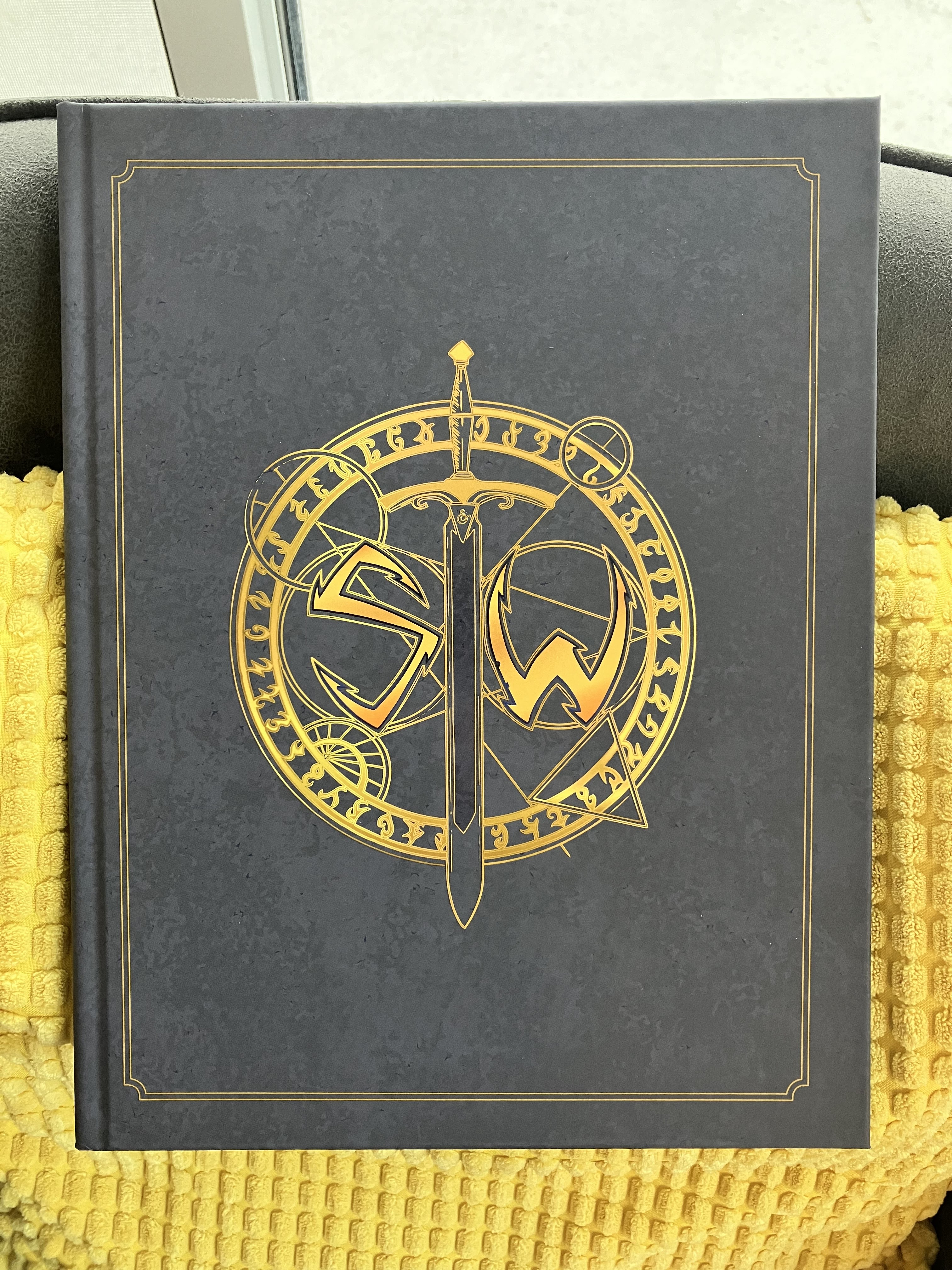
Several weeks ago, I received the special edition of Swords and Wizardry - Revised Edition. It’s a beautiful book. I love the matte cover! If you like S&W, I recommend obtaining one for yourself, if possible.


For my overview of this version of S&W, go here.

28 July 2023

Gary Gygax Bench in Lake Geneva


I’m a bit late in noticing this, but a park bench in Lake Geneva (Wisconsin, not Switzerland) was dedicated to Gary Gygax on Thursday, 27th July (Gygax's birthday). In addition to the bench dedication, there was a proclamation by the mayor announcing “Gary Gygax Day.”

(Of course, as anyone who has read the AD&D Dungeon Master’s Guide can attest, a table perhaps would’ve been more appropriate than a bench [see Appendices]…)

More information at ENworld. 


14 July 2023

The Unmagical Magic of 5th Edition Dungeons & Dragons

Time for another “airing of grievances” with respect to 5th edition Dungeons & Dragons!

I previously complained about the way resting and healing work in 5e – as well as noting some options for ‘fixing’ these problems, including options from the 5e Dungeon Master’s Guide and the Into the Unknown 5e variant. (I suspect that 99% of 5e players either ignore or are ignorant of these options in the DMG. But it’s only fair to note that they are indeed there; the designers of 5e were not oblivious to the possibility that some groups might not like the default “cartoon superhero” mode of the 5e rules.)

My other big complaint about 5e D&D concerns the magic system. Magic, and spellcasting in particular, is laughably common and easy. Spellcasters can cast cantrips without end, as well as the “ritual” versions of spells, including ones like “Identify,” “Detect Magic,” and “Alarm.” Moreover, magic-users … er, wizards, recover a number of spells following a short rest (one hour in the standard 5e rules) thanks to their “Arcane Recovery” ability.

The upshot of this is a game in which spells are ridiculously common. In my experience, no magic item goes unidentified for more than a few minutes, characters communicate via magical iPhones (the “Message” cantrip), campsites are surrounded with “Alarm” spells (making it almost impossible for the party to ever be surprised, except for attacks from the air or from below), and so forth. I certainly don’t blame my players for using their characters’ spells in these ways – they’re making intelligent use of the resources available to them! I applaud their excellent playing of the game – it’s the game itself that annoys me.

Hence its spell system is another reason why 5e D&D does not resemble at all “old school” D&D or AD&D, wherein spells were a precious commodity (at least until characters were of very high level) and “short rests” did not exist. 

If I were to “fix” 5e D&D so that it had more of a classic feel, I would: 
  • Either eliminate cantrips altogether or allow them to be cast only a limited number of times per day (perhaps equal to the character’s proficiency bonus).
  • Require that spells with the “ritual tag” be cast as “rituals” (i.e., take 10 minutes to cast) and take up spell “slots” (so no endless casting of Alarm, Identify, etc.). 
I note (yet again) my positive experience with the Adventures in Middle-earth roleplaying game based upon 5e D&D (the second edition of which is called The Lord of the Rings RPG). That experience led me to have a high opinion of the 5e core mechanics. And I do think that the core of 5e can make for an excellent game. But the way in which 5e D&D handles rest, recovery, and spells – all elements entirely reworked by AiME/LotR – has made me conclude that I never want to run 5e D&D RAW again.

[Trampier's classic "Emirikol" picture from the 1e AD&D DMG]

[2023-08-01: Edited to add the reference to wizards’ “Arcane Recovery” ability in the third paragraph.]


06 July 2023

Old School Dungeons and Dragons Action Figures

These beautiful "action figures" recently arrived in my mail: 

I really shouldn't spend money on things like this, as they have no real "game utility" and will just sit on my bookshelf.

But, as the title of the blog indicates, I'm pretty akratic at times.

12 June 2023

Recommended: Swords and Wizardry Complete – Revised Edition

The kickstarter for the revised version of the Swords & Wizardry Complete rules was a great success. Backers (like myself) now have PDFs of the new core rulebook. I’ve looked it over and am very favourably impressed. The organization and layout have been improved from earlier versions. Information is presented in a direct, economical, but nonetheless aesthetically pleasing way. Kudos to Suzy Moseby on doing such a fine job on the layout. The art is solid, with a few very good pieces, and nothing objectionably unappealing. I like all three covers (the Erol Otus one [depicted below], as well as the green and blue designs by Del Teigeler). (But I do miss the original wonderful S&W cover by Pete Mullen.)

It's amazing to me how much content Matt Finch has managed to pack into such a slim package (144 pages) in a clear and accessible way. Roughly speaking, Swords & Wizardry Complete, gives you pretty much everything in the original D&D 1974 box set, and a lot (but not all) from the subsequent supplements (Greyhawk, Blackmoor, and Eldritch Wizardry). What you end up with is something very close to Advanced Dungeons & Dragons (as realized in 1979), but somewhat simpler and lower-powered. The main (or at least most noticeable) differences: in S&W there are no half-orcs, gnomes, illusionists, or bards; alignment is three-fold (Lawful, Neutral, Chaotic); hit dice are lower (e.g., fighters have d8 in S&W instead of d10 as in AD&D); and slightly lower level-limits for demi-human characters. Aside from these changes – which, of course, are easy to modify if one wishes – S&W provides a “simplified” version of AD&D, and is readily compatible with most material produced for D&D and AD&D prior to 3rd edition.


There are some minor but helpful innovations in S&W that distinguish it from "0 edition" D&D. Among them: the ‘ascending’ scale for AC is used (which I appreciate and find preferable to the older system, although the old ‘descending’ system is provided as an option as well); a single unified ‘saving throw’ is provided for each class (but with the option to use the older system, broken down into categories like “death rays and poison”); four different options for determining initiative are outlined; rules for morale are provided; and rules for two-weapon fighting are included. These are all helpful additions to the game in my view.   


Since it is a “clone” of early (0e) D&D, S&W includes elements from that system that personally I am not that keen on. For instance, the special abilities of thieves (as well as assassins and monks) are quite miserable, with very low chances for success at anything until characters achieve higher (7+) levels. If I were to run S&W again, I’d probably just use my version of the class instead. Likewise, I’ve never been a fan of the way earlier editions of D&D and AD&D implemented “level limits” on non-human characters. I think that there are better ways to “balance” non-human characters against human ones. (S&W does include an optional rule to permit non-human characters to advance beyond their level limits, but with a 50% penalty to experience points earned by those characters. I’d likely either use that option, or simply grant some additional bonus to human characters instead.) Of course, one cannot really fault a retro-clone like S&W for “cloning” such rules from earlier editions, and in any case such things are easy to house-rule.  


In short, this revised, updated version of Swords & Wizardry is excellent, the best version yet. It was the “retro-clone” that helped inspire this blog in 2009 – and for which I wrote a number of house-rules – and it remains my favourite. I highly recommend it to anyone who enjoys the spirit of old school Dungeons and Dragons!


(For a more comprehensive review, check out this one at the blog “It’s Okay; Gary Sent Us.”)

Blog Archive

About Me

My photo
I'm a Canadian political philosopher who lives primarily in Toronto but teaches in Milwaukee (sometimes in person, sometimes online).