Here’s my list. Reflecting on the role-playing games that I’ve played over the past forty-five years or so, I’d say that my top five have to be the following:
23 July 2026
My Top-5 Roleplaying Games of All Time
Here’s my list. Reflecting on the role-playing games that I’ve played over the past forty-five years or so, I’d say that my top five have to be the following:
05 May 2026
The return of Elric?
It looks like the multiverse of the Eternal Champion Elric will be returning to the world of in-print role-playing games thanks to Goodman Games:
“Goodman Games is thrilled to announce a licensing agreement to publish official tabletop role-playing material based on Elric of Melniboné, the iconic sword & sorcery character and setting created by legendary author Michael Moorcock!
The Classic Era of Elric will include a line of sourcebooks, adventures, maps, and additional supplements, all designed for compatibility with both Fifth Edition and Dungeon Crawl Classics role-playing game systems. The project is scheduled to launch via crowdfunding in 2027. Products will be released following the successful campaign and will be available at game stores worldwide.”
Despite the influence that the early Elric stories had on me (and I remain fond of them to this day), I have to confess that I’m not all that excited about this. One reason is that the setting will use 5th edition Dungeons and Dragons and Dungeon Crawl Classics – two systems about which I have decidedly cool feelings. DCC was a poor fit for another cherished fictional setting – Jack Vance’s Dying Earth – and I doubt that it will be appropriate for Elric (at least not without some heavy reworking).
A second – more decisive – reason is that I already own a lot of "Elric" role-playing books: three editions of Chaosium’s Stormbringer (including Elric!, which is the same system as 5th edition Stormbringer), and a lot of supplemental books for those editions, as well as all the Elric of Melniboné books that were published for Mongoose’s Runequest II (MRQII) system. (MRQII, as many readers no doubt know, eventually evolved into Mythras.) So I already have more than enough Elric material – as well as some Hawkmoon and Corum material – to run multiple campaigns, all using RPG systems that I much prefer to both 5e D&D and DCC.
But who knows – maybe the new material will be good! Time (and funds) permitting, I may check out what Goodman Games produces for everyone’s favourite melancholy albino.
03 March 2026
What roleplaying games are you playing now? What games do you want to play?
I've been writing this blog for almost seventeen years now. Yet I've rarely addressed any questions to you, the human beings who look at these posts from time to time. But I'm curious about who actually visits this place (aside from the bots). I'm interested to know what game(s) you play.
As I explained in my previous post, the roleplaying games that I've been playing have shifted over the past two decades. Early on, I was focused primarily on "Old School Renaissance" games like Swords and Wizardry (and developed some house rules for it, many of which were later integrated into Crypts & Things, which I also played back in the day) and 1st edition Advanced Dungeons & Dragons/OSRIC. I also occasionally ran Call of Cthulhu.
Then, in spring 2011, I started playing in a "Young Kingdoms campaign" that used the Runequest II (MRQII) rules. (How could I refuse? The Gamemaster was one of the co-authors of the system!) This started a long period -- continuing to this day with Lyonesse -- of playing versions of the game that is now called Mythras (MRQII and Runequest 6 were the immediate ancestors of Mythras -- all written by Lawrence Whitaker and Pete Nash). I also continued to run Call of Cthulhu from time to time (winding up a sporadic campaign in 2017). And in 2017-2018 I ran an Adventures in Middle-earth campaign.
For a few years I ran a campaign using Dungeons & Dragons 5th edition in the "Gygax version" of the World of Greyhawk. (I eventually switched to the 5e-based Into the Unknown system, but ItU is close enough to 5e that I regard the whole campaign as my "5e" one.) I wanted to properly "try out" the current version of D&D and we ended up continuing until the characters reached 6th level. While that campaign was fun, I realized by the end of it that I had no desire to ever run 5e D&D again, at least for an extended period of time (I did run a couple of sessions of 5e for some kids last fall -- one of my few "charitable acts" as a RPGer).
Over the past few years, as GM, I've primarily run Against the Darkmaster. One campaign, set in Middle-earth, wrapped up a few months ago (although I have a "epilogue" set of adventures planned for the same characters sometime in the future). The other, set in my homebrew world of "Ukrasia," is still going strong.
So these days, I mainly GM Against the Darkmaster and I mainly play Mythras (I'm leaving out various "one shots" of different systems here). I would like to try out Dragonbane sometime, as it strikes me as similar to Mythras in many ways but is much "lighter" in terms of both rules and tone (the similarity shouldn't be that surprising, since both games are descendants of the "Basic Roleplaying" system created by Chaosium almost five decades ago).
What about you? What games do you play these days, either as GM or player? What game(s) do you want to play?
28 February 2026
There and Back Again: My Circular Role-playing Journey
I’ve talked about my personal history with the ‘Old School Renaissance’ or ‘Old School Revival’ (OSR) in the past at this blog (e.g., see this post from 2022). But some reflection on the games that I’ve been playing in recent years has prompted me to scribble some further thoughts. (My apologies for being a bit self-indulgent here …)
23 December 2025
The Sorrows of Young Efric (Lyonesse RPG)
As I mentioned recently, I’ve started playing in a Lyonesse campaign. I’m quite excited about this, as Jack Vance’s Lyonesse trilogy is among my all-time favourites. Also, I'm a bit burnt out from running two campaigns. While I enjoy being a GM, I prefer to focus on one campaign at a time (my "Against the Court of Urdor" campaign is still going strong), and it’s a pleasant change of pace to alternate between playing and gamemastering.
In case anyone is interested in what a Lyonesse player character looks like – perhaps to get a sense of the rules and setting – allow me to introduce my character: Efric ‘the Rational’.
I’ll begin with his brief backstory, generated in part by using the wonderful Lyonesse “Background Events” table. I tried to construct something suitably “Vancian” in flavour…
The Tale of Efric (so far):
Efric was born during an eclipse – along with his younger sister and brother – some eighteen years ago within the walled town of Sardilla in the realm of Caduz. It was an ominous sign. All the rats within his father’s tavern turned white that night.
The first twelve years of the triplets’ lives were uneventful. Efric and his brother learned how to play the lute and performed on occasion in the tavern. His sister loved to sing to their music. During those days the three “children of the eclipse” loved each other’s company.
But one day the legendary mage Tamurello chanced upon the trio whilst visiting the town. He sensed great magical potential within them and offered to take them on as his apprentices. Efric’s parents refused, and with a gracious smile the great mage departed.
A few months later, Efric’s parents died in a freak accident involve a runaway flaming cart filled with screaming cats. Whispers spoke of the involvement of the “Black Adder,” the mysterious spymaster of Caduz. Others suggested that magic was involved. In any case, Efric’s grandfather was overwhelmed by his new childcare duties. When Tamurello suspiciously reappeared in the town a month later, Efric’s grandfather was guiltily relieved to agree to let the mage take his three grandchildren as apprentices.
For six years Efric and his siblings studied at Tamurello’s manor Faroli in the Kingdom of Pomperol, at the edge of the Forest of Tantrevelles. The most talented of the triplets, Efric’s sister and brother eventually allied against him. Encouraged by Tamurello for his amusement (or so Efric suspected), his siblings became increasingly antagonistic towards him. Finally, unable to tolerate the miserable situation any further, Efric fled Faroli for Lyonesse Town.
Efric took his brother’s lute, a gift from Tamurello, when he fled. The lute was crafted by the famous Fairy Luthier, Fendair, and is greatly prized by all who know and understand the artistry of the lute and its music. Given his brother’s paltry skill at playing the instrument, Efric deemed it just that he should “liberate” it.
The pale young mage now tries to earn a living playing melancholy tunes on his faerie lute at the Sad Cathay. His favourite song is “How Soon is Now?”, which should be unsurprising given his bleak demeanor and chonomantic skills.
19 October 2025
To Do List: Middle-earth and Greyhawk campaign notes; a new Lyonesse character
I’ve sadly neglected this blog over the past two months. But I have not been (entirely) idle – indeed, I’ve been quite busy running my two campaigns.
One of them – Against the Witch-King – wrapped up two weeks ago. Or more precisely, it’s now on hiatus. A suitably epic conclusion – an audience with King Arvedui of Arthedain, following the completion of many important tasks – has brought things to an end for the time being. But the campaign will resume nine years later in “game time” – after a (hopefully not as long) break in “real time.” The final session of the current part of the campaign took place in the spring of 1965 of the Third Age; the campaign will resume (after the break) in early 1974. The characters all accomplished what they set out to do (a year earlier in game time; over two years ago in real time). But, as those of you familiar with the history of Middle-earth likely know, things become a bit “intense” in Eriador in 1974! So, while I need a rest from running this campaign, I’m determined to resume it at some point to see how Angmar’s final assault plays out.
Depressingly, I’ve fallen far behind in my campaign logs for both of the campaigns that I’ve been running over the past two-plus years, and especially for my Middle-earth one. Instead of writing entries as detailed as the first two for the Against the Witch-King campaign (1 and 2), I’ll try to write a brief overview of what happened, something like what I did when I encountered a similar problem (falling hopelessly behind) in my earlier Middle-earth campaign.
I really don’t like leaving my campaign logs unfinished! Even a truncated summary of what happened in the adventures is better than just leaving it incomplete – for my own future recollection, if nothing else, although I hope that at least a few other people might find the logs interesting.
This thought reminds me that I never finished the log for the Greyhawk Classics campaign that I ran a few years ago. While running that campaign made me realize that I rather dislike the 5th edition Dungeons & Dragons system, the role-playing aspects of the campaign were nonetheless a lot of fun, and I really should explain how everything wrapped up – including why ultimately the characters never actually went into the Temple of Elemental Evil.
[A modified portion of Darlene's famous World of Greyhawk map.]
The Against the Witch-King group will soon be starting a new campaign, using the Lyonesse system and setting (the system is an adaptation of Mythras). I’m quite excited about this – not only because it’ll be nice to have the opportunity to be a player again (while still running my other campaign), but also because Jack Vance’s Lyonesse trilogy is one of my all-time favourites. I’m presently putting the final touches on a rather fun and intriguing character – a former apprentice of the dreadful wizard Tamurello. If you’re curious about the game, here is a brief interview with one of the authors (and my GM) Lawrence Whitaker.Vancian times ahead!
14 July 2025
Mythic Armorica for Mythras
The Mythic Britain series for Mythras has a new instalment: Mythic Armorica. (I first mentioned this supplement – and included a preview of its maps – back in December.)
Here’s the description from the Design Mechanism site:
Across the Narrow Sea separating Britain from Europe, lie the three kingdoms of Armorica: Poher, Benoic, and Broërec. And across the heartland, the mighty, enchanted Forest of Broceliande.
Settled a 150 years ago by Britons from the mainland, they displaced the native Gauls and created their own lands. But now Armorica is a land under siege. The Franks and the Visigoths fight on the eastern border and threaten to make Armorica their battleground. Meanwhile, the bishops of Armorica fight a war against pagan practice, and under their urging, Broceliande is shrinking every year. Finally, a dark force is working from within, waging a covert war of conquest against the three kingdoms.
Mythic Britain: Armorica is a campaign expansion for the Mythic Britain setting. You will need both Mythras and Mythic Britain to make full use of this book.
With Mythic Britain, Logres, Waterlands, Gwynedd, and now Armorica, Mythras has the ultimate “historical fantasy” British setting for role-playing campaigns!
12 January 2025
My Life in Roleplaying Games: 2024 and 2025
I've been really enjoying running two Against the Darkmaster (VsD) campaigns, one in Middle-earth (“Against the Witch-King”), and one in my homebrew "Ukrasia" setting (“Against the Court of Urdor”). Both will continue into 2025, although I expect that the Middle-earth one will wrap up sometime this summer (but perhaps not, as these things are difficult to predict, at least for me).
Many of my fondest gaming memories are of the Middle-earth Roleplaying (MERP) and (to a lesser extent) Rolemaster adventures that I ran back in the day. These were mainly in high-school during the mid-late 1980s, but with sporadic sessions later, eventually petering out completely around 2000 (after a brief campaign that was aborted due to a problematic player). In recent decades, my collection largely sat on my shelves or in storage, although I would regularly flip through the books to mine for ideas or simply for the sake of nostalgia.
As I’ve explained before here, Against the Darkmaster plays a lot like a modified and updated MERP, especially with its vivid critical hits and its complex but immersive combat system. VsD streamlines some of MERP’s clunkier mechanics (especially regarding skills, combat, and experience) and introduces “drive points,” all changes I that like and hence my use of it instead of MERP. Nonetheless, the two systems are close enough that it’s easy to use MERP material for VsD.
This experience made me realize that I was foolish to have ever shelved the original game simply because it was out-of-print. (That’s not to say that there aren’t new games that I like a lot and want to try out – but obviously that doesn't preclude cherishing and playing the older games as well.) My recent experience with VsD reminds me of how I felt almost two decades ago, when the “Old School Renaissance” (OSR) was really getting going, and I realized that it was perfectly fine to prefer “Gygaxian” Advanced Dungeons and Dragons (and “Basic/Expert” D&D) over the then-in-print 3rd edition, despite the widely touted “improvements” of the more recent version. After running two 3e campaigns and finding them to be slogs, especially once the player characters reached fifth level or so, this realization was liberating and exciting. (My recent experience running a 5th edition campaign made me decide never to do so again. If I run “D&D” in the future, I’ll likely just employ a tweaked version of good old Swords & Wizardry. Wanting to share my house rules for S&W is what inspired me to start this blog in the first place, almost fourteen years ago.)
So Against the Darkmaster has made me happy to be a Game Master again. I'm enjoying it enormously and look forward to seeing how things unfold this year!
Outside of my role as GM, I'm always excited to play Mythras, and look forward to (probably) doing more of that later this year. (Last summer I played in Mythic Greece and Lyonesse “one shot” sessions and had a blast. And last year one of my groups wrapped up a long-running Mythras adaptation of the Beyond the Mountains of Madness campaign.)
More generally, beyond the particular games I’m playing at the moment, I very much appreciate the two gaming groups I’m in and am grateful to have the friends who participate in them. I also delight in the ways that players’ decisions can make the role-playing games go off in entirely unanticipated, novel directions – that’s not something you can find in any other hobby of which I'm aware, and it can be magical!
26 December 2024
Mythras Miscellany
The first is the Unearthed Companion for Mythras Classic Fantasy. Here’s the blurb from the Design Mechanism folks:
Delve deeper than ever before, with the Classic Fantasy: Unearthed Companion, the highly anticipated expansion for Mythras Classic Fantasy!
Classic Fantasy has become a popular branch of the Mythras family, blending the Mythras rules with traditional dungeoneering adventure mechanics. The Classic Fantasy core book presented everything needed for Ranks 1 to 3. This volume, long in the making, expands Classic Fantasy to Ranks 4 and 5, with updates and expansions to certain rules, but more importantly providing the additional magic, monsters and treasure for higher Rank characters and adventures.
Unearthed Companion is compatible with Classic Fantasy core, and Classic Fantasy Imperative.More information here.
25 October 2024
Trail of Cthulhu 2e and Broken Empires
To be clear, the products themselves might be fine or even quite good. For instance, Shadowdark certainly has some interesting mechanics, some of which I'm on the fence about (but which, I concede, very well may be vindicated in practice). But the cold hard truth of the matter is that I just don't see using this game that much (if at all) in the near future, as well as the other RPG products that have trickled in over the past few years (e.g., OSE).
09 September 2024
Mythras and Against the Darkmaster news
A supplement for the Lyonesse roleplaying game – roleplaying adventure in the Elder Isles of Jack Vance.Everyone loves a good villain, and the Elder Isles are full of them.Rogues, Rascals, and Rapscallions is a resource to the beleaguered Games Master. It has a cornucopia of criminals, a superfluity of scoundrels, a mass of miscreants, and a surfeit of scallywags. The book is divided into five chapters, respectively covering ne'er-do-wells, cults, societies, places, and schemes, each accompanied by multiple stories that can embroil the characters in villainy, either as victims, witnesses, investigators or – heavens forfend! – perpetrators.Packed full of scenario ideas, intriguing encounters, nefarious nemeses, and exotic locales, Rogues, Rascals and Rapscallions is a must for any campaign, be it Lyonesse or some other fine setting.Hardcover POD & PDF ($35.99 and $12.99 respectively)Colour & B/W140 pages
From the folks at Open Ended Games:
We’re thrilled to announce that the Against the Darkmaster GM's Guide is nearly complete! This complement to the Player’s Handbook, covering the GM’s side and Bestiary of the Core Rules, will be available both as a Print-On-Demand (POD) and PDF on DrivethruRPG. Here’s a preview of the cover art by the always excellent Heraldo Mussolini to whet your appetite!
I love that the cover is from the perspective of the Darkmaster. Very cool!
While I adore the massive VsD tome, having slimmer Player and GM books is more useful for running the game, in my view – and obviously less expensive for players. (Also, holding the VsD core rules in one hand while running a session can be a bit tricky…)
16 August 2024
Combat should be interesting
In the two campaigns that I currently am running – both using the Against the Darkmaster (VsD) system, one set in Middle-earth, the other in my home setting of Ukrasia – I rarely have more than one combat in any given session. Thanks to its “critical hits” system, combat in VsD can easily become quite deadly or debilitating, so players tend to avoid it when possible. Hence, two or more sessions (if not more) typically will pass between combats. I like this kind of pacing, as it ensures that when combat does take place, it is noteworthy and memorable.
26 June 2024
Mythras Imperative Contest
We’re excited to launch a brand-new competition for all Mythras enthusiasts and budding creators!The TDM ORC Imperative Contest celebrates the ORC open license, which includes the Mythras Imperative and Classic Fantasy Imperative rules released under it. Entrants are invited to send a submission between 2,000 and 10,000 words that creatively utilizes the Imperative rules and one or more assets (a descriptive paragraph, an image, or a map) that we provide.The submission can be whatever you can imagine: a scenario, a setting module, a mini-campaign, or anything in-between. Entrants can pick any genre, any time period, or create something completely new and unique.To view all the requirements, check out the Submissions Pack.What do you stand to gain? Let’s talk about the prizes!First Prize gives the winner a finished document they can immediately distribute for sale if you choose. This means that the TDM Production Team takes your submission, edits, proofreads, crafts a layout, and equips it with interior and cover art for the winner’s idea to make it a reality.Those who manage second and third places will get various levels of artwork that help get you on your path to completion of your project.The TDM ORC Imperative Competition is now open! You must be a Newsletter subscriber to enter with a chance of winning one of these glorious prizes! You can subscribe to the Newsletter on our website https://thedesignmechanism.com/So, get your thinking caps on, dig out those old notebooks, and brainstorm with your gaming group!Here’s your chance to create some fantastic material using Mythras Imperative and the ORC License that gets that professional touch.
16 February 2024
My RPG Foci: Fantasy and Eldritch Horror
Recently someone over at the RPG Pub asked what genres people preferred in their gaming. Reflecting on this question, I realized that over the past twenty-five years or so, almost all of my role-playing activity has been focused in two genres: fantasy and horror.
Fantasy
Perhaps unsurprisingly, the vast majority of my gaming has involved various flavours of fantasy, especially the following sub-genres.
High Fantasy
By “high fantasy” I mean the kind of fantasy that you find in the writings of J.R.R. Tolkien and the like. High fantasy worlds have a clear distinction between “good” and “evil” – even if there are morally ambiguous characters and difficult situations between the two extremes.
I’ve mentioned before here that I was an avid player of Middle-earth Roleplaying back during the 1980s. Indeed, I probably played as much MERP as I did AD&D during my high-school days (it eventually became my group’s “main game”). And when I first started playing RPGs semi-regularly again, around 1999, I naturally started with MERP (before, unfortunately, moving to the Rolemaster Standard System, which despite its obvious mechanical relation to MERP [MERP was derived from an earlier version of Rolemaster], was not nearly as smooth or fun to use in practice).
A lot of the games that I’ve run over the years have been in this subgenre, including past and present Middle-earth games. My current “Court of Urdor” also falls within this category.
The brilliant Against the Darkmaster FRPG – which is heavily inspired by MERP – is designed for precisely this kind of fantasy campaign. Indeed, it builds the “Darkmaster” conceit into some of its core mechanics. As the name indicates, the struggle against the Darkmaster is assumed to be a central feature of any campaign, even if only in the background.
Swords and Sorcery
Another familiar sub-genre. Robert E Howard’s Hyborea and Atlantis, Michael Moorcock’s Young Kingdoms (and “multiverse” more generally), Fritz Leiber’s Nehwon, Karl Edward Wagner’s “Kane,” and the like, are all exemplars of this sub-genre. I would include Jack Vance’s Dying Earth corpus, and many of Clark Ashton Smith’s stories (especially those set in Zothique, Averoigne, and Hyperborea), as members of this family as well.
After rereading REH’s Conan stories – and reading for the first time his Kull and Bran Mac Morn tales – fifteen years ago (when they were republished in nice volumes by Ballantine), I came up with a number of house rules for Swords & Wizardy in order to run some “swords and sorcery” flavoured games. Those house rules are still available here – and seem to attract regular visits to this day. Many of them were later integrated into D101 Games’ Crypts & Things role-playing game, which I highly recommend.
In addition to running my modified version of S&W (and later C&T), I also was a player in a wonderful campaign set in the Young Kingdoms (of Moorcock’s Elric tales), using the Mongoose Runequest II system (the grandfather of the excellent Mythras RPG).
Dungeons & Dragons
Blend the above two sub-genres together – and add some quirky monsters (e.g., beholders, mind flayers), novel twists on old ideas (e.g., drow elves, planar cosmology), and some innovations (e.g., dungeon-delving, wandering monsters) – for the singular “Dungeons and Dragons” sub-genre. I regard “D&D fantasy” as its own thing, even though it obviously draws heavily on a wide range of sources (not just fantasy).
However, my experience running and playing post-TSR D&D has not been that great. I ran two 3rd edition games – one 3.0e and one 3.5e – just over two decades ago. The system was new and shiny, and seemed to “fix” all the purported “problems” with the earlier versions of the game. Both campaigns lasted about a year but became quite tedious to run once the characters reached 3rd or 4th level. I came to find that being a DM for 3rd edition D&D was simply a chore. After the second campaign, I vowed to never run the game again. I subsequently ran a few sessions of Castles & Crusades, AD&D, and played a bit of the Warhammer RPG (2nd edition). All of those games I enjoyed far more than 3rd edition D&D (although I probably would only bother with AD&D again today).
I skipped 4th edition D&D altogether. After reading halfway through the Player’s Handbook in fall 2008, I realized that it was just not for me.
Years later, I ran a few one-shots of 5th edition. At first, I thought rather highly of it – at the very least, it seemed to be a vast improvement over 3rd edition. I quite liked some of the books that were published for it (namely, Tales from the Yawning Portal, Ghosts of Saltmarsh, and Goodman Games’ updated versions of classic TSR modules – not coincidentally, books that all contained a lot of “Gygaxian" Greyhawk material).
More recently, I ran a campaign set in the World of Greyhawk, much of which took place in the legendary area around the village of Hommlet. It was great fun! But it was fun despite the system (at least for me as the Dungeon Master). The ubiquitous, often “free” magic, and almost absurd “superhero” quality of the characters, came to grate on my nerves. I’ve explained some of my problems with 5th edition D&D before (see here and here) so I won’t say any more about that here.
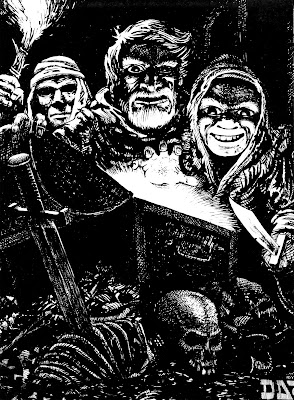
After these experiences, I conclude that I definitely prefer “old school” D&D within this genre – specifically, the more challenging and flavourful 1st edition Advanced Dungeons and Dragons and Basic/Expert Dungeons & Dragons (and related “clone” systems, like OSRIC and S&W). I like magic to be at least somewhat rare and at least somewhat costly to use. (Endless cantrips and ritual spells? No thanks!) It’s clear to me that the post-TSR versions of the game just are not my thing. I certainly have no interest in the recent offerings from the Wizards of the Coast.
There is one honourable exception regarding 5th edition D&D: the Middle-earth adaptations of the 5e system, as presented in Adventures in Middle-earth and The Lord of the Rings RPG. I thoroughly enjoyed the AiME campaign that I ran a number of years ago. But those games don’t feel like “D&D” at all – the magic system is entirely different, the classes are entirely different, etcetera. They also import a number of mechanics from The One Ring RPG. And of course, those games belong to the “high fantasy” genre discussed earlier.
Historical Fantasy
As a player, the bulk of my gaming over the past decade has been in historical fantasy settings. I suppose that this is unsurprising, given that I’ve played a lot of Mythras (and its predecessors, RuneQuest 6 and MRQII) during this time. So, I’ve played in long-running Mythic Britain and Mythic Babylon campaigns, as well as some one-shot sessions in other settings.
Both Mythic Britain and Mythic Babylon are excellent and highly recommended!
Blog Archive
About Me
- Akrasia
- I'm a Canadian political philosopher who lives primarily in Toronto but teaches in Milwaukee (sometimes in person, sometimes online).


