29 January 2024

Will Gygax’s Castle Greyhawk finally be published?


Almost two decades ago, Troll Lord Games ("TLG") began working with Gary Gygax to produce a version of his legendary “Castle Greyhawk” – renamed (for legal reasons) “Castle Zagyg” ("CZ"), after the mad wizard who created it. TLG began this grand endeavour by publishing a few new things concerning the surrounding (“not-Greyhawk”) territory, such as a regional folio and a large hardcover book describing the city of Yggsburgh. I purchased all the CZ products back in the day. Unfortunately, like most TLG products, they were quite poorly edited. Moreover, they weren’t directly based upon the original setting from the early 1970s, and were not especially noteworthy in my view (even ignoring the editing problems). Nonetheless, there was the promise that the famous dungeon would eventually appear, albeit in a modified “updated” form.

In 2008 Castle Zagyg: The Upper Works box set was published. It was co-authored by Jeffrey Talanian, as Gygax was in ill health at this point. My understanding (perhaps incorrect) is that Talanian was using Gygax’s notes and consulting regularly with him on the overall development of the dungeon, not just the initial box set. 

To my relief, Castle Zagyg: The Upper Works was reasonably well-done. I still own it and think that it’s a solid product. (For an informative and interesting PDF review by Greyhawk expert Grodog, go here.) But tragically, Gygax passed away in 2008, and the license for CZ subsequently was pulled from TLG. My understanding is that there was enough material completed by this time to produce further products in the line, but none of it would see the light of day.

Recently, though, TLG received permission to republish the Yggsburgh hardback, as well as some other things by Gygax. And now the green light has been given for them to develop and publish the rest of “Castle Zagyg”!

You can read the announcement from the TLG here.

Upon reading the announcement, two things stood out to me. 

First, it looks like the 2008 box set will not be republished, at least not in its original format. The Trolls write: “We’ve not yet settled on an organizational format but have settled on hardcover books with pockets in the back to hold the many maps that will come with this set.” Since the box set included the “Mouths of Madness” (it was one booklet among five), at least part of it will be published again. Perhaps the other five booklets will be part of the “Castle Ruins” volume (CZ Volume II)? (In any case, I’m [rather selfishly] pleased that the box set will not be republished, as it ensures that it will remain a rare “collector’s item” in the future.)

Second, while (I assume) it’s a good thing that Luke Gygax and James Ward are involved, as they have knowledge of the original dungeon, I did not see Jeffrey Talanian mentioned. Perhaps he was invited to take part in the resurrected project but declined, given that his focus these days presumably is on his own Hyperborea game. But if they are drawing upon the work that Talanian did with Gygax, I would think that he would get credit for that and be mentioned, no? It certainly would dampen my interest in this project if the team now working on it plans to ignore the work on the dungeon that had been completed up to 2008.

In any case, I’ll keep my eye on this. I’m curious to see what comes of it. 

(The picture of Zagyg above is by Jeff Easley and appeared in Dragon #70.)

Update (January 30th): It turns out that Jeffrey Talanian will be consulting on the project. From the TLG "Worlds of Gary Gygax" webpage: "we will be consulting with family members such as Ernie and Luke Gygax, and long time friends like James M. Ward and Jeffrery Talanian to make these works as close to Gary’s vision as we can."

My apologies for missing this in my initial post.

28 January 2024

Against the Court of Urdor Campaign – Part 1

Zepheus the Mage and the Prince Berethil 


Our story begins in the first month of the 1000th year of the Second Age of Humanity… 

Ten centuries ago, the Rylandar Imperium – led by the undying Autarch N’veldar – was defeated, thereby ending the First Age of Humanity (in its 2,550th year). While the centre of the Imperium was the great northern island of Aldena, it also cruelly ruled much of the southern island of Urdor. 

The celebrations in the Republic of Koronande – and its allied realms, Taaliraan, Hathor, and Tuktan – are intense, despite rumours of the Autarch’s return in the north. The date passes uncelebrated in the Kingdom of Tantûrak, however, as it is a former colony of Rylandar, and remembers fondly the time of the Imperium’s hegemony. 


Our protagonists – Einar Quicksilver, the Green (“Dusk”) Elf scout of Koronande, and Kiren Hammerstone, the Dwarf animist of Grimhold (one of the five Halls of Pale Steel) – meet in the great Elvish city of Tauronde, the centre of the Green Elvish community within the Republic of Koronande. In the city’s splendid taverns, over glasses of Taaliraani wine and pints of Hathorian lager, they learn that they have overlapping goals. Einar must travel to the Taaliraani city of Tilvirin, where he hopes that the learned Blue Elf sages there can analyse a sample of his late aunt Yvenna’s blood and identify the poison that killed her. The mystery concerning her assassination is a dark cloud that hovers over the young elf. Kiren also must travel to Tilvirin, where he hopes to learn more about the ancient Night Elf organization, “The Court of Urdor.” After defeating a band of Dwergar raiders, the forces of Grimhold recovered the body of a Night Elf magician wearing a badge of that organization. Most scholars, however, believe that the Court ceased to exist over 3700 years ago, with the final defeat of Queen Everekka at the end of the Era of the Elves. Before they travel to Taaliraan, though, Einar intends to deliver his slain aunt’s enchanted necklace to his cousin Nuriel. She is said to be the leader of a band of Green Elves – the “Emerald Guardians” – within the region known as the "Cursed Lands." 


February 1000 2AH

1st – 3rd: The Journey South 

The adventurers leave the Elvish region of Koronande and enter Kirani (human) lands, travelling south along the great Koronande highway from the city of Tauronde to the city of Azure Spires. The next day they travel to the river’s mouth and take a ferry across it to a fortified border village. They then leave the territory of Koronande and follow a trail along the coast for a while, before turning west into the dim and misty jungle. Once they pass the jungle’s verge, the going becomes easier, as the canopy above permits little sunlight to the lands beneath, and hence there is minimal ground vegetation. Ominously, the jungle region that the duo enters is known as “The Weblands” because of the numerous giant spiders that are said to dwell within it.

At the end of the third day of their journey, Einar and Kiren make camp. Around midnight, a malevolent black mist descends upon them, defeating their vigilance and causing them to fall unconscious.


4th: The Barrow of Prince Berethil

The heroes awaken within a large tent. They find that there are iron bands on their wrists. Also in the tent is an elderly Tantûraki in a deep blue cloak and four rather sour looking warriors (another Tantûraki, a Hathorian, a Kirani, and a Half-Orc). The cloaked Tantûraki introduces himself as “Zepheus.” He explains that the iron bands on the adventurers’ wrists are enchanted, and at his command they will constrict, severing the adventurers’ hands. Zepheus promises to remove the bands if Einar and Kiren perform a service for him. They must enter the barrow of the Green Elf Prince Berethil, something that he and his warriors cannot do, as the barrow is warded against humans. Within the barrow, Zepheus explains, the adventurers must locate the preserved heart and brain of Berethil and return the organs to him intact. Once this is done, Zepheus promises to remove the iron bands and, moreover, reward each of the adventurers with a sack of gold coins.


Einar recalls that Prince Berethil was the younger brother of Queen Blàithnaid, who was the last ruler of the Green Elves of northern Taaliraan. A thousand years ago, in the final battle against Tantûrak (which then was part of the Rylindar Imperium), Queen Blàithnaid and her Green Elves were allied with the Blue Elves of southern Taaliraan, the Kirani of Koronande, and the Hathorians of Hathor. Prince Berethil and his band of followers, however, fled before the battle, stealing the Queen’s crown. While the Autarch’s forces were defeated in the great battle, the Green Elves suffered terribly, and subsequently abandoned their lands, departing for either southern Taaliraan or Korondande. Because of the death caused by the final battle, and the undead minions of the Autarch that are said to haunt it to this day, the region became known as “The Cursed Lands.” The Green Elf Queen herself disappeared afterwards. The fate of the Prince is unknown, although legends say that he was hunted down and slain by the Queen’s former bodyguards a few years after his treachery. 

Drawing upon his knowledge of arcane matters, Kiren infers that Zepheus plans to magically prepare and consume Prince Berethil’s heart and brain, in the belief that doing so will confer upon him the agelessness of the Elves. While some uniquely powerful Arsilonian (“High Men”) mages, including those among the Tantûraki, choose to follow the Autarch and become liches in order to avoid death, a few scholars believe that there is an alternative, namely, transformation into living immortality through the consumption of the brain and heart of a powerful Elf (or other descendant of Faerie) or, alternatively, a Demon. Whether this is in fact true, Kiren does not know. The attempt to skirt death, however, is deeply offensive to Dwarfish religion and philosophy, as it thwarts the soul’s quest for union with The Form of the Good.

Zepheus provides the heroes with a vial of universal antidote (which will cure any poison or venom upon consumption), two doses of Amerke (a shrub root that, when made into a paste, can stop bleeding), four leaves of Abaas (which, when crushed and consumed, will facilitate healing), and two torches. Einar and Kiren then leave the camp, unhappy with their situation but with little choice but to do what Zepheus demands.

After a couple of hours, the duo discovers the barrow within a small clearing in the jungle. Einar is surprised to find that there are two Elbrinth trees – the white trees that the Elves use to craft many of their enchanted items – growing upon the barrow. The entrance to the barrow itself is blocked with a smooth white door with a green tree engraved in its centre. On either side of the tree are two handprints. Einar places his hands on the handprints, and the white door slides upwards. The party enters the barrow.

They soon come across the burial place of Prince Berethil. The elfin lord’s skeleton lies upon a great slab of smooth dark green stone. It wears white wooden armour – crafted from Elbrinth trees – and holds two black arrows in its crossed arms. A crown of twisted white branches, with green leaves sprouting from it, adorns the lord’s skull. Beyond the slab hangs a great hourglass, suspended from the ceiling by a mighty silver chain. Kiren casts “Sense Darkness” on the skeleton and discerns that it is cursed. Beyond the slab chamber, the heroes find a barrel filled with green elvish wine. They are puzzled that it still looks fine after all these centuries.

Exploring further, the adventurers encounter some skeleton guards wearing ancient Tantûraki armour. They are sentient, and in the midst of a game of dice when happened upon. The undead guards speak an archaic form of Arsilonian, but the adventurers can understand them well enough. They stiffly ask the duo to leave, explaining that they were cursed almost a thousand years ago by the followers of Prince Berethil to serve as guards here. Noting that the adventurers do not seem inclined to leave, they apathetically shrug. Over the years, discipline seems to have waned. However, they cannot end their service, at least not until the spirit of the elfin lord departs the mortal plane for Faerie. If the adventurers wish to speak with Prince Berethil, the skeletons say that turning the hourglass over will summon his ghost for a brief time (until the sand runs out). They remark that he’s not that much fun to talk to, but perhaps as non-humans, he will be less hostile towards the adventurers. The skeletons then ask them if they would like to exchange favours. If the adventurers release one of their comrades from a giant spider’s web, they will tell them about what lies in the rest of the barrow and give them a magic glowing bead as well. They mention that an elf had entered the barrow recently – he also had iron bands on his wrist (no doubt an earlier victim of Zepheus’s machinations) – and had agreed to help their comrade, but never returned. The skeletons assume that the elf was slain by the spiders. 

Kiren and Einar return to the skeleton of Prince Berethil. They turn over the hourglass. As the bright white sand starts to fall, the ghost of the elfin lord appears. He at first moves to attack the duo but stops once he notices a fellow Green Elf. The adventurers explain why they are in the barrow. Prince Berethil responds that he will tell them how they can remove the iron bands, and moreover receive a great gift from him, if they promise to help him lift his curse. He asks that the crown of his sister, Queen Blàithnaid, be returned to her. If this is done, his curse shall be lifted, and his spirit will be able to depart for Faerie. However, he will linger in the barrow long enough for the adventurers to return and receive their reward. When asked if the Queen is still alive, he affirms that he knows that she is because of his connection to her. She lingers in the mortal realm, somewhere near the final battle of the past Age. Einar and Kiren vow to return the crown within one year. In return, Prince Berethil tells them that there is a turquoise pool within the barrow that will dissolve anything that is not of living flesh or bone. Within the pool, moreover, is some treasure that the party may keep. As he starts to fade, the ghost tells the adventurers that they may take the two black arrows, which are enchanted to slay humans.


The heroes return to exploring the barrow. They fill their wineskins with the green wine that they found earlier, which turns out to be enchanted with rejuvenation and healing magic. They subsequently find a tapestry that vividly displays a scene from Faerie.  Eventually, they come to the chamber with the turquoise pool. To their great relief, the iron bands dissolve once Einar and Kiren thrust their hands into the cool liquid. Also within the pool is a white steel lockbox, apparently immune to the liquid’s effects. Einar removes the box and skillfully picks the lock, uncovering numerous valuable gems. The adventurers are now moderately wealthy!


Exploring further, the duo comes upon the chamber of preservation. Within enchanted urns, they discover the arcanely maintained brain and heart of Prince Berethil. No longer bound to Zepheus’s vile task, they leave the organs in their resting places. 

The heroes then come to a large room filled with webs. There are four web sacks hanging from the ceiling, one of which is moving. Curses in ancient Arsilonian emanate from it. No doubt it contains the missing skeleton guard. They also spot the corpses of an elf and a massive spider lying on the ground. It looks as though the two recently slew each other, as their bodies have not rotted away yet. Just after they recover a smart looking sword from the grip of the dead elf, a living spider scuttles across the ceiling toward them. This one is far smaller than the one slain by the elf, but nonetheless proves to be quite a challenge. It bites Kiren, but the dwarf shakes off the effects of its venom. It then bites Einar and the Green Elf screams in agony as the venom courses through his veins. Kiren uses his magic to cause the spider to fall asleep, and quickly dispatches the disgusting creature with his mace. He administers the vial of universal antidote to Einar. The two then free the skeleton guard from the web sack and return with him to the chamber where the other guards are still rolling dice. In gratitude for the return of their friend, the skeleton guards give the adventurers an enchanted glowing bead – it provides a perpetual candle worth of light – and tell them about a secret exit from the barrow to the east. 

The duo drink from the enchanted elvish wine and feel much better. Kiren thinks to write a message to any future invaders that might be sent by Zepheus, telling them about the turquoise pool. Hopefully this will thwart any future attempts by the blackhearted Tantûraki magician to obtain the heart and brain! The adventurers leave the message on a piece of wood, propped up by the slab on which Prince Berethil lies. 

After telling the bored skeleton guards that they hope to lift their curse within a year, the adventurers leave the barrow. They wander through the dim jungle for a few hours before finding the trail that they previously had been following. As night falls, they journey a bit north of the trail and camp for the night, delighted that they have recovered their freedom.

Notes:
  • The master page for the World of Ukrasia and this campaign is here.
  • The Island of Urdor (especially its central part) draws upon – but significantly modifies – ICE’s 1981 Court of Ardor campaign module by Terry Amthor. The map of the central region and the “Cursed Lands” are from the module’s main map, by Peter Fenlon. (I added a number of new locations to the “Cursed Lands” map – it should be obvious which ones are not part of the original map.)
  • The political map of the island of Urdor is my creation (although, as noted, the central part draws upon The Court of Ardor).
  • The barrow of Prince Berethil draws upon – but significantly modifies – the adventure, The Barrow of the Elf King (review here). The pictures of Prince Berethil and the lockbox are from that adventure. 
  • The picture of Einar is from the Neverwinter Nights CRPG; the pictures of Kiren and Zepheus are from the Icewind Dale Enhanced Edition CRPG.
  • Queen Blàithnaid is from the Against the Darkmaster core book. Nuriel is from the Silence of Dawnfell adventure for VsD. As will become clear in future posts, I have adapted both adventures for this setting.

27 January 2024

I Survived Helm's Deep

I'll be seeing The Two Towers in concert this evening. 
"Witness Peter Jackson's legendary movie adaptation on a big screen, with a full orchestra performing Howard Shore's award-winning soundtrack in real time to picture. With the battle for Middle-Earth reaching an absolute fever pitch in this second instalment, hearing the pounding Uruk drums, monumental battlefield music and enchanting soundscapes of the Elven realms performed completely live will transport the audience to Arda like never before."
My "I survived Helm's Deep" hoodie is ready for action! 


I saw The Fellowship of the Ring in concert last January and it was awesome. I've been looking forward to this for a year now.
 

19 January 2024

1.5 Million


I’m not sure exactly when this milestone was reached, but in recent days this blog passed 1.5 million page visits since I started it in June 2009. I have no idea how “good” that is for a blog of this age, but I don’t think it’s “bad”! 

The overall focus of the blog has been pretty consistent: fantasy (and other) role-playing games, fantasy (and science fiction) literature and related media (films, television series, art, etc.), and occasionally other related topics (e.g., “industry” events, like the attempt to revoke the OGL by Wizards of the Coast last year). Granted, the specific topics have changed somewhat over the years –- e.g., I don’t play certain games, like The Call of Cthulhu or Swords & Wizardry (or the S&W variant to which I contributed, Crypts and Things), quite as often as I used to, although I remain very fond of them and continue to support them. But I don’t think I’ve deviated far from the main interests that motivated me to start this (rather self-indulgent) blog almost fifteen years ago.

Anyway, thanks to those of you who visit this place from time to time, and even occasionally comment. It’s always nice to know that there are others in this world who have overlapping interests and passions. 


18 January 2024

The Rings of Power — Season 2 Rumours


Warning: spoilers about season one of The Rings of Power and rumours about season two below.

The first season of The Rings of Power was visually amazing. I have to give the show credit for some remarkable sets, especially those of Khazad-dûm, Númenor, and Ost-in-Edhil. But the writing — the storylines, dialogue, and so forth — was definitely lacking overall. A few elements were okay — the relationship between Elrond and Durin was often charming, the new character “Adar” was intriguing — but overall it was quite disappointing. 

Especially vexing were all the gratuitous deviations from Professor Tolkien’s creation. I can understand changing elements of the established canon for the sake of the medium (e.g., removing Tom Bombadil and replacing Glorfindel with Arwen in Peter Jackson’s Fellowship of the Ring). But so many of the changes in season one of TRoP were not simply unnecessary but painfully ridiculous. I loathed the “time compression” –- squishing 2000 years of history into maybe a decade or so. The whole “mithril-as-the-cure-for-Elf-cancer” invention was utter nonsense. And the existence of two “Durins” at the same time annoyed me. But I don’t wish to go through all the problems with the first season again.

Because of the weakness of the first season, I don’t have a lot of optimism about the next one. The One Ring website recently reported on some purported leaks about the second season and, well, it looks pretty grim. Granted, these rumours may all turn out to be vapours. But I remember dismissing the “leak” that “Halbrand” was Sauron — it just seemed too ridiculous and obvious — only for that to turn out to be the case.

Granted, the idea of presenting an episode (or a few episodes) from the perspective of Sauron could potentially be really cool (so long as the show didn’t try to present him in a sympathetic light, a kind of “emo Sauron”). And I would love to see the Song of Creation –- the Ainulindalë –- portrayed well on the screen. But, based on the first season, I really doubt that the writers for TRoP have the chops to pull these things off.

And many of the other rumoured elements of the second season look absolutely terrible. A son of Sauron? (Who is killed by Adar?) Tom Bombadil revealed to be in fact Morgoth (apparently bound in this form as punishment from Mandos)? And Goldberry in fact Ungoliant? What? If true … why?!?

I pray to Eru that most of these “leaks” turn out to be nothing more than jokes.

Further discussion can be found at The One Ring and (in video form) The Nerd of the Rings. (As usual, I largely agree with the perspective of the latter.)


10 January 2024

Jennell Jaquays RIP

It was announced over at the RPG Pub that the legendary adventure designer Jennell Jaquays has passed away.

Perhaps I'm somewhat unusual in this respect within the online ‘grognard’ community, but while I missed her early classic adventures (Caverns of Thracia, Griffin Mountain, Dark Tower, etc.), I was quite familiar with Jaquay’s illustrations for Iron Crown Enterprise’s old Shadow World (Rolemaster) products (as well as the ‘Nehwon Mythos’ pictures in the 1st edition AD&D Deities and Demigods). Indeed, I associate her artwork with my favourite book in the Shadow World series, Terry Amthor’s epic Jaiman: Land of Twilight. (Amthor is another recently deceased RPG legend.)

Here's the picture of the creepy "darklord" of Jaiman: “Lorgalis ‘the White’” (any resemblance to a certain Melnibonéan sorcerer-emperor is purely coincidental, I’m sure):


The Throne of the Dragon Lord:


And one of the ‘good guys’ – a rather unusual Loremaster:


Later (during 2000s) I picked up Thracia (the 3e version, and the PDF of the original) and some other classic things by Jaquays. I should be getting Goodman Games’ revamped version of Dark Tower (to which Jaquays contributed some new material, I believe) sometime later this year.

RIP.

20 December 2023

Second Edition Advanced Dungeons and Dragons


Over at his Mythlands of Erce blog, Anders H* has a couple of amusing polemical posts defending the honour and goodness of second edition Advanced Dungeons and Dragons (part one concerns the rules; part two addresses the ‘culture’ of the game).

Second edition AD&D was an edition that I almost entirely skipped. I say “almost” because I played very briefly in a 2e campaign one summer around 1990. However, I never owned any 2e AD&D books during its lifecycle (I bought a few books for the Greyhawk and Planescape settings years later). I had drifted away from AD&D by the late 1980s and did not play role-playing games that regularly during the 1990s. To the extent that I did, it was stuff like MERP, Rolemaster, Call of Cthulhu, Hawkmoon, GURPS, and the like.

I eventually did “play” a lot of 2e AD&D, but only via various computer RPGs, namely, the “Infinity engine” Baldur's Gate games, Icewind Dale, and Planescape: Torment (the latter game motivated me to learn more about the Planescape setting, hence my subsequent purchase of the box set and a few other things). It didn't seem that different from 1e AD&D, at least in terms of the rules (the addition of “kits” seemed to be the main difference).

The hatred directed towards 2e by adherents of 1e AD&D (primarily from grognards grumbling on the internet – not that there’s anything wrong with that!) always struck me as primarily flavour-based. And I share their irritation with 2e’s “purging” of things like assassins, half-orcs, demons, devils, etc., (all things that eventually crept back into the game, however, during the 1990s). Also contributing to this sentiment was some bitterness about TSR’s treatment of Gary Gygax, and the unavoidable fact that 2e AD&D was the first “post-Gygax” version of the game. 

There are some rules differences between the two editions, of course, and in my view some favour 2e (e.g., the way thief skills were handled), others 1e (e.g., the presence of a distinct "illusionist" class). 

I much prefer the art in the original 1e AD&D books, especially the classic Dave Trampier Player’s Handbook cover. Overall, the 1e art seems “grittier” and less “family-friendly” than the 2e stuff. Trampier’s pictures often looked like etchings from some mysterious past (as did David Sutherland’s epic “Paladin in Hell”). Erol Otus’s pictures looked like visions of an alternate reality.  

But in terms of rules, I’m fine with 2e AD&D. I certainly prefer them over 3e (which I’ll never touch again), 4e (which I never played after reading halfway through the PHB), and 5e (which, admittedly, is the “least bad” of the post-TSR versions of AD&D/D&D, but still not my cup of tea). I'd be quite happy to play in a 2e campaign. But if I ever run an “old school” AD&D campaign again, it almost certainly would be (a house-ruled version of) Gygaxian 1e AD&D.

(*Note: Anders H is the author of the excellent Into the Unknown RPG, an “old school” variant of the 5e rules. Check it out! If you’re curious, I go over some of the main differences between ItU and 5e here.) 


09 December 2023

The new Mythras Imperative is now available!

I recently mentioned that a new version of Mythras Imperative was in the works. Well … it’s here!

The Design Mechanism’s announcement (at the RPG Pub):


The new, revised, expanded, ORC-licensed edition of Mythras Imperative is now available – just in time for Christmas.

While the game and mechanics are fundamentally the same, we've tweaked a few rules, made errata corrections, and fully integrated rules for firearms, vehicles, new character creation options, and sample creatures (with a complete list of traits to make them worthy opponents).

Most important of all, Mythras Imperative is licensed under ORC, meaning that 3rd party creators can freely use, adapt and build upon the Mythras Imperative foundation for their own unique d100 games, supplements and adventures. Combine Mythras Imperative with its sister book, Classic Fantasy Imperative, or any other ORC-licensed open gaming system.

So whether you want gritty fantasy or mythic historical, Pulp-era spies or cinematic superheroes, Mythras Imperative has you covered. Simple to learn, simple to play, but with a surprising depth that is the result of many, many years of refinement.

The PDF version is free to download. The Print on Demand version is $24.99 (black and white, softcover, 80 pages). A POD version for Drivethru customers will follow later.


As I’ve mentioned many times before at this blog, Mythras is the game that I’ve played the most over the past dozen years (I include its immediate ancestors, RuneQuest 6 and Mongoose Runequest II, within the ‘Mythras’ category, as they’re all essentially the same game, written by the same people). I don’t write about it as much as I do some other games, primarily because I don’t run (“Game Master”) Mythras. I tend to write more about games that I’ve run in the past, am running currently, or plan to run in the future. But if I wasn’t so fortunate as to belong to a group with a couple of excellent Mythras GMs – one of whom is the co-author of the system, the other the co-author of the Mythic Babylon book – I’d definitely be running Mythras myself. 

Anyhow, if you’re still unfamiliar with Mythras, I recommend checking out Mythras Imperative, as it’s a nice, lean presentation of the system, easily readable within an afternoon.


04 December 2023

My original fantasy sandbox: ICE’s Middle-earth


One reason why I have such affection for Iron Crown Enterprise’s line of Middle-earth campaign and adventure modules, is that I learned how to run genuine “sandbox” campaigns (decades before that term was a thing) by using them. This was during the mid-late 1980s, when TSR increasingly released “story-driven” modules like their Dragonlace series. Somewhat ironically, given their literary source, the Middle-earth campaign and adventure modules typically were quite open-ended and location-based in nature, not at all focused on a predetermined “plot” or necessary sequence of events. (The one exception of which I know, and which was published quite late in ICE’s Middle-earth tenure, is their Palantir Quest ‘adventure path’.) 

What happened in my Middle-earth games back in the day, essentially, is that the players would create characters in Esgaroth, Bree, Tharbad, or wherever. I would contrive some reason why they all knew each other (usually something like: “you meet at an inn and intuit that you’re all solid, trustworthy fellows looking for adventure and to protect the free peoples of Middle-earth”). The characters then would simply wander around, following whichever adventure hooks they liked. While I added hooks, encounters, and adventures to what was provided in the Middle-earth campaign modules, the books typically provided very solid frameworks for such campaigns. Or at least the ones that I used did so. As I think I’ve mentioned before here, I ran a summer-long campaign during high-school (we probably played at least 12 hours every week in those halcyon days) using the Rangers of the North (Arthedain) book, building on the adventure notes in the back (years later, these notes would be expanded by ICE into their Palantir Quest book).

I learned a lot from using ICE’s Middle-earth campaign modules. Indeed, trying to figure out how to use them, and doing what I could as a teenager to run challenging and fun sessions in a Middle-earth “sandbox” was a formative experience. (Beyond gaming, I think running MERP helped me to learn how to “think on my feet” far more than running D&D/AD&D adventures – whether published modules or my own creations – ever did.)

Yes, the books varied in quality – well, not the maps by Pete Fenlon or the covers by Angus McBride, which were always amazing. And yes, some didn’t really belong in Middle-earth, like the (totally awesome) Court of Ardor. Nonetheless, overall, I loved MERP, and I still do to this day. Hence my present joy in running the MERP-influenced Against the Darkmaster, both in 20th century Eriador (“Against the Witch-King”) and in my “homebrew” world of Urkasia (“Against the Court of Urdor”).

[This post is a modified version of a comment I posted over at the blog Grognardia, in response to a rather negative, but not unfair, review of the original Iron Crown Middle-earth module, Southern Mirkwood.]

[The pictures are by the great Angus McBride. The top one is from the cover of the Lost Realm of Cardolan campaign module, the bottom one is from the cover of the Rogues of the Borderlands adventure module.]


03 December 2023

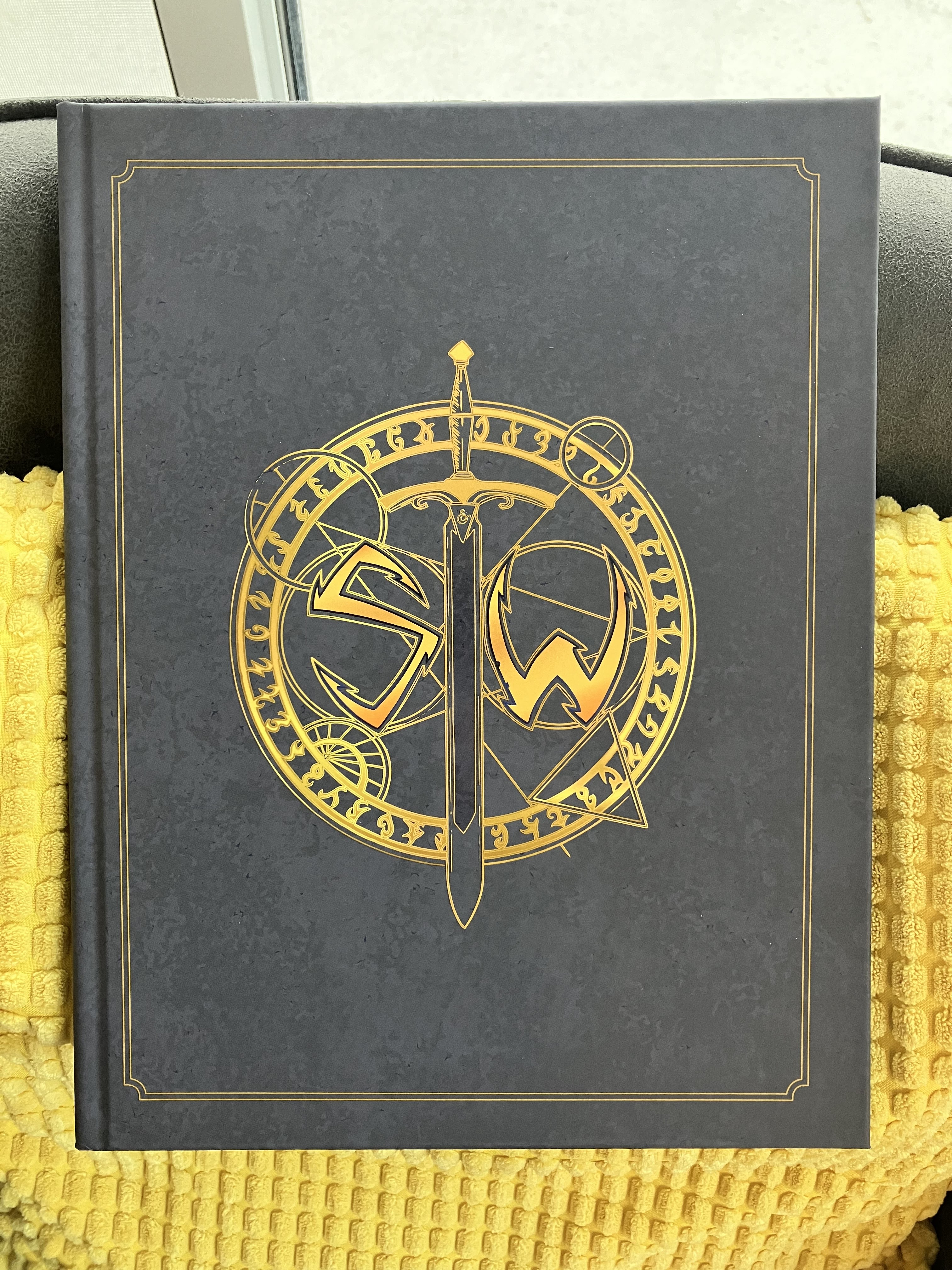
Swords and Wizardry special edition

Several weeks ago, I received the special edition of Swords and Wizardry - Revised Edition. It’s a beautiful book. I love the matte cover! If you like S&W, I recommend obtaining one for yourself, if possible.


For my overview of this version of S&W, go here.

Blog Archive

About Me

My photo
I'm a Canadian political philosopher who lives primarily in Toronto but teaches in Milwaukee (sometimes in person, sometimes online).