Showing posts with label MERP. Show all posts

23 July 2026

My Top-5 Roleplaying Games of All Time

Over at the “RPG Pub” there is a thread asking people to post their top-five favourite role-playing games of all time.

Here’s my list. Reflecting on the role-playing games that I’ve played over the past forty-five years or so, I’d say that my top five have to be the following:

Middle-earth Roleplaying (MERP)/Against the Darkmaster (VsD)


My first “real” campaign involved MERP and ICE’s beautiful maps and detailed campaign modules. MERP – and its descendant VsD – captures what I like the most about Rolemaster – the flexible class-based character development system; the detailed, vivid critical hit charts; the overall coherent rules framework – but without the large volume of charts and details that (IME) bogged down RM in actual play.

Some of my fondest memories of playing RPGs involve MERP and my two favourite campaigns of all time as GM (one still ongoing) use VsD.

Mythras 


I started playing this in 2011 – back when it was still being published by Mongoose and was called RuneQuest II (i.e., MRQII) – and haven’t stopped since. I’ve played in campaigns set in the Young Kingdoms (“Elric”), Mythic Britain, Mythic Babylon, Beyond the Mountains of Madness (the CoC campaign adapted to Mythras), and now Lyonesse, as well as in several “one-shots” or short campaigns (Mythic Greece, Luther Arkwright, Meeros, etc.). A really excellent system overall.

Call of Cthulhu


I haven’t played CoC since 2017 and I’m in no rush to do so again soon. But I’ve run a lot of CoC over the years – almost always as GM (er, “Keeper”) – and I’ve always really enjoyed it. I’m pretty sure it’s the game I’ve run the third most often (after MERP/VsD and AD&D). The scenarios are generally excellent (although some needed work). My only regret is that I have yet to run one of the “classic” campaigns for it (although I did play through BMoM using Mythras).

Dungeons & Dragons/Advanced Dungeons & Dragons (TSR era)


Like most RPGers, I started with D&D and spent a lot of my early gaming days (the early 1980s) playing and running AD&D (and I’ve returned to it from time to time since then). Reading Gygax’s hardbound volumes not only improved my vocabulary as a wee lad, but also sparked my imagination. They were the works of a disorganized creative genius. I still treasure the classic modules from that era as well. Although aspects of the system never failed to frustrate me, the game will always have a special place in my heart.

Stormbringer/Elric!/Hawkmoon/Corum 
(i.e., BRP “Eternal Champions” games)


I don’t really have any interest in running these BRP RPGs now – Mythras has largely filled that space for me – but I still have these books and really enjoyed these (closely related) games back in the day. 

There are other games that I like and other games I hope to try – but these are the games that I consider my all-time favourites.

Feel free to post your "top-5" lists in the comments, if you like. I'd be curious to learn what games have stood "the test of time" for you.


05 July 2026

Against the Court of Urdor – Part 6

The Return to Prince Berethil’s Barrow and the Journey to Taaliraan

Our protagonists – Einar Quicksilver, the Green Elf rogue of Koronande, and Kiren Hammerstone, the Dwarf animist from the Halls of Pale Steel – have accomplished many things in the past month:
  • The two adventurers were magically coerced by the vile Tantûraki necromancer Zepheus to raid the Barrow of the Elf Prince Berethil – only to escape with the help of Berethil’s ghost. The ghost asked the duo to return the crown of Queen Blàithnaid – which the prince had stolen from his older sister a thousand years ago – to her in the northern Cursed Lands. They agree and take the crown made of entwined white branches with them. (Part 1.)
  • Einar and Kiren encountered the Company of the Morning Star, travelled to Korlax’s Haven, and helped the bard Blarth recover his harp from some fiendish redcaps – but at the cost of poor Blarth’s life. In the process, the two adventurers liberated the half-orc Krumm and the pixie Neriss. (Part 2.)
  • The duo travelled through the Cursed Lands with Neriss, eventually arriving at the town of Dawnfell. There Neriss was taken hostage by the town’s leader, Brynjar, who demanded that Einar and Kiren recover the town’s protective artifact, the Dawnchime. The adventurers then went to the elvish village Crystal Glade, where Einar met his cousin Nuriel, the village’s leader. An important artifact of the village, the Dragon’s Eye, had recently been taken by raiding trolls. From a prisoner, the group learns that the trolls are working with a band of human brigands, the “Dread Wolves,” all under the guidance of the vile Zepheus. (Part 3.)
  • With the help of the Wyrdwood guardian Aleisa and an intelligent macaw Quiss, the adventurers recovered the Dawnchime from some trolls holed up in a ruined Tantûraki temple. Returning the Dawnchime to Brynjar, the party then helped the elves of Crystal Glade and the men of Dawnfell capture the “Dread Wolves” and recover the Dragon’s Eye. At the urging of the gnome “Grizzy,” Neriss then decided to return to her Faerie Mound. Kiren acquired a falcon companion named Miranda. Having successfully reconciled the Crystal Glade and Dawnfell, Einar and Kiren travelled to the Tower of the Morning Star where they met with some members of the Company of the Morning Star, including the ranger Karos. The adventures then journeyed on to the Tantûraki town of Soggy Fields. (Part 4.)
  • Einar and Kiren travelled to Misty Vale. While there, they solved the mystery of the “Beast of the Lake,” helped (and was helped by) the herbwife Eileen, discovered that the village’s leader Wulfric is secretly in league with Zepheus, who seeks the legendary “Elfstone,” and recovered the true Warden’s pendant from the Warden’s Mound south of the village. Most impressively, the adventurers travelled to the Isle of the Lake of Mists, which they learned is a fragment from the plane of Faerie. There, they returned the white crown to Queen Blàithnaid. Moved by this act, she lifted the curse on her brother, and gave the Elfstone and a mighty enchanted blade, the “Queen’s Thorn,” to the adventurers. Her spirit then passed onto Fairie, her body transforming into a thicket with flowering white roses. (Part 5.)

[The Cursed Lands] 

27th February 1000 2AH (Second Age of Humanity): 

While at the Tower of the Morning Star, Kiren and Einar meet with Bleys, Karos, and Onshay of the Company of the Morning Star. The duo relates their recent adventures in Misty Vale and the various things that they learned there about the machinations of Zepheus. (Kiren, however, is careful to gloss over the “flaming outhouse” incident, as he is somewhat ashamed of what happened there.) The members of the Company are most impressed! Karos decides to lead a group of fifteen soldiers to drive Wulfric and his henchmen out of the vale and discover the fate of his friend Nevynn the Wise. Kiren and Einar give Karos the Medallion of the Warden to give to Eileen while there. 

[Misty Vale]


In recognition of their impressive deeds, Karos declares the two adventurers “Friends of the Company” and they are given permanent private quarters in the tower. Kiren and Einar mention their forthcoming plans: to go to Prince Berethil’s barrow to inform the ghost that his curse has been lifted, and then to journey to the elven port of Tilvirin to give the Elfstone of Queen Blàithnaid to Prince Eldanar. Karos recommends that they go to the Manor of the Elf Lord Laurre Menelrana for counsel before proceeding to Tilvirin.

[Karos]

28th February 1000 2AH: 

While enjoying their new permanent quarters in the tower, the halfling servant Cora tells Einar and Kiren that there are some “rather strange” travellers staying in the Evening Star inn looking for them. Within one of the inn’s booths the duo encounters three faeries: their pixie friend Neriss, her brother Nervo, and the gnarly gnome Grizzy. Neriss explains that she came looking for the adventurers when she heard her magic whistle blown three days ago.

[Neriss]

The adventurers chat with the wee fey folk. Grizzy is intrigued by the connection of the Isle of the Lake of Mists to the plane of Faerie. The gnome encourages the pixies to accompany him to the island to explore the possibility of moving their faerie settlement there. Grizzy also advises Kiren in the ways of animist magic. The dwarf tells the fairies that Eileen and Padraig are trustworthy folk within the mannish settlement near the lake. 

[Grizzy]

1st March 1000 2AH:

Grizzy, Neriss, and Nervo depart the Tower of the Morning Star for the Lake of Mists.

2nd – 6th March 1000 2AH:

Einar and Kiren rest, recover, and reflect at the tower. 

[Kiren]

7th March 1000 2AH:

Karos departs from the tower with fifteen mounted soldiers to rid Misty Vale of the malevolent presence of Wulfric and his lackies.

Kiren and Einar travel south to Triumvir Town. There, at the Evening Song inn, Kiren tells Marda the innkeeper and Jabbo “the Far-Walker” about the fight with the ghouls back at the Warden’s Mound. Alas, his attempt is an abject failure: the two do not belief the dwarf. Fortunately, Einar salvages the awkward social situation with some smooth talking. 

[Einar]

8th March 1000 2AH:

While in Triumvir Town, the duo visits their friend Xerric. The Arsilonian scholar is most impressed by the tale related to him, especially the role of Einar and Kiren in returning the white crown to Queen Blàithnaid and thereby ending the curse on Prince Berethil. In return for this news, Xerric gives the adventurers a golden quill. The quill is magical: if tapped three times an unending supply of ink will be provided at its tip; if tapped once the ink will disappear. 

[Xerric]

Later the same day, taking advantage of the pleasant weather, the adventurers travel to Korlax’s Haven. They reach the small settlement just before dusk. Einar impresses the gruff dwarven guards with the tale of Blarth. Aethelia the herbalist greets the two adventurers warmly and is told of their exploits since their last meeting, four weeks earlier. She is in awe of the two’s daring and bravery, and agrees to accompany them to Tilvirin, where she is from. But first she must properly store her herbs, unguents, potions, and other supplies, which will take a few days.

9th – 11th March 1000 2AH:

The party rests in Korlax’s Haven for a couple of days.

12th March 1000 2AH:

Einar and Kiren head east. By late afternoon a fog has descended. Nonetheless, by the end of the afternoon, the party successfully reaches the pentagon where they first met Karos, Evrix, and Zephyr just over a month ago. The adventurers cannot believe that so little time has passed since that fateful encounter!

13th March 1000 2AH:

The duo heads into the jungle. After a day of difficult travel, they make camp. Chittering and other disturbing noises are heard off in the darkness.

14th March 1000 2AH:

The jungle air is thick and damp as the duo reaches the site of Prince Berethil’s barrow. An eldritch black cloud hovers over the barrow. Sensing great danger within the cloud, the two adventurers sneak up to the doorway. Einar opens the door by placing his elvish hands on it and the two enter. The ghost of Prince Berethil greets the party and thanks them profusely for bringing about an end to his thousand-year curse. He releases the Tantûraki undead from his service. Before he departs for Faerie, the ghost gives his white Elbrinth wood armour and sword to the duo. The skeletal remains of Prince Berethil then collapse into dust. 

After recovering the dice from the now immobile skeleton guards, Einar and Kiren deliberate about what to do next. They go to the preservation chamber and find shattered urns. It appears that Prince Berethil’s heart and brain have been stolen! The adventurers take the tapestry of Faerie. Kiren uses the Elfstone to travel with Einar back to the Tower of the Morning Star via the Ethereal realm. (They actually appear a few miles south of the tower, but are unscathed if weary.)

By dusk Einar and Kiren are in the common room of the inn of the Evening Star where they enjoy a brisk drink together. Kiren retires for the night while the elf lingers, listening to the comely Hathorian minstrel Lena sing “The Ballad of Blarth the Bard.” Moved, Einar tells Lena of his adventurers since their last encounter. A spark is lit between the two and a night of passion follows. 

[Lena]

15th March 1000 2AH:

The duo meets with Bleys, Wylane, and Onshay of the Company of the Morning Star. Bleys reacts with alarm to the news that Prince Berethil’s brain and heart have been taken. He also suspects that a demon of some kind has been bound to the barrow. He and Onshay praise the adventurers on their clever escape using the Elfstone. Einar and Kiren agree to accompany Onshay on her journey to the village of Green Shields, in the south of the Cursed Lands, where she is to meet up with Evrix and deliver weapons to the village’s leader, Lord Vilm.

[Bleys]

16th March 1000 2AH:

Kiren and Einar relax and prepare for their journey in the Tower of the Morning Star.

17th March 1000 2AH:

The three travellers head south to Triumvir Town where they obtain lodging at the Evening Song inn. While in town, the duo meets again with Xerric the loremaster. Xerric examines the Elbrinth wood sword and explains that it is capable of taking different forms: those of a scimitar, a longsword, and a greatsword. Moreover, he notes that the enchanted wood is harder than steel and will never dull. 

18th March 1000 2AH:

The group travels to Korlax’s Haven. There Kiren and Einar are reuninted with Aethelia, whom they update on their adventure at the Prince Berethil’s barrow. They give her the prince’s Elbrinth sword in gratitude for her willingness to accompany them to Tilvirin.

[Aethelia]

While relaxing at the Storm’s End inn, both adventurers notice that they are being observed by a well-dressed Arsilonian. Einar chats with the fellow, who introduces himself as “Torth.” Kiren cases a spell and discerns that Torth is in fact a servant of darkness! The dwarf confronts the Arsilonian; the latter reacts negatively and storms out of the inn in irritation. The party learns from the innkeeper Wakkim that Torth visits the hamlet occasionally. Disturbed by the encounter, the party rests for the night.

19th March 1000 2AH:

The party of four – Einar, Kiren, Onshay, and Aethelia – departs Korlax’s Haven. Kiren instructs his falcon Miranda to fly about, keeping her eyes out for any sign of Torth

Halfway to Green Shields the group is attacked by a bomb-throwing dwergar, a murder of gorcrows, the vile sorcerer Torth, and a faceless demon! The fight is difficult: Aethelia’s hand is broken by one of the dwergar’s explosions, one of the horses is slain, and Onshay’s hand is badly damaged while grappling with the demon. While the dwergar, demon, and gorcrows eventually are vanquished, Torth transforms into a great black hawk and flees from the ambush site. Athelia and Onshay are partially healed by the ancient elvish wine that Einar and Kiren had obtained from Prince Berethil’s barrow. Kiren heals the surviving horse. 

[Faceless demon]

Hours later the battered band reach Green Shields. Onshay, Kiren, and Einar go to see Lord Vilm and Evrix at the town’s manor house while Aethelia rests at the Soothing Songs inn.  Recent developments are discussed by the group, and Lord Vilm invites the travellers to stay the night. A magnificent dinner is enjoyed by all (except Aethelia, who remains at the inn). That evening, Onshay boldly knocks on Kiren’s bedroom door, and the two dwarves enjoy a lustful night involving little sleep.

[Onshay]

20th – 26th March 1000 2AH:

Evrix and Onshay depart Green Shields to head north back to the Tower of the Morning Star. Einar, Kiren, and Aethelia stay in the small town while Aethelia’s wrist mends. 

27th March – 3rd April 1000 2AH:

The trio travels south. Kiren spots a giant eagle with a rider flying high above. Aethelia reassures the dwarf that it is an eagle rider of Taaliraan, patrolling the northern boundary of the elvish realm. Soon after, the travellers reach the great elvish fortress, The Eye of Taaliraan. They stay at the Gentle Breeze inn, which is near the fortress.

The next day the party enters the realm of Taaliraan. They travel to the village of Maethling, where they stay at the Silver Harp inn. Then they continue southwards, leaving the jungle behind and entering the rolling hills and vineyards that constitute the heart of the realm. Aethelia seems happy to be back in her homeland and relates some of its history to her companions.

By mid-morning of the third day of April, the group reaches the Vale of Tumlinde, the location of the manor of the ancient and mighty Lord Laurre Menelrana

------------------------------------------

HEREIN ENDS THE FIRST BOOK OF AGAINST THE COURT OF URDOR: TALES OF THE CURSED LANDS.

THE NEXT BOOK: MISSIONS FOR THE GUILD OF ELEMENTS.

------------------------------------------

Notes:

The master page for the World of Ukrasia and this campaign is here. (Links to other log posts can be found on the master page.)

The “Court of Urdor” setting (including the central part of the island) draws upon – but significantly modifies – ICE’s 1981 Court of Ardor campaign module by Terry Amthor. The map of the “Cursed Lands” is from the module’s main map, by Peter Fenlon. (I added a number of new locations to the “Cursed Lands” map – it should be obvious which ones are not part of the original map.)

I drew the map of Misty Vale; many of its locations are from the adventure included in the Against the Darkmaster core rulebook.

The picture of Grizzy is from the book Secrets of the Golden Throne from Open Ended Games. The picture of the faceless demon is from the Against the Darkmaster core book (also from Open Ended Games). The picture of Aethelia is by Stephanie Brown (found on the web). The pictures of Karos and Kiren are from the Baldur’s Gate II Enhanced Edition CRPG. The pictures of Einar and Onshay are from the Neverwinter Nights Enhanced Edition CRPG. The other portraits are from a “mod” for BGIIEE (found on the web – I don’t know where they’re originally from, unfortunately). 


28 February 2026

There and Back Again: My Circular Role-playing Journey

I’ve talked about my personal history with the ‘Old School Renaissance’ or ‘Old School Revival’ (OSR) in the past at this blog (e.g., see this post from 2022). But some reflection on the games that I’ve been playing in recent years has prompted me to scribble some further thoughts. (My apologies for being a bit self-indulgent here …)

[Saruman by Angus McBride]

It’s been an interesting journey. I was ‘floating around’ at various role-playing games fora during the early days of the OSR over two decades ago. Disappointment with 3rd edition Dungeons & Dragons – and nostalgia for my early days of gaming – led me to dig out (and in some cases repurchase) my old Advanced Dungeons & Dragons, Basic/Expert Dungeons & Dragons, Rules Cyclopaedia D&D, and other out-of-print RPG books. I was excited – and later disappointed – by Castles & Crusades in its early days. (I wrote positive reviews at RPG.net of both the C&C box set and Players’ Handbook, but eventually came to find the atrocious editing by Troll Lord Games intolerable.)  

I started this blog in 2009 in order to post some rules ideas for Swords & Wizardry (S&W). Some of my ‘swords and sorcery’ house rules for S&W appeared in early issues of Fight On! and Knockspell. Eventually, many of those rules were incorporated into Crypts and Things. So I guess that I contributed – albeit in a small way – to the creation of OSR “stuff,” at least early on. 

But I haven’t really been that engaged with the OSR for about a decade now. I still follow it to some extent. I mean, I have Dolmenwood and Shadowdark, as well as the more recent versions of S&W, and a few other things. I’ve backed the forthcoming ‘3rd edition’ of OSRIC (the original “retro-clone,” in this case of 1980 AD&D). While I regret some of my purchases, overall I find that there are still interesting things being produced. But I don’t really use any OSR (by which I mean here ‘TSR D&D-derived’) systems anymore, and haven’t for years. They just don’t appeal to me that much these days. I think that, given my tastes, there are superior alternatives available. I guess I shouldn’t be surprised by this. I sort of thought the same thing about AD&D/D&D around 1985.

Almost all my gaming these days involve either Mythras or Against the Darkmaster (but sometimes my groups will play ‘one shots’ of other things, e.g., Mothership or Delta Green, and I’d like to run some Dragonbane someday). I find these systems more satisfying overall than any version of D&D (TSR, OSR, 3e, 5e, whatever). I guess I’m not a ‘rules lite’ person after all. In retrospect, I think that I thought that about myself only because I found running 3e D&D to be such a tedious chore. 

Of course, both Mythras and Against the Darkmaster are descendants of other ‘old school’ systems: Chaosium’s Basic Roleplaying (Runequest, Stormbringer, and the like) in the case of Mythras, and Iron Crown Enterprise’s Middle-earth Roleplaying (itself a simplified version of 2nd edition Rolemaster), in the case of Against the Darkmaster. So, I guess they're kind of ‘OSR’ systems as well (but not if we adhere to the “OSR = derived from TSR AD&D/D&D” definition). 

I can’t help but be struck by the extent to which my personal gaming history has repeated itself: dissatisfaction with AD&D/D&D led me to move to Middle-earth Roleplaying (MERP) and Basic Roleplaying (BRP), including Call of Cthulhu, Hawkmoon, and Stormbringer, in the mid-late 1980s. And about three decades later the same thing happened with OSR D&D and 5e D&D. Hopefully I've learned my lesson and won’t go through this cycle again.

As an aside, one thing that makes me think of the old MERP campaign modules as "old school" in nature is that – whatever their other faults – they were effectively “sandboxes” (as I explain here). They described a number of locations, some in detail, and provided advice for GMs on how to provide "hooks" for players. There were a few “adventure modules” for MERP – books with 3 adventures (usually aimed at levels, 1, 3, and 5) – but even those were pretty loose for the most part (generally they provided a setting and a situation), not “railroad” adventures. So, after my first several years with AD&D, a lot of my GMing involved using and running Middle-earth “sandbox” campaigns, although of course that term was not used in those days (at least to my knowledge). Indeed, I vividly recall comparing my MERP modules to TSR's Dragonlance series around 1986 or 1987, and noting how little room for improvisation or player freedom the latter allowed.

Anyhow, to the extent I was still involved in the hobby during the 1990s, the games I followed were those that came out earlier, especially MERP and Stormbringer (the latter revised and renamed Elric! during that decade). I remember visiting gaming stores in the 1990s and being a bit baffled and even put off by all the “goth” stuff. I never got into Vampire and the like (just as I never got into the Magic craze.) When D&D 3e came out, I was excited by it because it seemed to “improve” D&D by including certain things from other systems that I liked (e.g., skills). In play, though, I came to loathe the system after two year-long campaigns, and so was primed for the OSR when it happened.

Of course, had I been sensible, I would’ve just kept playing MERP, Call of Cthulhu, Stormbringer, and similar older games – and just ignored the hype around 3e D&D and the “d20” universe in the early 2000s. These days, for the most part, I’m happy to stick with my “d100” games, Mythras and Against the Darkmaster. Wisdom, I hope, comes with age.

27 December 2025

An Old School Warhammer Against the Darkmaster in 2026

I thought I would mention here that the guys at Open Ended Games have posted a short (~23 minutes) end-of-year "Questions & Answers" video on Youtube.

The most noteworthy piece of news to come out of the Q&A, in my opinion, is that in 2026 we will see a VsD city adventure -- Trouble in Greyport -- from legendary game designer Graeme Davis (who is most famous for his work on Warhammer Fantasy Roleplay, but has written for many other systems as well). I'm really looking forward to reading this module and hope that it will have a little of that old school "grim and perilous" Warhammer flavour!

Also coming out is an adventure set in some "badlands" or wastes for higher level characters (levels 7-10) by Gabe Dybing (whose previous VsD module is The Crown of Castle Cynehelm). I look forward to checking this out as well, especially given that there is not much available for VsD in this level range (probably only the latter part of the epic Secrets of the Golden Throne campaign).

Some kind of supplement for higher-level (10+) characters is in the works but is unlikely to come out in 2026.

Overall, the wheels keep turning for VsD. I liked both of the adventures that came out in 2025: The Crown of Castle Cynehelm and the dwarf-focused The Mines of Kor-Khazan. Both have a (more or less) "sandbox" (or "setting" + "situation") structure to them, with the course of action very much in the hands of the players. But I do wish that the maps in OEG's adventures would include proper scales!


[From the cover of The Mines of Kor-Khazan]

19 October 2025

To Do List: Middle-earth and Greyhawk campaign notes; a new Lyonesse character

I’ve sadly neglected this blog over the past two months. But I have not been (entirely) idle – indeed, I’ve been quite busy running my two campaigns. 

[The Witch-King by Liz Danforth]

One of them – Against the Witch-King – wrapped up two weeks ago. Or more precisely, it’s now on hiatus. A suitably epic conclusion – an audience with King Arvedui of Arthedain, following the completion of many important tasks – has brought things to an end for the time being. But the campaign will resume nine years later in “game time” – after a (hopefully not as long) break in “real time.” The final session of the current part of the campaign took place in the spring of 1965 of the Third Age; the campaign will resume (after the break) in early 1974. The characters all accomplished what they set out to do (a year earlier in game time; over two years ago in real time). But, as those of you familiar with the history of Middle-earth likely know, things become a bit “intense” in Eriador in 1974! So, while I need a rest from running this campaign, I’m determined to resume it at some point to see how Angmar’s final assault plays out.

Depressingly, I’ve fallen far behind in my campaign logs for both of the campaigns that I’ve been running over the past two-plus years, and especially for my Middle-earth one. Instead of writing entries as detailed as the first two for the Against the Witch-King campaign (1 and 2), I’ll try to write a brief overview of what happened, something like what I did when I encountered a similar problem (falling hopelessly behind) in my earlier Middle-earth campaign.

I really don’t like leaving my campaign logs unfinished! Even a truncated summary of what happened in the adventures is better than just leaving it incomplete – for my own future recollection, if nothing else, although I hope that at least a few other people might find the logs interesting. 

This thought reminds me that I never finished the log for the Greyhawk Classics campaign that I ran a few years ago. While running that campaign made me realize that I rather dislike the 5th edition Dungeons & Dragons system, the role-playing aspects of the campaign were nonetheless a lot of fun, and I really should explain how everything wrapped up – including why ultimately the characters never actually went into the Temple of Elemental Evil.

[A modified portion of Darlene's famous World of Greyhawk map.]

The Against the Witch-King group will soon be starting a new campaign, using the Lyonesse system and setting (the system is an adaptation of Mythras). I’m quite excited about this – not only because it’ll be nice to have the opportunity to be a player again (while still running my other campaign), but also because Jack Vance’s Lyonesse trilogy is one of my all-time favourites. I’m presently putting the final touches on a rather fun and intriguing character – a former apprentice of the dreadful wizard Tamurello. If you’re curious about the game, here is a brief interview with one of the authors (and my GM) Lawrence Whitaker. 

[The wizard Tamurello from the Lyonesse RPG book]

Vancian times ahead!


27 July 2025

Against the Court of Urdor – Part 5

Misty Vale, Queen Blàithnaid’s Elfstone, and the Warden’s Pendant 

[Map of the Cursed Lands]

Our heroes – Einar Quicksilver, the Green Elf rogue of Koronande, and Kiren Hammerstone, the Dwarf animist from the Halls of Pale Steel – have endured many things over the past month. They have travelled from the fair tree city of Tauronde to the Cursed Lands that lie between the realms of Tantûrak, Koronande, and Taaliraan. And in the Cursed Lands they have escaped capture and have journeyed to a number of places, from isolated havens of civilization to terrible dwellings of redcaps, trolls, and bandits. These adventures are related in the earlier installments of this log (parts 1, 2, 3, and 4).

We rejoin the adventuring duo as they break their fast in the Blazing Hearth Inn in the town of Soggy Fields on the 22nd day of February, in the 1000th year of the Second Age of Humanity. They aim to fulfil their promise to the ghost of Prince Berethil by returning the crown of white branches to the prince’s sister Queen Blàithnaid. The queen once ruled northern Taaliraan but disappeared following the terrible battle at the end of the First Age of Humanity, after which most of the Green Elves of the land departed for either Koronande or southern Taaliraan, and the region became known as the “Cursed Lands.” Prince Berethil’s ghost assured the adventurers that his sister lingers still on this mortal plane somewhere within the Lake of Mists.

February 1000 2AH (Second Age of Humanity) 22nd:

Einar, Kiren, and Kiren’s loyal falcon Miranda, travel from Soggy Fields to the village of Misty Vale. While marching near the Lake of Mists, Kiren discerns a mystical “defensive will” emanating from the lake. Moreover, the water of the lake seems unnaturally cool. The clash between the lake’s cool water and the land’s warm air create the mists for which the region is named. There is something distinctly odd about the place. Perhaps it is a “fragment” from the plane of Faerie?

[Map of Misty Vale in the northeastern Cursed Lands]

While staying in the village, the adventurers:

  • Notice that the crown of Queen Blàithnaid has sprouted white flowers upon nearing the lake.
  • Inform Blarth’s father and sister – Balic and Belwyn – of Blarth’s tragic death. The bard’s magical silver harp – “Songbird” – is also returned to his family. 
  • Learn that a number of villagers recently have gone missing, including: Nevynn “the Wise,” a friend of the Company of the Morning Star (missing for two weeks); Eamon the Warden of the Vale (missing for thirteen days); and Archibold the halfling farmer (missing for one day.) (The adventurers are informed of the last disappearance by Archibold’s weeping wife, Mirabella, while staying at the village’s only inn).
  • Learn that the disappearances are widely blamed on the “Beast of the Lake,” as large monstrous footprints have been found near the lakeshore.
  • Learn that the new thane of the village – a man of mixed Hathorian and Tantûraki heritage named Wulfric – is popular, even though his claim to the position seems tenuous. Wulfric is accompanied by a company of Tantûraki mercenaries and promises to make the valley safe.
  • Are informed by the town crier that there is an award of 100 gold bars for anyone who kills the “Beast of the Lake” and brings peace to the village. 

Kiren and Einar avoid Wulfric and his minions. Instead, they visit with Eileen the herbwife, who turns out to have been romantically involved with Eamon (the missing warden) and is deeply suspicious of Wulfric. The adventurers tell Eileen that they eventually must travel to the island on the Lake of Mists. Since Kiren greatly fears drowning – like most dwarves, he is unable to swim – the herbwife offers to prepare a concoction that will enable him to hold his breath for long periods of time. However, it will take her a couple of days to create the complex mixtures. In return, the adventurers agree to investigate the footprints of the “Beast of the Lake” and try to discover what is happening in the Vale.  

February 1000 2AH 23rd: 

The adventurers leave the village and travel to the cottages near the eastern edges of the lake. There they discuss the recent disappearances with Padraig, who was Eamon’s best friend. Padraig fears that his dear friend is likely dead. And like Eileen, Padraig is deeply suspicious of Wulfric

The adventurers investigate the strange footprints near the lake. This involves a lot of tracking, marching about, and the like. Eventually they follow the tracks to an old dwarf hold in a hill to the north. The hold’s doors are unopenable, but the tracks end there. The elf’s keen eyes notice that they are replaced by human-sized footprints. The party follows these new prints into the jungle to the east. After many hours, they come upon an isolated hunting cabin. Within the cabin Einar and Kiren discover a trio of ne’er-do-wells: a Tantûraki warrior and two half-orc henchmen. At the side of the cabin are a pair of very large wooden “feet” with straps on them. It turns out that the Tantûraki had been using them to create the fake footprints of the “Beast of the Lake”!

The adventurers light the outhouse on fire, which draws one of the half-orcs out of the cabin to investigate. The half-orc is slain, and the others surrender. Kiren tries to interrogate the other half-orc, fails miserably, and, in his frustration, kills the prisoner in cold blood. The Tantûraki is horrified by the dwarf’s savagery, and offers to tell all that he can to the two adventures it they take an oath to let him go afterwards. Reluctantly the adventurers agree. 

From their Tantûraki prisoner, Einar and Kiren learn:  

  • His name is Ivarr
  • He works for Zepheus the necromancer!
  • Wulfric also works for Zepheus, and is in the Vale to obtain the “Stone of Queen Blàithnaid,” also known simply as the “Elfstone,” which the foul necromancer seeks.
  • Wulfric slew Eamon in order to obtain the Warden’s pendant, which Wulfric believes will enable him to travel to the island on the Lake of Mists and find the Elfstone. 
  • Ivarr and his half-orc henchmen slew Archibold, as the halfling had discovered them creating the false footprints. The halfling’s remains were left at the Broken Monolith

Ivarr vows to leave Zepheus’s service and begin a new life in Dûshera. The party lets him leave, but Kiren instructs his falcon Miranda to follow the Tantûraki blackguard for a day to ensure that he does not turn around and attempt to warn either Wulfric or Zepheus. It would seem that Ivarr took his vow seriously, as he disappears into the northeast, towards Dûshera and away from Misty Vale.

February 1000 2AH 24th: 

This day the duo notices that they are being tracked by a cloud of bats while in the jungle and a murder of gorcrows as soon as they return to the valley. Worried that they are being spied upon, Kiren writes a note for Eileen, informing her of all that they have learned. He then uses his magic to speak with Miranda, and instructs the falcon to deliver the message to the herbwife. Hours later Miranda returns with a note from Eileen, informing them that she hasn’t completed the breath-holding concoction yet, and will meet the adventurers the next day at Padraig’s cabin. The adventurers then return to the jungle and manage to evade the dark birds and bats following them. They rest for the night.

February 1000 2AH 25th: 

The adventurers travel to Padraig’s cabin. There they wait anxiously for Eileen, who eventually arrives with flasks of her “breath-holding” potion. Padraig provides the duo with a rough map of the outer regions of the island within the Lake of Mists – like all the folk of the Vale, he has never been able to land upon it and so does now know what lies within the isle’s inner reaches. But he notes a steep black rocky hill upon it. 

Einar and Kiren row one of Padraig’s boats onto the lake. It is covered in cool mists – clearly, it has an eldritch nature and is out of place in the southlands of Urdor. The mists and waters resist the efforts of the adventurers to approach the isle. Einar makes a plea to the lake, explaining in the Green Elvish tongue that he and his companion desire to return the white branch crown to Queen Blàithnaid. Water spirits of the lake seem to seize the boat and beach it on the northern edge of the island.

The duo begins exploring the island. It is covered in strange trees. Kiren, drawing upon his considerable knowledge of flora, recognize them as “pine trees” not native to the southlands (save the higher regions of the Skyclaw Mountains). Once again, the lake and its isle seem profoundly out of place.

Einar and Kiren head south along a path through the woods. The mists and strange vegetation cause them to become lost. Einar hears the voice of their former pixie companion Neriss calling out to him for help. She tells him that her foot has been caught in the roots of a tree. The two adventures are confused but suspect that the pixie’s voice must be some kind of trick. Eventually Kiren becomes separated from his elvish friend and loses his way. He blows his falcon whistle – and while Einar hears it, he cannot tell where it is from. Nervously, the elf blows the faerie whistle that Neriss gave to him before their separation. The elf continues to hear the pixie pleading for help but is wary of leaving the trail, and so returns to the beach to rest for the night. Kiren and Miranda also rest for the night, lost in the unearthly woods. They are afflicted by an unnatural cold and so relocate. Eventually the cold air subsides.

February 1000 2AH 26th: 

After much difficulty, the adventurers find one another early in the day. Einar recalls his people’s lore, and is convinced that the lake and island are indeed from the plane of Faerie, a realm of wild chaos. 

The adventurers take the eastern path this day. Eventually they encounter a bizarre tree. A cloud of pollen engulfs the duo – Einar is rendered hopelessly inebriated, whereas Kiren finds himself sneezing constantly. A pair of eyes open on the tree and then abruptly close. After some fumbling about the two move away from the area and recover. 

They then decide to take the western path again. Eventually they come upon a burbling putrid bog. They decide to use one of the potions of breath-holding so that they don’t have to breath in the bog’s fetid air. Kiren becomes tangled up in some vines but manages to get out with some help from Einar. The duo then leaves the boggy area, continues south, and comes upon an ancient battlefield. They find a massive chunk of black ice with a silver spear embedded in it. Warily the adventurers avoid the ice and spear and continue on their way.

[The black hill of Dùn Tùr]

Eventually the adventurers come upon the spire of black rock that rises into the sky from the misty isle. Upon a side of the rock are a pair of silver doors. Where the doors meet is embedded a stylized symbol of a hound. Einar impatiently touches the door and yelps in pain as his hand is frostbitten. The silver doors exude an unearthly cold. Fortunately, Kiren successfully draws upon his healing skills to help Einar.


After some deliberation about how to proceed, Einar tries touching the hound symbol with the flowering crown of Queen Blàithnaid. To the relief of the adventurers, the silver doors magically swing open! The duo enters the black spire and ascends a twisting stairway.

Eventually the duo exits the stairway to find themselves at the top of the spire. There they come upon a pleasant flat field, about a hundred metres across, of verdant grass, lavender, and bright shrubbery. The air is cool but the sun is bright. Golden flowers bloom in patches. Beneath them the adventurers can see the mists that blanket the isle and much of the lake. In the centre of the field is a small white stone cabin, with a simple stone bench and well nearby. 

A daunting elfin warrioress approaches the two adventurers. Her beauty is unearthly and disturbing. This is none other than Queen Blàithnaid – discovered after centuries of hidden seclusion!


The queen demands to know why she has been disturbed. Einar and Kiren quickly explain their oath to Prince Berethil. They return to her the white crown that was stolen from her, on the eve of the great battle against the forces of the Autarch, over an eon ago. Moved by her brother’s tormented fate, the queen tells the adventurers to inform the prince’s ghost that she forgives him for his theft and betrayal. Perhaps his spirit now will be able to finally return to Faerie. She also gives to the duo her Elfstone, and makes them promise to deliver it to Prince Eldanar – the monarch with whom she co-ruled Taaliraan centuries ago. 

Queen Blàithnaid explains that, by means of the Elfstone, she is aware of a number of events that have transpired recently in the Vale. In response to the adventurers’ questioning, she informs them that Neriss is not on the island – the voices they heard were malevolent deceptions. She also reveals the Eamon is dead but the Warden’s pendant that he wore was a false one. Suspicious of Wulfric’s plans, Eamon had hidden the true pendant in the ancient Warden’s Mound to the south. The queen suggests that it be recovered and be given to a person pure of heart to become the new Warden. 
 
Queen Blàithnaid then prepares the Elfstone to take the adventurers to the edge of the isle, where their boat is located. She gives her magnificent sword, “the Queen’s Thorn,” to Einar. Then she sits down on the field, takes a final breath, and transforms into a beautiful flowering thicket. Her time on the Mortal Plane has ended and her spirit has returned to Faerie.

After a few moments of reverential silence, Kiren carefully examines the Elfstone. He then uses it to travel with Einar through the Ethereal Plane – a realm of glowing mists and swirling silver clouds – to the location of their boat. Since the artifact had been prepared by Queen Blàithnaid, the journey is successful. 

The adventurers deliberate about what to do next. Einar recalls that the ancient Standing Stones to the south is where the Green Elves granted the Vale to men and recognized Aelfwine as the first Warden a thousand years ago. Amazingly, he also recalls a little-known tale that Aelfwine was slain by his own brothers at the Standing Stones years later and was subsequently interred in the Warden’s Mound. They decide to go to the Warden’s Mound and see if they can recover the true Warden’s pendant.

The duo takes the boat to the western shore of the Lake of Mists. They start to travel south but notice that they are being observed by some gorcrows. Annoyed by these feathered spies, Kiren uses the Elfstone to travel via the Ethereal Plane to the Warden’s Mound. The dwarf succeeds but is greatly wearied by the task. He drinks some of the Green Wine from Prince Berethil’s barrow and is refreshed.  

The adventurers determine that they are actually on a hill to the north of the Warden’s Mound. They travel south to the correct mound and discover a pair of tarnished silver doors with the same Hound symbol that they had encountered earlier at the black spire. With some difficulty, the duo manages to open the doors. The two companions then explore the ancient barrow. 
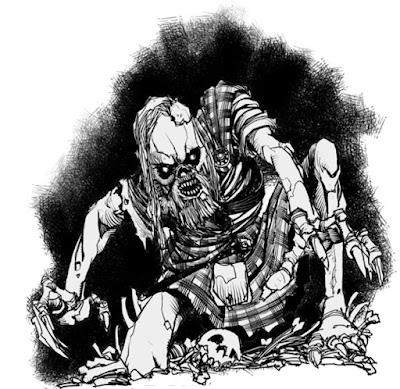

In the course of their explorations, the adventurers are attacked by four terrible ghouls! Kiren is battered badly and knocked out while Einar severs the fingers of three different ghoul hands. (The elf considers renaming his sword “Finger Cleaver” because of this.) Einar and Miranda stand guard by the unconscious dwarf, waiting for him to recover. Eventually, after seven hours of rest, Kiren awakens. He uses some herbs and magic to recover further. 

After some additional exploration the heroes find the true Warden’s pendant. They also find some tapestries that portray the events immediately after the final Great Battle on Urdor at the end of the First Age of Humanity, a thousand years ago. These include the granting of Misty Vale to men, the Green Elves gifting the Warden’s pendant to Aelfwine, and the departure of the Green Elves from the Cursed Lands

Worried about encountering Wulfric’s forces in their weakened state, Kiren, Einar, and Miranda leave the Warden’s Mound and head west to the Tower of the Morning Star. They travel through the night and reach the tower early the next day. While tired, the adventurers are pleased with their success. They have: 
  • Solved the mystery of the “Beast of the Lake.”
  • Completed the quest given to them a month ago by the ghost of Prince Berethil.
  • Recovered the Elfstone of Queen Blàithnaid.
  • Recovered the true Warden’s pendant.
  • Obtained the powerful magical sword “the Queen’s Thorn.”
Truly, Kiren and Einar have travelled far on the difficult path to greatness!


Notes:
  • As always, all posts relevant to this campaign and setting are available at this master page.
  • The map of the "Cursed Lands" is from the larger map of "Ardor" by Peter Fenlon (produced for the old ICE campaign module, The Court of Ardor). I've added some locations to the map.
  • I drew the map of "Misty Vale" but most of the locations on it are taken from the adventure in the Against the Darkmaster core rulebook.
  • The adventure described in this post is based on the "Shadows of the Northern Woods" mini-campaign in the core VsD rulebook. It was heavily modified to fit with my campaign and setting.
  • All of the pictures in this post are taken from the core VsD rulebook.  

17 June 2025

Reflections on Middle-earth Roleplaying, Rolemaster, Against the Darkmaster, and Art

Back when I was a young lad and able to devote much of my time to role-playing games (late middle-school and high-school), I tried out a wide variety of different systems. Naturally, Dungeons and Dragons – and especially first edition AD&D – was a primary focus, given that it was the great colossus in the hobby during the 1980s, and everyone was familiar with it. But my friends and I also explored other games. We used our allowance money to try out alternatives like Dragonquest, Runequest, Thieves’ Guild, Traveller, Star Frontiers, and others. But our focus remained AD&D; it was the game with which we actually tried to play proper “campaigns” – usually failing for one reason or another, often with “total party kills” consciously or subconsciously engineered by tired or frustrated DMs. In contrast, we typically drifted away from the other systems after a couple of sessions. 

About halfway through high-school, though, my group – and especially me in my capacity as Game Master – shifted to Middle-earth Roleplaying (“MERP”). We still played other games – such as Call of Cthulhu and GURPS – but MERP became our main focus. My first “proper” campaign was one that I ran over a summer using MERP. The characters successfully completed a major quest and did some interesting things before my immaturity sadly led me to make some bad decisions that eventually caused the end of the campaign. Nonetheless, I remember it fondly, and parts of it vividly, even after all these years (almost four decades!).


Eventually we tried out Rolemaster as well. And although there were things about it that we liked, it proved less easy to use in play than the comparatively streamlined MERP. Sometimes we ‘mixed-and-matched’ things from the two systems, which was easy to do since MERP was a simplified “Tolkien-ized” version of Rolemaster (the relation between the two systems resembled that of Basic/Expert D&D and AD&D). In particular, the players used the individual weapon charts from Arms Law and spell charts from Spell Law, whereas I relied on the more general charts from MERP as GM. 

I continued to occasionally buy MERP and Rolemaster books even when I went to university and stopped playing RPGs regularly for a while. The Shadow World setting, by the highly creative Terry Amthor, especially intrigued me, although I never ran a campaign set in it. I bought the Rolemaster Companions as they were published and spent many hours daydreaming about the numerous options they provided (many of which, I recognized even at the time, were ill-conceived). However, the Middle-earth material remained my favourite. 

Given my longstanding interest in Rolemaster, I had known for many years that a new edition was in the works. This new version was ambitiously entitled “Rolemaster Unified” (“RMU”). It promised to “unite” elements of second edition Rolemaster (“RM2e”), the version that was dominant throughout the 1980s and into the early 1990s (later fixed up slightly and republished as Rolemaster Classic [“RMC”] around 2007) and Rolemaster the Standard System (“RMSS”), the even-more-complicated version that was published in the 1990s (a truncated version of which was later published in a single hardcover book, Rolemaster Fantasy Role-playing, with expansion books to cover the rest of system). I won’t delve into the edition differences here, most of which I have forgotten over the years. My perception is the RM2e/RMC remained more popular overall, but that RMSS had (and perhaps still has) strong advocates. Personally, after trying to GM some RMSS sessions about 25 years ago, I concluded that I preferred RM2e/RMC, and preferred MERP to both. 

In any case, given my gaming history, I was curious to see what the new version of Rolemaster – RMU – looked like. So, I recently checked out the products at DrivethruRPG. Alas, my curiosity was quickly extinguished. One reason was the price. Four PDFs are needed for the complete game, each of which is quite expensive. Given that I currently am quite happy with Against the Darkmaster (“VsD”) for this kind of game, and was simply curious about the new edition, my reaction was “no thanks.” (The complete rulebook for VsD in PDF is only one quarter the price of the four PDFs needed to play RMU.)

But just as much of a turn off as the price for RMU was the cover art. I would much prefer blank covers than ones graced with those pictures. I sincerely hope that the artist never reads this post, since I may come across as a bit mean here, but those covers are not ones that I would want to have to look at on a regular basis while playing a game every week.  

This made me reflect on the high quality of the art that characterized the main ICE (Iron Crown Enterprises) fantasy role-playing games – MERP and Rolemaster – during the company’s heyday from the mid-1980s to the early 1990s. That quality, for the most part, was due to the singular work of Angus McBride, whom I’ve praised many times at this blog in the past, including ranking him as one of the all-time greatest FRPG artists. 


That’s not to say that only McBride’s covers were excellent. The cover for the early UK edition of MERP was by Chris Achilleos and expressed a “metal” vision of Middle-earth better than anything else I’ve ever seen. (I remember seeing this cover in an advertisement in the UK gaming magazine White Dwarf back in the day and being bitter that I couldn’t purchase that version of the game in Canada.)

Also with respect to ICE’s Middle-earth line, the map artwork of Peter Fenlon was very important to me (and Fenlon is another artist whom I’ve praised here). Indeed, I spent hours just looking at Fenlon’s maps, thinking about how to detail the various locations on them (at least those that were not already described in the relevant Middle-earth setting books). I continue to cherish and use them to this day.


I actually started playing MERP before McBride started providing the covers for the line – although not before Fenlon started making the maps, as he was with the company from the start – so I don’t think my fondness for MERP was entirely due to the art. But I remember seeing McBride’s covers gracing the new MERP books and I can’t deny that they motivated me to buy a few more over the years than I would’ve otherwise. Certainly Middle-earth in my mind’s eye became infused with McBride’s vision of the world – and remains so even to this day.

I’ve mentioned before at this blog that I regard Against the Darkmaster (VsD) to be a worthy successor to MERP. It is not a “clone” – it changes too many things for it to be classified as such. But it is close enough to be readily compatible with MERP. I have had no difficulty in using elements of my MERP collection in both of my current VsD campaigns. 

In addition to its rules, VsD is also a worthy successor to MERP with respect to its art. The cover art for the core rulebook by Andrea Piparo is beautiful. 

The interior art for VsD is also of a very high quality. And I noticed an homage to one of my favourite McBride covers. (Unfortunately, I do not know which artist is responsible for the black and white picture below. The artists credited for the interior art are: Francesco Saverio Ferrara, Tommaso Galmacci, Rich Longmore, Heraldo Mussolini, Andrea Piparo, and Marcin Ściolny. The McBride picture was originally used for the Lost Realm of Cardolan module, and later used for the large Arnor book, which combined material from several earlier modules, including Cardolan.)


Well, this has been something of a rambling post. I guess that if I were to try to summarize my “key points” they would be:

  1. I liked MERP and Rolemaster (2nd edition) back in the day.
  2. Both MERP and Rolemaster, at least after the early days of ICE, benefitted from excellent cover art (primarily by Angus McBride). MERP also benefitted from amazing maps by Peter Fenlon. (The official RM setting, Shadow World, unfortunately did not enjoy as impressive cover or map art.)
  3. The cover art for the new version of Rolemaster (RMU) is not that great, in my view. The core rules also are quite expensive (even as PDFs). So I’m passing on RMU, at least for the time being.
  4. The rules for VsD are inspired heavily by MERP – and hence rock. The art for VsD is excellent as well. So I’m quite happy with the game overall – mechanically and aesthetically. 

Namárië!

Blog Archive

About Me

My photo
I'm a Canadian political philosopher who lives primarily in Toronto but teaches in Milwaukee (sometimes in person, sometimes online).