Showing posts with label Dungeons and Dragons. Show all posts

23 July 2026

My Top-5 Roleplaying Games of All Time

Over at the “RPG Pub” there is a thread asking people to post their top-five favourite role-playing games of all time.

Here’s my list. Reflecting on the role-playing games that I’ve played over the past forty-five years or so, I’d say that my top five have to be the following:

Middle-earth Roleplaying (MERP)/Against the Darkmaster (VsD)


My first “real” campaign involved MERP and ICE’s beautiful maps and detailed campaign modules. MERP – and its descendant VsD – captures what I like the most about Rolemaster – the flexible class-based character development system; the detailed, vivid critical hit charts; the overall coherent rules framework – but without the large volume of charts and details that (IME) bogged down RM in actual play.

Some of my fondest memories of playing RPGs involve MERP and my two favourite campaigns of all time as GM (one still ongoing) use VsD.

Mythras 


I started playing this in 2011 – back when it was still being published by Mongoose and was called RuneQuest II (i.e., MRQII) – and haven’t stopped since. I’ve played in campaigns set in the Young Kingdoms (“Elric”), Mythic Britain, Mythic Babylon, Beyond the Mountains of Madness (the CoC campaign adapted to Mythras), and now Lyonesse, as well as in several “one-shots” or short campaigns (Mythic Greece, Luther Arkwright, Meeros, etc.). A really excellent system overall.

Call of Cthulhu


I haven’t played CoC since 2017 and I’m in no rush to do so again soon. But I’ve run a lot of CoC over the years – almost always as GM (er, “Keeper”) – and I’ve always really enjoyed it. I’m pretty sure it’s the game I’ve run the third most often (after MERP/VsD and AD&D). The scenarios are generally excellent (although some needed work). My only regret is that I have yet to run one of the “classic” campaigns for it (although I did play through BMoM using Mythras).

Dungeons & Dragons/Advanced Dungeons & Dragons (TSR era)


Like most RPGers, I started with D&D and spent a lot of my early gaming days (the early 1980s) playing and running AD&D (and I’ve returned to it from time to time since then). Reading Gygax’s hardbound volumes not only improved my vocabulary as a wee lad, but also sparked my imagination. They were the works of a disorganized creative genius. I still treasure the classic modules from that era as well. Although aspects of the system never failed to frustrate me, the game will always have a special place in my heart.

Stormbringer/Elric!/Hawkmoon/Corum 
(i.e., BRP “Eternal Champions” games)


I don’t really have any interest in running these BRP RPGs now – Mythras has largely filled that space for me – but I still have these books and really enjoyed these (closely related) games back in the day. 

There are other games that I like and other games I hope to try – but these are the games that I consider my all-time favourites.

Feel free to post your "top-5" lists in the comments, if you like. I'd be curious to learn what games have stood "the test of time" for you.


03 March 2026

What roleplaying games are you playing now? What games do you want to play?

I've been writing this blog for almost seventeen years now. Yet I've rarely addressed any questions to you, the human beings who look at these posts from time to time. But I'm curious about who actually visits this place (aside from the bots). I'm interested to know what game(s) you play. 

As I explained in my previous post, the roleplaying games that I've been playing have shifted over the past two decades. Early on, I was focused primarily on "Old School Renaissance" games like Swords and Wizardry (and developed some house rules for it, many of which were later integrated into Crypts & Things, which I also played back in the day) and 1st edition Advanced Dungeons & Dragons/OSRIC. I also occasionally ran Call of Cthulhu

Then, in spring 2011, I started playing in a "Young Kingdoms campaign" that used the Runequest II (MRQII) rules. (How could I refuse? The Gamemaster was one of the co-authors of the system!) This started a long period -- continuing to this day with Lyonesse -- of playing versions of the game that is now called Mythras (MRQII and Runequest 6 were the immediate ancestors of Mythras -- all written by Lawrence Whitaker and Pete Nash). I also continued to run Call of Cthulhu from time to time (winding up a sporadic campaign in 2017). And in 2017-2018 I ran an Adventures in Middle-earth campaign.

For a few years I ran a campaign using Dungeons & Dragons 5th edition in the "Gygax version" of the World of Greyhawk. (I eventually switched to the 5e-based Into the Unknown system, but ItU is close enough to 5e that I regard the whole campaign as my "5e" one.) I wanted to properly "try out" the current version of D&D and we ended up continuing until the characters reached 6th level. While that campaign was fun, I realized by the end of it that I had no desire to ever run 5e D&D again, at least for an extended period of time (I did run a couple of sessions of 5e for some kids last fall -- one of my few "charitable acts" as a RPGer).

Over the past few years, as GM, I've primarily run Against the Darkmaster. One campaign, set in Middle-earth, wrapped up a few months ago (although I have a "epilogue" set of adventures planned for the same characters sometime in the future). The other, set in my homebrew world of "Ukrasia," is still going strong. 

So these days, I mainly GM Against the Darkmaster and I mainly play Mythras (I'm leaving out various "one shots" of different systems here). I would like to try out Dragonbane sometime, as it strikes me as similar to Mythras in many ways but is much "lighter" in terms of both rules and tone (the similarity shouldn't be that surprising, since both games are descendants of the "Basic Roleplaying" system created by Chaosium almost five decades ago). 

What about you? What games do you play these days, either as GM or player? What game(s) do you want to play?


28 February 2026

There and Back Again: My Circular Role-playing Journey

I’ve talked about my personal history with the ‘Old School Renaissance’ or ‘Old School Revival’ (OSR) in the past at this blog (e.g., see this post from 2022). But some reflection on the games that I’ve been playing in recent years has prompted me to scribble some further thoughts. (My apologies for being a bit self-indulgent here …)

[Saruman by Angus McBride]

It’s been an interesting journey. I was ‘floating around’ at various role-playing games fora during the early days of the OSR over two decades ago. Disappointment with 3rd edition Dungeons & Dragons – and nostalgia for my early days of gaming – led me to dig out (and in some cases repurchase) my old Advanced Dungeons & Dragons, Basic/Expert Dungeons & Dragons, Rules Cyclopaedia D&D, and other out-of-print RPG books. I was excited – and later disappointed – by Castles & Crusades in its early days. (I wrote positive reviews at RPG.net of both the C&C box set and Players’ Handbook, but eventually came to find the atrocious editing by Troll Lord Games intolerable.)  

I started this blog in 2009 in order to post some rules ideas for Swords & Wizardry (S&W). Some of my ‘swords and sorcery’ house rules for S&W appeared in early issues of Fight On! and Knockspell. Eventually, many of those rules were incorporated into Crypts and Things. So I guess that I contributed – albeit in a small way – to the creation of OSR “stuff,” at least early on. 

But I haven’t really been that engaged with the OSR for about a decade now. I still follow it to some extent. I mean, I have Dolmenwood and Shadowdark, as well as the more recent versions of S&W, and a few other things. I’ve backed the forthcoming ‘3rd edition’ of OSRIC (the original “retro-clone,” in this case of 1980 AD&D). While I regret some of my purchases, overall I find that there are still interesting things being produced. But I don’t really use any OSR (by which I mean here ‘TSR D&D-derived’) systems anymore, and haven’t for years. They just don’t appeal to me that much these days. I think that, given my tastes, there are superior alternatives available. I guess I shouldn’t be surprised by this. I sort of thought the same thing about AD&D/D&D around 1985.

Almost all my gaming these days involve either Mythras or Against the Darkmaster (but sometimes my groups will play ‘one shots’ of other things, e.g., Mothership or Delta Green, and I’d like to run some Dragonbane someday). I find these systems more satisfying overall than any version of D&D (TSR, OSR, 3e, 5e, whatever). I guess I’m not a ‘rules lite’ person after all. In retrospect, I think that I thought that about myself only because I found running 3e D&D to be such a tedious chore. 

Of course, both Mythras and Against the Darkmaster are descendants of other ‘old school’ systems: Chaosium’s Basic Roleplaying (Runequest, Stormbringer, and the like) in the case of Mythras, and Iron Crown Enterprise’s Middle-earth Roleplaying (itself a simplified version of 2nd edition Rolemaster), in the case of Against the Darkmaster. So, I guess they're kind of ‘OSR’ systems as well (but not if we adhere to the “OSR = derived from TSR AD&D/D&D” definition). 

I can’t help but be struck by the extent to which my personal gaming history has repeated itself: dissatisfaction with AD&D/D&D led me to move to Middle-earth Roleplaying (MERP) and Basic Roleplaying (BRP), including Call of Cthulhu, Hawkmoon, and Stormbringer, in the mid-late 1980s. And about three decades later the same thing happened with OSR D&D and 5e D&D. Hopefully I've learned my lesson and won’t go through this cycle again.

As an aside, one thing that makes me think of the old MERP campaign modules as "old school" in nature is that – whatever their other faults – they were effectively “sandboxes” (as I explain here). They described a number of locations, some in detail, and provided advice for GMs on how to provide "hooks" for players. There were a few “adventure modules” for MERP – books with 3 adventures (usually aimed at levels, 1, 3, and 5) – but even those were pretty loose for the most part (generally they provided a setting and a situation), not “railroad” adventures. So, after my first several years with AD&D, a lot of my GMing involved using and running Middle-earth “sandbox” campaigns, although of course that term was not used in those days (at least to my knowledge). Indeed, I vividly recall comparing my MERP modules to TSR's Dragonlance series around 1986 or 1987, and noting how little room for improvisation or player freedom the latter allowed.

Anyhow, to the extent I was still involved in the hobby during the 1990s, the games I followed were those that came out earlier, especially MERP and Stormbringer (the latter revised and renamed Elric! during that decade). I remember visiting gaming stores in the 1990s and being a bit baffled and even put off by all the “goth” stuff. I never got into Vampire and the like (just as I never got into the Magic craze.) When D&D 3e came out, I was excited by it because it seemed to “improve” D&D by including certain things from other systems that I liked (e.g., skills). In play, though, I came to loathe the system after two year-long campaigns, and so was primed for the OSR when it happened.

Of course, had I been sensible, I would’ve just kept playing MERP, Call of Cthulhu, Stormbringer, and similar older games – and just ignored the hype around 3e D&D and the “d20” universe in the early 2000s. These days, for the most part, I’m happy to stick with my “d100” games, Mythras and Against the Darkmaster. Wisdom, I hope, comes with age.

19 October 2025

To Do List: Middle-earth and Greyhawk campaign notes; a new Lyonesse character

I’ve sadly neglected this blog over the past two months. But I have not been (entirely) idle – indeed, I’ve been quite busy running my two campaigns. 

[The Witch-King by Liz Danforth]

One of them – Against the Witch-King – wrapped up two weeks ago. Or more precisely, it’s now on hiatus. A suitably epic conclusion – an audience with King Arvedui of Arthedain, following the completion of many important tasks – has brought things to an end for the time being. But the campaign will resume nine years later in “game time” – after a (hopefully not as long) break in “real time.” The final session of the current part of the campaign took place in the spring of 1965 of the Third Age; the campaign will resume (after the break) in early 1974. The characters all accomplished what they set out to do (a year earlier in game time; over two years ago in real time). But, as those of you familiar with the history of Middle-earth likely know, things become a bit “intense” in Eriador in 1974! So, while I need a rest from running this campaign, I’m determined to resume it at some point to see how Angmar’s final assault plays out.

Depressingly, I’ve fallen far behind in my campaign logs for both of the campaigns that I’ve been running over the past two-plus years, and especially for my Middle-earth one. Instead of writing entries as detailed as the first two for the Against the Witch-King campaign (1 and 2), I’ll try to write a brief overview of what happened, something like what I did when I encountered a similar problem (falling hopelessly behind) in my earlier Middle-earth campaign.

I really don’t like leaving my campaign logs unfinished! Even a truncated summary of what happened in the adventures is better than just leaving it incomplete – for my own future recollection, if nothing else, although I hope that at least a few other people might find the logs interesting. 

This thought reminds me that I never finished the log for the Greyhawk Classics campaign that I ran a few years ago. While running that campaign made me realize that I rather dislike the 5th edition Dungeons & Dragons system, the role-playing aspects of the campaign were nonetheless a lot of fun, and I really should explain how everything wrapped up – including why ultimately the characters never actually went into the Temple of Elemental Evil.

[A modified portion of Darlene's famous World of Greyhawk map.]

The Against the Witch-King group will soon be starting a new campaign, using the Lyonesse system and setting (the system is an adaptation of Mythras). I’m quite excited about this – not only because it’ll be nice to have the opportunity to be a player again (while still running my other campaign), but also because Jack Vance’s Lyonesse trilogy is one of my all-time favourites. I’m presently putting the final touches on a rather fun and intriguing character – a former apprentice of the dreadful wizard Tamurello. If you’re curious about the game, here is a brief interview with one of the authors (and my GM) Lawrence Whitaker. 

[The wizard Tamurello from the Lyonesse RPG book]

Vancian times ahead!


18 February 2025

‘Level Up’ exhibit at the Chicago Writers Museum

While Toronto is my ‘home base’ these days, as my wife and I own a condo there (and her job is based there), I also currently live part of the time in Chicago due to work (until the end of 2025, barring some catastrophe). Last weekend my wife was visiting Chicago, and by chance we discovered that it was a “free Sunday” at the American Writers Museum (located at 180 North Michigan Avenue – about a fifteen minute walk north of my present “crash pad”).

The museum currently has a special exhibit called “Level Up.” Here’s the description:
“Our special exhibit, Level Up: Writers & Gamers, explores how Americans use role-playing and video games to define and respond to our culture. The exhibit guides visitors into the world of game writing, from the 1970s to the present. Some of the games featured include Dungeons & Dragons, Zork, Apocalypse World, Baldur’s Gate III, and game writers from the last 50 years such as Michael Pondsmith, Porpentine, and Tanya DePass.” 
 The exhibit was small but had some artifacts of note:


It looks like this set was once owned by Terry Kuntz (older brother of Rob Kuntz).


The good old Holmes Basic Set – the game that started it all for me!


Anyhow, the exhibit runs until 5 May 2025. More information can be found here. If you’re in Chicago and have some time to kill, I recommend checking it out.

07 October 2024

Sale on issues 1-14 of Fight On!


As recently announced here, the Old School Renaissance fanzine Fight On! has returned to publication after a long sabbatical.

If you are missing PDF versions of the first run, issues 1-14, they currently are available in a bundle at Drivethru RPG for 50 percent off (34.99 USD). The sale will run until this Saturday (12 October 2024).

It’s great to have Fight On! back with us … and fighting on! 


30 September 2024

My grievances concerning 5th edition Dungeons and Dragons: a final statement


Let me start with some background about what “fantasy” means to me and hence what I generally look for in fantasy role-playing games (FRPGs).

I saw The Lord of the Rings animated movie when I was 9 or 10 at a repertory theatre. Then I read The Hobbit. That got me really interested in fantasy stuff. It’s what motivated me to then ask my parents for the Dungeons and Dragons Basic Set for my birthday. (It was the one written by Dr. Holmes – hence it had those annoying chits instead of dice.)


As an adolescent I became interested in other works of fantasy – especially, in the early-mid 1980s, Michael Moorcock and Robert E. Howard (along with a lot of related pastiche “Conan” stories) – because of D&D and AD&D. The “Melnibonéan Mythos” in the Deitites and Demigods was one of my favourites in the book even before I read anything by Moorcock. 
 

Given these influences, I would say that Tolkien, Moorcock, and Howard had the most influence in shaping how I interpreted D&D/AD&D when I got into FRPGs in the early-mid 1980s. (I eventually would go on to play games directly based on the writings of Tolkien and Moorcock; indeed, these eventually supplanted AD&D in my high-school group.) Perhaps this is why – more than any particular set of rules – the more recent Wizards of the Coast versions of the game leave me cold. Over the past 25 years the game has felt more like “fantasy superheroes” than the kind of fiction that I had associated with it – and, I suppose, still do, when I think of “classic D&D.”

Turning to my experience running a “World of Greyhawk” campaign using the fifth edition rules – and leaving aside the game’s overall “ethos” and “aesthetics” (including its unfortunate recent turn towards “twee”) – there are three elements of the game that especially came to vex me:

a. Its “superhero” “no-wounds-are-serious” system of rest and recovery

b. Its “unmagical” magic system; and

c. Its flavourless, often tedious combat system.

(For further explanation of each of these points, go to the posts to which I’ve linked above.)

I recently managed to sell most of my WotC 5e D&D collection (I kept the core rules and a few books I liked, such as Saltmarsh and Yawning Portal). I used a local used bookstore for the sake of convenience. It felt good to free up the shelf space. I don't know why I bothered getting most of those books originally – even when I was playing 5e, I barely used most of them. (I stopped buying WotC stuff years ago when I realized this, as well as the declining quality of the line.)

I will say this for 5e D&D: it’s far better than 3e was. I mean, if 5e D&D were the only FRPG available, I would play it – whereas I would just abandon the hobby if 3e was the only option. And I would not rule out occasionally playing 5e D&D in the future (say, running a game for a friend’s kids or something like that). And I would be happy to play the Middle-earth variant, The Lord of the Rings RPG (indeed, I greatly enjoyed that game’s predecessor, Adventures in Middle-earth, having run a successful campaign about seven years ago).

But as for my “main” FRPG, I’ll never use 5e D&D again. Hence, I don’t have any interest in the new 2024 books. There are just too many superior alternatives (including, of course, earlier editions of D&D/AD&D, and related “retro-clones” and “near clones”).


16 August 2024

Combat should be interesting


Combat obviously is an important element in most fantasy role-playing games. At its best, it’s exciting and dramatic. After all, the protagonists’ lives are at risk! And surprising things can happen – either because of chance (the rolls of the dice) or because of players’ inventiveness (or even inspiration on the part of the Game Master in the midst of a session). 

In the two campaigns that I currently am running – both using the Against the Darkmaster (VsD) system, one set in Middle-earth, the other in my home setting of Ukrasia – I rarely have more than one combat in any given session. Thanks to its “critical hits” system, combat in VsD can easily become quite deadly or debilitating, so players tend to avoid it when possible. Hence, two or more sessions (if not more) typically will pass between combats. I like this kind of pacing, as it ensures that when combat does take place, it is noteworthy and memorable.  

The two games that I play the most these days – VsD and Mythras – both have involved and colourful combat systems. While VsD has vivid critical hits, fumbles, and the like, Mythras has hit locations and exciting “special effects” (previously called “combat manoeuvres”) that allow for a wide range of tactical options, including defensive ones. They definitely are not “rules light” systems! 

Almost two decades ago (!), when I finally realized that I disliked 3rd edition Dungeons and Dragons, I thought that that was because I disliked “rules heavy” FRPGs. But that wasn’t really the case. I’ve always liked certain “rules heavy” – or at least “rules medium” – systems, like Middle-earth Roleplaying and Stormbringer. What I disliked was how tedious the rules for 3e D&D were – both in terms of prep work and its combat system. Running and playing 3e D&D involved a lot of work – and there was very little pay-off for that, as combats in 3e were frequent but usually quite boring. For the most part, characters and their opponents were “blocks of hit points” that would be chipped away during combats that involved a lot of rather flavourless options (and ubiquitous, bland “attacks of opportunity”). 

The problem isn’t nearly as bad in 5th edition Dungeons and Dragons. But it’s still there: the game assumes that combat is common (which the DM can ignore, of course) and that it rarely threatens the lives of the characters (thanks to all their abilities, inflated hit points, “death saves,” and the like). (Yes, there are options to make the game more “gritty” and deadly hidden in the Dungeon Master's Guide, but the default mode is very much “fantasy superheroes,” wherein player characters rarely face serious risks.) Combat in 5e D&D is pretty dull in my experience – at least when compared to the alternatives with which I am familiar, such as Mythras and VsD.

So what my recent 5e D&D campaign taught me was that what I dislike are “rules heavy” or “rules medium” systems in which combat is insipid and (usually) not that risky (at least to the characters). I had to work hard to ensure that at least some of the combats in my campaign were novel. In contrast, no such work is needed for Mythras or VsD, given the intrinsic qualities of those combat systems. Even an encounter with some “vanilla” bandits or orcs can be risky and interesting.

That said, sometimes one doesn’t want to engage in a lot of book-keeping when running a game. That’s certainly fine. This is where older (TSR era) editions of D&D and AD&D shine (at least when one isn’t using all the rules outlined by Gary Gyax in the AD&D rules – which almost no one ever did or does). In old school D&D (and associated “retro-clones” like Swords and Wizardry, OSRIC, and Crypts & Things), combat is fast. So while it lacks the colourfulness and tactical depth of other systems, at least it rarely takes more than 20 minutes to resolve (unlike even trivial combats in 3e or 5e D&D). And of course, combat can be more deadly in older versions of D&D, given the lower hit points of characters, the absence of “death saves,” the relative rarity of healing spells, etc.

In short, my view is that combat should be either interesting or fast. One of my gripes with 5th edition D&D is that combat typically is neither (although sometimes it can be), at least in comparison to the other FRPGs that I play.  


30 July 2024

Fight On! Is Back

In the early days of this blog, when the “Old School Renaissance” scene was full of vim and vigour, a major player was the fanzine Fight On! It was a wonderful, eclectic, and somewhat chaotic journal, filled with fun scenarios, monsters, optional rules, and the like. I happily contributed a couple of articles back in the day (“Background Professions” to #5 and “The Duchy of Briz” to #7).

After a decade of enchanted sleep, Fight On! is back with issue #15. Here’s the blurb from the editor Ignatius Umlaut:

Ten years later, we are back from the dead to Fight On once more! These revenant runes are just as jam-packed as you remember with classes, monsters, spells, magic items, rules mods, homebrews, and awesome adventures in the spirit of the eldritch era of fantasy roleplaying! Dedicated to seventies D&D legend J. Eric Holmes, this issue brings together old and new stalwarts alike to celebrate our 15th issue and new beginning! With art and articles by J. Eric and Christopher Holmes, Tom Gordon, Calithena, Gabor Lux, Jeff Rients, James Maliszewski, Kesher, Pete Mullen, Cameron Hawkey, Zach Howard, Alex Schroder, Richard Rittenhouse, Settembrini, Patrick Farley, Jason Sholtis, Robert Conley, Kelvin Green, Philipp H., Attronarch, Mitzi!, and many more, this is the first of our new forays into fanzine fame and glory! Ride that wyvern while the sun is shining, and keep Fighting On!

My life with roleplaying games started with Dr. J. Eric Holmes’s Basic Dungeons & Dragons set back in 1980 (the one with chits instead of dice). So I’m especially keen to check out this issue!


[Picture by Peter Mullen from FO! 15]


24 June 2024

Dungeons and Dragons 2024: the Twee Edition

This picture of the Dungeon Master’s “tracking sheets” for the forthcoming 2024 version of Dungeons and Dragons (edition 5.5?) pretty much confirms that this incarnation of the game is not for me:


A happy cute pink beholder adorning a “Campaign Expectations” sheet, which includes “Potentially Sensitive Elements” and “Player Hopes and Expectations.” Ugh.

Okay, to be fair, not all the new art is “twee” like this.  

But as I’ve said before here, I'm done with the current version of D&D. I had a fun time running a 5th edition D&D campaign – but that was despite the system not because of it. (And I ended up using some significant house rules to make it tolerable.) However, I will give 5e credit for being a lot less tedious than 3e.

Thankfully, neither of my two gaming groups is that interested in playing 5e (or 5.5e or whatever the 2024 “revision” ends up being called) D&D. One group includes a few people who actively dislike D&D (all versions) while the other group includes people who like 5e but are happy to play other things instead. So, unless I end up running some contemporary D&D as a favour for someone outside of my regular gaming groups in the future, I’m done with the Wizards of the Coast versions of the game. 

I haven’t bought a new WotC D&D book in a few years now, as their quality seemed to decline sometime after Ghosts of Saltmarsh. The 2024 revisions look pointless to me. I understand the need to make $$$, but the changes (to my knowledge) move the game even further away from what I want.

(I'll confess that I’m mildly curious to see what is done with the “World of Greyhawk” in the Dungeon Master’s Guide. But I certainly don't "need" any more Greyhawk material.)

Anyhow, if you want some more information about the new versions of the core rulebooks, this article provides an overview (it includes some of the new art as well).

17 May 2024

Greyhawk to appear in the 2024 Dungeon Master’s Guide

Eight months ago, I wrapped up a campaign set in Gary Gygax’s version of the World of Greyhawk (specifically, the version found in the 1983 box set).* I used the 5th edition rules for Dungeons and Dragons for the campaign (initially the rules more or less “as written” in the 2014 books; later, the Into the Unknown variant of 5e D&D, with some house rules for sake of continuity and the Greyhawk setting). Although the campaign was great fun, I realized about halfway through it that I did not care at all for the 5th edition rules, and hence concluded the campaign much earlier than I had originally planned (although it still ended in a satisfying way, I think). 

Since I don’t plan to run the current version of Dungeons and Dragons ever again, I have no interest in the “updated” 2024 editions of the core books. (According to Wizards of the Coast, this is not a “new edition,” so it’s not “6th edition” – I expect that it eventually will be called something like “edition 5.5,” but we’ll see.) In fact, I’m planning on selling off (or giving away) much of my 5e collection.

But to my surprise, the 2024 version of the Dungeon Master’s Guide will include an overview of the “World of Greyhawk” – along with a poster with maps of the Flannaes (the main region described in previous versions of the setting) and the City of Greyhawk. I had thought that we would not see any “new” version of the World of Greyhawk for the current incarnation of D&D (beyond adventures like those included in Ghosts of Saltmarsh and Tales of the Yawning Portal). However, it looks like I was wrong.

I still doubt that I’ll get the 2024 DMG. But now I’m not ruling it out entirely – it depends on how good the new Greyhawk material is. If the maps are nice, and the overview of the setting is interesting, perhaps I’ll consider picking up the book. 


* I have yet to write up the final installments of the campaign. I hope to do this over the next month or so. I also plan to write a post reflecting on the entire experience. Stay tuned!


03 May 2024

Swords and Wizardry Kickstarter: 3 days left

I’ve been swamped with work lately – hence no posts at all in April (which, I think, is the first time that I’ve missed an entire month since starting this blog almost fifteen years ago). Because of this, I almost missed the current Swords and Wizardry kickstarter. It includes optional supplemental rules for S&W, a book of new monsters, an adventure, and a referee's screen. There are only 3 days left!

Swords and Wizardry has a special place in my heart. It is what inspired me to start this blog many moons ago – specifically, I wanted to post my house rules online so that other people could check them out. (Some of those rules later were incorporated into Crypts and Things.)

So I like to support S&W whenever I can. Even though I’m not playing or running it right now, I very likely will do so again in the future. And the updated version of the rules is excellent!


19 March 2024

James M. Ward, RIP

TSR legend Jim Ward has passed away

I have many fond memories of poring over the entries in Deities & Demigods as a young teenager. The overviews of the "AD&D-ified" pantheons helped to get me interested in learning more about real world mythologies. Deities & Demigods also prompted me to check out the fiction of H.P. Lovecraft, Fritz Leiber, and Michael Moorcock.

Thanks for everything, mighty wizard Drawmij!

RIP


16 March 2024

OSRIC Player's Guide


There is a new Player’s Handbook -- er, Player's Guide -- for OSRIC (the “retro-clone” for first edition Advanced Dungeons and Dragons) available. The PDF is available for free here; paper versions are available on Amazon (Canada/US). 

OSRIC, of course, was the original retro-clone. Along with Basic Fantasy (which appeared around the same time), OSRIC helped to launch the “Old School Renaissance” almost two decades ago. 

The original OSRIC was not a proper ruleset; rather, it simply included the necessary information (tables and the like) to permit the publication of material (primarily modules) for 1e AD&D. Shortly after it originally appeared, however, OSRIC was fleshed out into a complete game. Since then, though, it has not been substantially updated. 

But there are now plans to revise it so that it (a) includes more material from the original Dungeon Master’s Guide (in particular, I think, material having to do with campaign-building and running) and (b) more closely resembles the 1st edition AD&D rules. (Since it was the original attempt at a retro-clone, OSRIC was cautious in replicating the original ruleset. Subsequent retro-clones, like Old School Essentials, have demonstrated that near complete fidelity to the originals is unproblematic. So hopefully half-elves will not be so horrible in the revised version of OSRIC.) 

I believe that there will be a kickstarter for the revised edition of OSRIC sometime next autumn. In the meantime, it’s great that there now is a very attractive player's book available. 

29 January 2024

Will Gygax’s Castle Greyhawk finally be published?


Almost two decades ago, Troll Lord Games ("TLG") began working with Gary Gygax to produce a version of his legendary “Castle Greyhawk” – renamed (for legal reasons) “Castle Zagyg” ("CZ"), after the mad wizard who created it. TLG began this grand endeavour by publishing a few new things concerning the surrounding (“not-Greyhawk”) territory, such as a regional folio and a large hardcover book describing the city of Yggsburgh. I purchased all the CZ products back in the day. Unfortunately, like most TLG products, they were quite poorly edited. Moreover, they weren’t directly based upon the original setting from the early 1970s, and were not especially noteworthy in my view (even ignoring the editing problems). Nonetheless, there was the promise that the famous dungeon would eventually appear, albeit in a modified “updated” form.

In 2008 Castle Zagyg: The Upper Works box set was published. It was co-authored by Jeffrey Talanian, as Gygax was in ill health at this point. My understanding (perhaps incorrect) is that Talanian was using Gygax’s notes and consulting regularly with him on the overall development of the dungeon, not just the initial box set. 

To my relief, Castle Zagyg: The Upper Works was reasonably well-done. I still own it and think that it’s a solid product. (For an informative and interesting PDF review by Greyhawk expert Grodog, go here.) But tragically, Gygax passed away in 2008, and the license for CZ subsequently was pulled from TLG. My understanding is that there was enough material completed by this time to produce further products in the line, but none of it would see the light of day.

Recently, though, TLG received permission to republish the Yggsburgh hardback, as well as some other things by Gygax. And now the green light has been given for them to develop and publish the rest of “Castle Zagyg”!

You can read the announcement from the TLG here.

Upon reading the announcement, two things stood out to me. 

First, it looks like the 2008 box set will not be republished, at least not in its original format. The Trolls write: “We’ve not yet settled on an organizational format but have settled on hardcover books with pockets in the back to hold the many maps that will come with this set.” Since the box set included the “Mouths of Madness” (it was one booklet among five), at least part of it will be published again. Perhaps the other five booklets will be part of the “Castle Ruins” volume (CZ Volume II)? (In any case, I’m [rather selfishly] pleased that the box set will not be republished, as it ensures that it will remain a rare “collector’s item” in the future.)

Second, while (I assume) it’s a good thing that Luke Gygax and James Ward are involved, as they have knowledge of the original dungeon, I did not see Jeffrey Talanian mentioned. Perhaps he was invited to take part in the resurrected project but declined, given that his focus these days presumably is on his own Hyperborea game. But if they are drawing upon the work that Talanian did with Gygax, I would think that he would get credit for that and be mentioned, no? It certainly would dampen my interest in this project if the team now working on it plans to ignore the work on the dungeon that had been completed up to 2008.

In any case, I’ll keep my eye on this. I’m curious to see what comes of it. 

(The picture of Zagyg above is by Jeff Easley and appeared in Dragon #70.)

Update (January 30th): It turns out that Jeffrey Talanian will be consulting on the project. From the TLG "Worlds of Gary Gygax" webpage: "we will be consulting with family members such as Ernie and Luke Gygax, and long time friends like James M. Ward and Jeffrery Talanian to make these works as close to Gary’s vision as we can."

My apologies for missing this in my initial post.

20 December 2023

Second Edition Advanced Dungeons and Dragons


Over at his Mythlands of Erce blog, Anders H* has a couple of amusing polemical posts defending the honour and goodness of second edition Advanced Dungeons and Dragons (part one concerns the rules; part two addresses the ‘culture’ of the game).

Second edition AD&D was an edition that I almost entirely skipped. I say “almost” because I played very briefly in a 2e campaign one summer around 1990. However, I never owned any 2e AD&D books during its lifecycle (I bought a few books for the Greyhawk and Planescape settings years later). I had drifted away from AD&D by the late 1980s and did not play role-playing games that regularly during the 1990s. To the extent that I did, it was stuff like MERP, Rolemaster, Call of Cthulhu, Hawkmoon, GURPS, and the like.

I eventually did “play” a lot of 2e AD&D, but only via various computer RPGs, namely, the “Infinity engine” Baldur's Gate games, Icewind Dale, and Planescape: Torment (the latter game motivated me to learn more about the Planescape setting, hence my subsequent purchase of the box set and a few other things). It didn't seem that different from 1e AD&D, at least in terms of the rules (the addition of “kits” seemed to be the main difference).

The hatred directed towards 2e by adherents of 1e AD&D (primarily from grognards grumbling on the internet – not that there’s anything wrong with that!) always struck me as primarily flavour-based. And I share their irritation with 2e’s “purging” of things like assassins, half-orcs, demons, devils, etc., (all things that eventually crept back into the game, however, during the 1990s). Also contributing to this sentiment was some bitterness about TSR’s treatment of Gary Gygax, and the unavoidable fact that 2e AD&D was the first “post-Gygax” version of the game. 

There are some rules differences between the two editions, of course, and in my view some favour 2e (e.g., the way thief skills were handled), others 1e (e.g., the presence of a distinct "illusionist" class). 

I much prefer the art in the original 1e AD&D books, especially the classic Dave Trampier Player’s Handbook cover. Overall, the 1e art seems “grittier” and less “family-friendly” than the 2e stuff. Trampier’s pictures often looked like etchings from some mysterious past (as did David Sutherland’s epic “Paladin in Hell”). Erol Otus’s pictures looked like visions of an alternate reality.  

But in terms of rules, I’m fine with 2e AD&D. I certainly prefer them over 3e (which I’ll never touch again), 4e (which I never played after reading halfway through the PHB), and 5e (which, admittedly, is the “least bad” of the post-TSR versions of AD&D/D&D, but still not my cup of tea). I'd be quite happy to play in a 2e campaign. But if I ever run an “old school” AD&D campaign again, it almost certainly would be (a house-ruled version of) Gygaxian 1e AD&D.

(*Note: Anders H is the author of the excellent Into the Unknown RPG, an “old school” variant of the 5e rules. Check it out! If you’re curious, I go over some of the main differences between ItU and 5e here.) 


03 December 2023

Swords and Wizardry special edition

Several weeks ago, I received the special edition of Swords and Wizardry - Revised Edition. It’s a beautiful book. I love the matte cover! If you like S&W, I recommend obtaining one for yourself, if possible.


For my overview of this version of S&W, go here.

26 November 2023

Erol Otus cover of Dragon Magazine now on my wall

I'm thrilled that I now have a framed print of the cover illustration by Erol Otus of the very first Dragon magazine that I ever owned (issue # 55) hanging on my wall:

The print is number 99 (out of 200) and signed Otus.

The original magazine cover:

The corner of my study:


25 November 2023

Eyes of a Catoblepas, Wings of an Owlbear (Greyhawk campaign)

PART 10: EYES OF A CATOBLEPAS, WINGS OF AN OWLBEAR

10.1 The Wood Elf Camp (Richfest 2nd – 3rd)

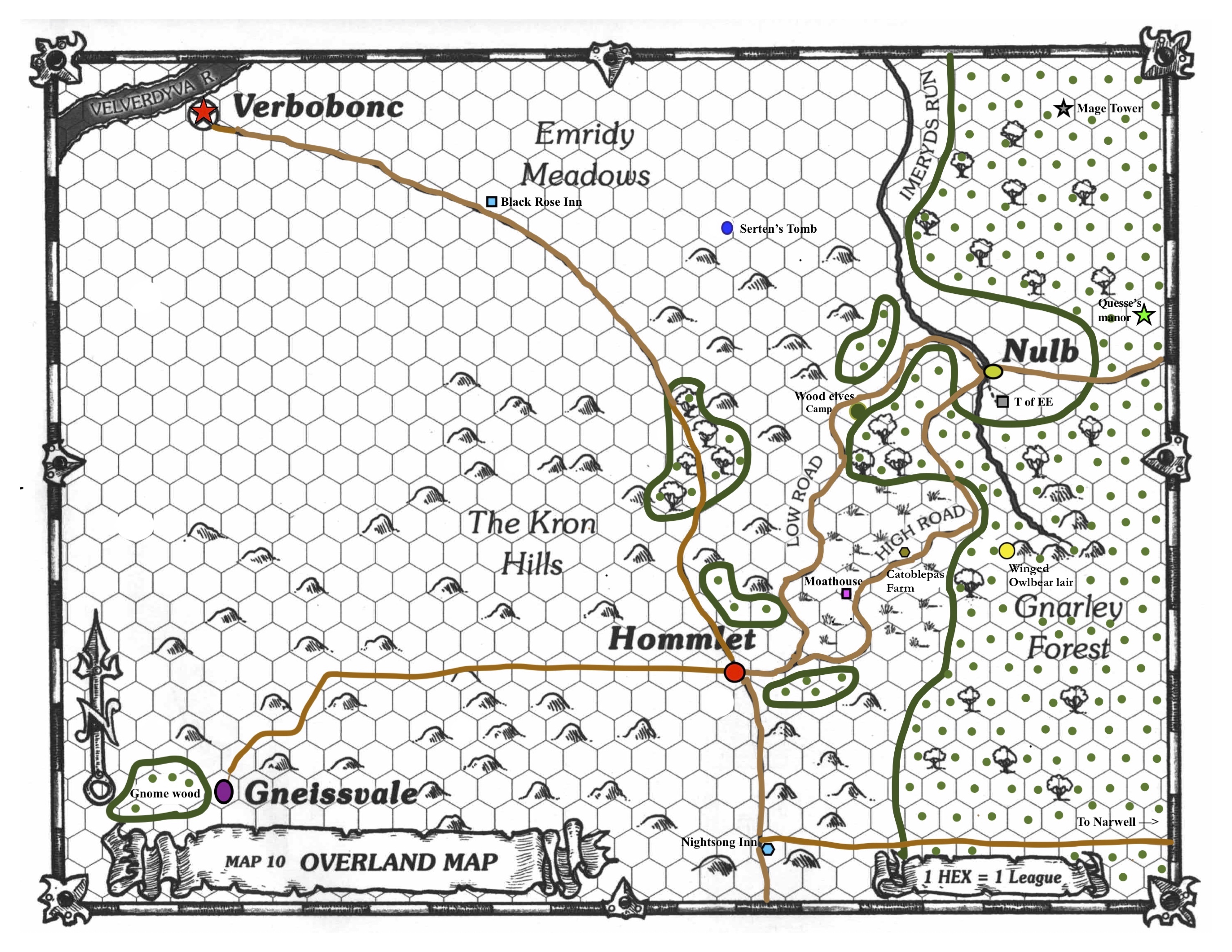
Our dauntless adventurers — Erik (the mountain dwarf fighter from the Lortmils), Althaea (the high elf wizard from the city of Tringlee), and the brothers Godric (the human rogue from the Barony of Shiboleth) and Cedric (the human cleric of St. Cuthbert) – journey to the Wood Elf camp after successfully exploring the Tomb of Serten

Erik decides to give the legendary Helm of Laga Vulin to Cedric. The dwarf is sad and reluctant to make this decision. Finding the helm had been his dream ever since he learned of its existence and its ability to cure the wearer of the effects of all poisons and toxins – including alcohol. He had hoped that finding it would enable him to indulge in hedonistic drunken excesses without suffering disabling hangovers. Alas, the helm also impresses a commitment to LAW in those who wear it, something that Erik ultimately could not accept. He figures that it would be far better for one already devoted to dour order, like the warrior priest Cedric, to make use of it.

After two days of journeying through the northern reaches of the Kron Hills (with their loyal mule Vick), the party reaches the Wood Elf camp. There the party meets with the band’s leader, the beautiful half-elf Tomyria.


Godric explains his quest to find the Manor of Quesse (a legendary half-elf roguish mage, and distant relation of Godric and Cedric). Tomyria informs the party that she knows where the manor is located, but will divulge this information only if the party recovers one of three items for her: 
- A gryphon egg (from a nest located somewhere to the southwest, in the Kron Hills).
- The eyes of a catoblepas (from an abandoned farmhouse to the south).
- The wings of a unique (mutant?) flying owlbear (likely nesting in some hills to the southeast).

She explains that her band is looking for these items for the reclusive mage Master Nyv (of the Mage Tower, located roughly 9 leagues north of Nulb).

That evening, the party makes merry with the high-spirited elves. Tomyria and Godric hook up, as do Althaea and the wood elf scout Urth. Cedric tries to share the wisdom of St. Cuthbert with the elves, but is roundly mocked by the boisterous followers of Rillifane Rallathil. Erik, free from the discipline of the Helm of Laga Vulin, drinks until he passes out in an unwholesome puddle. 

10.2 Some Harpies, a Catoblepas, and a Ghost (Richfest 4th – 7th)

The party decides to recover the catoblepas eyes after Tomyria offers some additional platinum pieces as an incentive. The half-elf band leader gives them a magical glass container for the creature’s deadly eyes.

The adventuring quartet then journeys to the abandoned farmhouse, which lies on the northern side of the High Road, a mere two leagues away from the accursed Moathouse. En route, the party is attacked by a trio of vicious harpies. Erik is momentarily charmed by their music, but a magic missile blast from Althaea knocks his senses back into him. Eventually, the party is triumphant over the monsters.


At the farmhouse the party hunts down the terrible catoblepas in a mire. It is a difficult battle, but the party slays the creature and recovers its malevolent eyes. Althaea places them in the magical glass container. The party also slays a giant spider that attacks them in the barn, and some giant centipedes in the cottage.

Later in the old cottage, the adventurers are approached by a silent ghost. The ghost attempts to possess Godric but fails. Cedric figures out that the ghost is not in fact hostile but is trying to communicate with the party. When Cedric invokes the name of St. Cuthbert, the ghost looks at the cleric with hope, and then leads the party to a withered corpse hidden outside. Apparently, the ghost was once the farmer here, but was slain by vile brigands and not given a proper burial. The party builds a cairn for the body, which Cedric consecrates with holy water. The ghost thanks the party and disappears, having crossed over to its proper afterlife. 

After this good deed, the party naturally decides to loot the place. They uncover some bloodstones, a potion of healing, and a slightly magical dagger.

On their journey back to the Wood Elf camp, the adventurers again encounter Darr the druid. Darr learns of the party’s plans to eventually go to Nulb, and tells them that Otis is an ally, and that Mother Screng is actually friendly and helpful, even if she does not seem so at first. Darr also confirms that there is a flying owlbear in the region – such creatures are unnatural, and the druid encourages the party to destroy it if they are so inclined.

Darr travels north with the party along the High Road but leaves them when the adventures head west back to the Wood Elf Camp.

Tomyria is profoundly grateful for the catoblepas eyes and tells the party where Quesse’s ruined manor is located. She provides additional “rewards” to Godric later that evening. 

10.3 Some Ankhegs and the Wings of an Owlbear (Reaping 1st – 5th)

Tomyria offers the party forty platinum pieces if they will perform another job for her. The greedy adventurers agree to obtain the owlbear wings. The half-elf then provides the party with two large sacks for the wings, along with a vial of preservation fluid. 

The party heads back into the Gnarley Forest to find the lair of the flying owlbear. During their search, they are surprised by some vicious ankhegs, but manage to defeat the burrowing beasts. 

As the party nears the hills within the dark woodland, they are attacked by the winged owlbear! It swoops down a number of times to attack, and the party at first has a hard time responding. But Althaea manages to bring the savage brute down using a “Web” spell to entangle its wings. Erik then somehow disembowels the owlbear with his staff of striking. The wings are removed, covered with preservation fluid, and placed in the great sacks strapped to Vick the mule.

The adventuring quintet explores the owlbear’s lair. Within, they find hidden amongst the vile debris and waste a gold ring. The ring turns out to be magical – it enables its wearer to magically jump great distances. Erik is thrilled by the item and implores his friends to let him have it. Since they pity the dwarf for how the helm turned out for him, they agree to his request. 

The party also finds a secret door at the back of the cave. Beyond is a smugglers’ den, long abandoned. The adventurers recover some unruined bolts of silk. A cask of fine dwarvish brandy also is obtained, but Erik drops it while drunkenly stumbling down the hill, and the fine liquor is lost forever. 

Upon returning the Wood Elf camp, Tomyria rewards the adventurers for the wings. She also gives them a key to the band’s cabin on the outskirts of Nulb. And once again, she grants Godric a “special reward” later that night.

10.4 A Visit to Nulb (Reaping 6th – 8th)

The party spends a couple of days in the nasty village of Nulb, staying at the Wood Elves’ cabin and doing their best to remain inconspicuous. 


While in the village they overhear some cultists speaking Abyssal in the Waterside Hostel. They also interact positively with Mother Screng – who reveals herself to be Canoness Y’dey of the Church of St. Cuthbert, assisted by the Elf Murfles. (Apparently the druid Darr had informed them of the party’s efforts in the Moathouse during his previous visit.) Y’dey fills the party in on their mission (namely, spying on the activities of the agents of the Temple of Elemental Evil within Nulb and the surrounding region) and the general activities of the “Iuzians” in the area. She also gives the party a jar of “Keoghtom’s Ointment” to help them in their fight against the forces of Chaotic Evil.

The adventurers then make contact with Otis, who is acting as a smith in the village. After discussing the sad fate of Otis’s brother Elmo, the four learn that Otis is an agent of Viscount Wilfrick of Verbobonc. Otis makes tea for all and mentions that he uses two owls as spies in the area.

Finally, the group visits the Curio Shop run by the mysterious half-elf Elris. They find a map of an ancient tomb (located somewhere in the Vast Swamp), a tome on the “History of the Free City of Greyhawk,” a rusty barbute helmet, and a gnarled walking stick with a crystal on the top. They purchase all these items. Later, Althaea discovers that the crystal is an “Ioun Stone of Sustenance” – a wondrous item that enables its user to survive indefinitely without food or drink. Erik is repulsed by the item – food and drink give meaning to his life – whereas Althaea is delighted by it.

The four decide that their next destination will be the Tower of Master Nyv


Notes:
  • The characters reached 5th level while resting near Nulb.
  • The picture of Tomyria is by Kim Sokol (found online). The monster pictures are from WotC. The map is from Goodman Games’ Temple of Elemental Evil book, with my additions. 
  • There are only two more log entries left for this campaign! (See the full list here.)


Blog Archive

About Me

My photo
I'm a Canadian political philosopher who lives primarily in Toronto but teaches in Milwaukee (sometimes in person, sometimes online).