Showing posts with label Shadow World. Show all posts

13 August 2026

Pete Fenlon on the Rise and Fall of Iron Crown Enterprises

Throughout most of the 1980s and 1990s, Iron Crown Enterprises was my favourite role-playing company. Of course, like most, I started out in this hobby playing Dungeons and Dragons, and I bought a lot of books and games from TSR during the 1980s – not just for AD&D (although that certainly was my focus), but other games as well, like Star Frontiers and Gamma World. Many of Gary Gygax’s classic AD&D books and modules I cherish to this day. I also was a fan of a few Chaosium games, and I had a strange fondness for Gamelords’ Thieves’ Guild products. I remember liking SPI’s Dragonquest as well (and still have the softcover rulebook – purchased forty-three years ago! – on my bookshelf). At some point in the late 1980s and well into the 1990s I became somewhat interested in GURPS, and was always impressed by their sourcebooks. But overall, well into the late 1990s (a time when I wasn’t gaming that often but always wished I was), I was most loyal to ICE’s Middle-earth Roleplaying (MERP) and (to a somewhat lesser extent) Rolemaster and Shadow World. (I also owned and liked the original Spacemaster but I never actually played it.) In fact, I followed ICE until it ultimately went bankrupt. (I also remained interested in what ICE produced when it was later resurrected – I bought Rolemaster Classic and Rolemaster Express two decades ago – but by that time I wasn’t really playing Rolemaster or MERP. My last, short-lived MERP campaign was in 1999.)


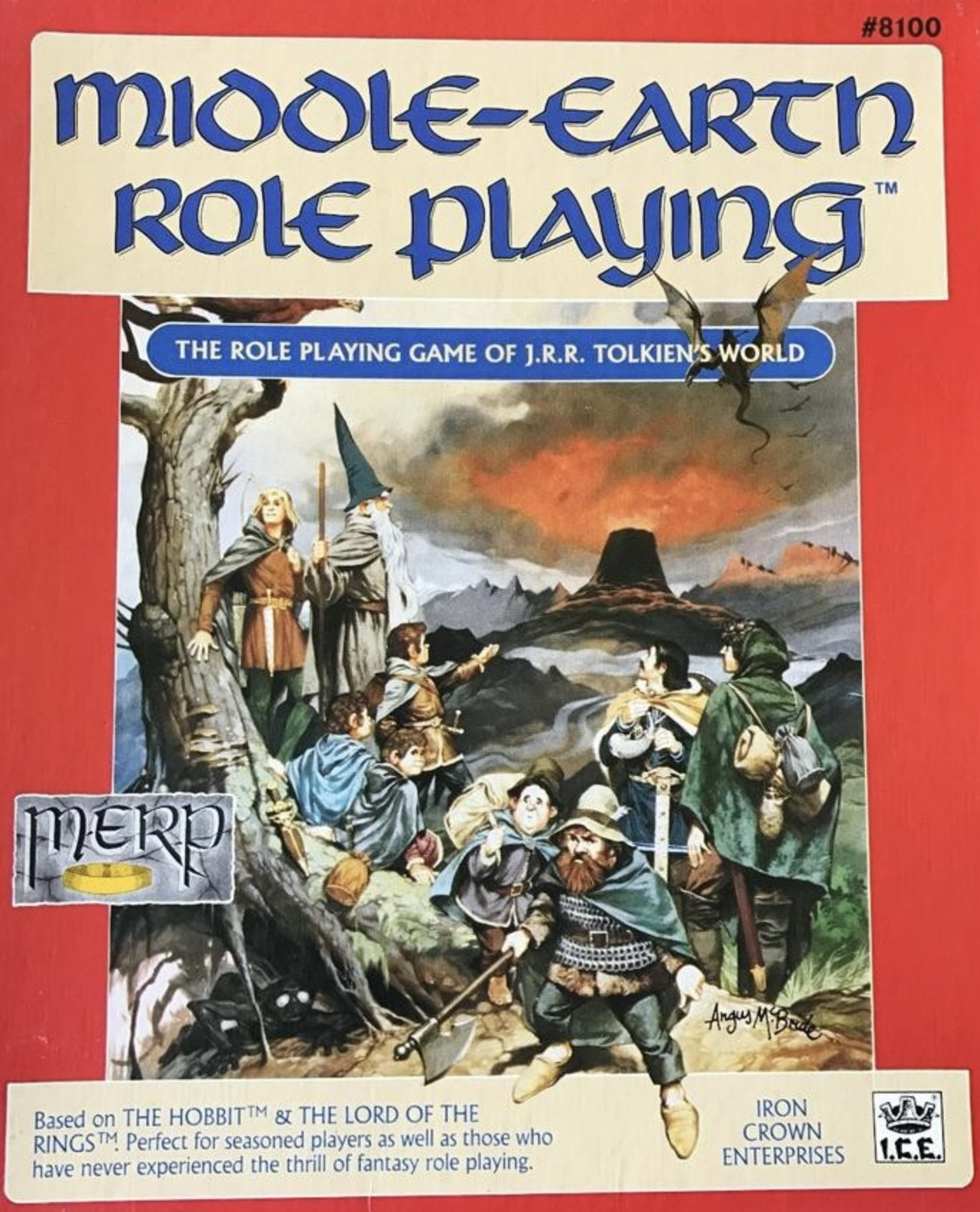
The driving force behind the original ICE was Pete Fenlon. In addition to running the company for about eighteen years, he helped to design Rolemaster – and of course he created all those beautiful Middle-earth maps! Indeed, Fenlon’s amazing mapwork earned him spot number four on my list of “top 5” fantasy role-playing artists. (Angus McBride’s wonderful covers for many of ICE’s MERP books earned him second place.)

Recently I discovered (thanks to a post by “Mankcam” at the RPG Pub) an illuminating interview with Pete Fenlon (by Wolfshield Games) on Youtube. It’s in three parts, with each part about 31-35 minutes long – so it’s a pretty informative and involved discussion.

Here is where you can find the three parts: 
  1. Part One: The Birth of Iron Crown Enterprises (link).
  2. Part Two: The Rise of Iron Crown Enterprises (link).
  3. Part Three: The Fall of Iron Crown Enterprises (link).
I was already familiar with some of the events described by Fenlon (e.g., the reasons for ICE’s financial troubles and the eventual loss of the Middle-earth license). But there was a lot of new information (for me, at least)!


Here are some of the things that came up that I found especially noteworthy:
  • Apparently TSR, and especially David Sutherland, were impressed by the early drafts of Arms Law (the combat system for Rolemaster) and the Vog Mur mini-setting (eventually part of ICE’s “Loremaster” series, and then Shadow World). But TSR could only offer a small amount of money at the time and so Fenlon (and “Iron Crown Productions”) declined. It’s probably a good thing that TSR failed to offer enough money to purchase that early version of Rolemaster. ICE needed to be the autonomous to properly create the game. But I can’t help but wonder how different the history of role-playing games would’ve been had TSR been able to make a decent offer at the time.
  • ICE acted fast when SPI lost the license to produce Middle-earth games. Even though TSR acquired SPI, Fenlon knew that Tolkien Enterprises (which controlled the license) had had a somewhat antagonistic relationship with TSR, thanks the use of “hobbits,” “balrogs,” and the like in early D&D products. So Fenlon judged that if they made a decent offer Tolkien Enterprises would be happy to pass the license on to ICE rather than TSR. 
  • ICE managed to make a deal with Dragon magazine that secured for them the full back cover of every issue (starting around number 67, I think) for their advertisements. They held that “space” for many years (certainly for as long as I read Dragon). I suspect that those gorgeous full-page ads helped MERP to become the second-best selling fantasy role-playing game during the late 1980s.
  • It seems that Fenlon never really stopped working on his detailed map of Middle-earth and now has somehow returned to a situation where he may be able to legally make it available. (The precise details are a bit unclear to me – I’d have to listen to the second interview again, and even then, I doubt I’d fully be able to follow the chain of events.) If this is so, this is extremely exciting news! The release of a full “Fenlonian” map of Middle-earth would be a dream come true.

Even if you weren’t a fan of ICE or MERP the interview is well worth listening, in my opinion, if you’re interested in the history of role-playing games. The history of TSR has been documented extensively in recent years (and rightfully so, given its central importance in the creation and development of the hobby). It’s great that we’re learning about some of the other important games and companies from the early years (I would say the “Golden Age”) of RPGs as well.

17 June 2025

Reflections on Middle-earth Roleplaying, Rolemaster, Against the Darkmaster, and Art

Back when I was a young lad and able to devote much of my time to role-playing games (late middle-school and high-school), I tried out a wide variety of different systems. Naturally, Dungeons and Dragons – and especially first edition AD&D – was a primary focus, given that it was the great colossus in the hobby during the 1980s, and everyone was familiar with it. But my friends and I also explored other games. We used our allowance money to try out alternatives like Dragonquest, Runequest, Thieves’ Guild, Traveller, Star Frontiers, and others. But our focus remained AD&D; it was the game with which we actually tried to play proper “campaigns” – usually failing for one reason or another, often with “total party kills” consciously or subconsciously engineered by tired or frustrated DMs. In contrast, we typically drifted away from the other systems after a couple of sessions. 

About halfway through high-school, though, my group – and especially me in my capacity as Game Master – shifted to Middle-earth Roleplaying (“MERP”). We still played other games – such as Call of Cthulhu and GURPS – but MERP became our main focus. My first “proper” campaign was one that I ran over a summer using MERP. The characters successfully completed a major quest and did some interesting things before my immaturity sadly led me to make some bad decisions that eventually caused the end of the campaign. Nonetheless, I remember it fondly, and parts of it vividly, even after all these years (almost four decades!).


Eventually we tried out Rolemaster as well. And although there were things about it that we liked, it proved less easy to use in play than the comparatively streamlined MERP. Sometimes we ‘mixed-and-matched’ things from the two systems, which was easy to do since MERP was a simplified “Tolkien-ized” version of Rolemaster (the relation between the two systems resembled that of Basic/Expert D&D and AD&D). In particular, the players used the individual weapon charts from Arms Law and spell charts from Spell Law, whereas I relied on the more general charts from MERP as GM. 

I continued to occasionally buy MERP and Rolemaster books even when I went to university and stopped playing RPGs regularly for a while. The Shadow World setting, by the highly creative Terry Amthor, especially intrigued me, although I never ran a campaign set in it. I bought the Rolemaster Companions as they were published and spent many hours daydreaming about the numerous options they provided (many of which, I recognized even at the time, were ill-conceived). However, the Middle-earth material remained my favourite. 

Given my longstanding interest in Rolemaster, I had known for many years that a new edition was in the works. This new version was ambitiously entitled “Rolemaster Unified” (“RMU”). It promised to “unite” elements of second edition Rolemaster (“RM2e”), the version that was dominant throughout the 1980s and into the early 1990s (later fixed up slightly and republished as Rolemaster Classic [“RMC”] around 2007) and Rolemaster the Standard System (“RMSS”), the even-more-complicated version that was published in the 1990s (a truncated version of which was later published in a single hardcover book, Rolemaster Fantasy Role-playing, with expansion books to cover the rest of system). I won’t delve into the edition differences here, most of which I have forgotten over the years. My perception is the RM2e/RMC remained more popular overall, but that RMSS had (and perhaps still has) strong advocates. Personally, after trying to GM some RMSS sessions about 25 years ago, I concluded that I preferred RM2e/RMC, and preferred MERP to both. 

In any case, given my gaming history, I was curious to see what the new version of Rolemaster – RMU – looked like. So, I recently checked out the products at DrivethruRPG. Alas, my curiosity was quickly extinguished. One reason was the price. Four PDFs are needed for the complete game, each of which is quite expensive. Given that I currently am quite happy with Against the Darkmaster (“VsD”) for this kind of game, and was simply curious about the new edition, my reaction was “no thanks.” (The complete rulebook for VsD in PDF is only one quarter the price of the four PDFs needed to play RMU.)

But just as much of a turn off as the price for RMU was the cover art. I would much prefer blank covers than ones graced with those pictures. I sincerely hope that the artist never reads this post, since I may come across as a bit mean here, but those covers are not ones that I would want to have to look at on a regular basis while playing a game every week.  

This made me reflect on the high quality of the art that characterized the main ICE (Iron Crown Enterprises) fantasy role-playing games – MERP and Rolemaster – during the company’s heyday from the mid-1980s to the early 1990s. That quality, for the most part, was due to the singular work of Angus McBride, whom I’ve praised many times at this blog in the past, including ranking him as one of the all-time greatest FRPG artists. 


That’s not to say that only McBride’s covers were excellent. The cover for the early UK edition of MERP was by Chris Achilleos and expressed a “metal” vision of Middle-earth better than anything else I’ve ever seen. (I remember seeing this cover in an advertisement in the UK gaming magazine White Dwarf back in the day and being bitter that I couldn’t purchase that version of the game in Canada.)

Also with respect to ICE’s Middle-earth line, the map artwork of Peter Fenlon was very important to me (and Fenlon is another artist whom I’ve praised here). Indeed, I spent hours just looking at Fenlon’s maps, thinking about how to detail the various locations on them (at least those that were not already described in the relevant Middle-earth setting books). I continue to cherish and use them to this day.


I actually started playing MERP before McBride started providing the covers for the line – although not before Fenlon started making the maps, as he was with the company from the start – so I don’t think my fondness for MERP was entirely due to the art. But I remember seeing McBride’s covers gracing the new MERP books and I can’t deny that they motivated me to buy a few more over the years than I would’ve otherwise. Certainly Middle-earth in my mind’s eye became infused with McBride’s vision of the world – and remains so even to this day.

I’ve mentioned before at this blog that I regard Against the Darkmaster (VsD) to be a worthy successor to MERP. It is not a “clone” – it changes too many things for it to be classified as such. But it is close enough to be readily compatible with MERP. I have had no difficulty in using elements of my MERP collection in both of my current VsD campaigns. 

In addition to its rules, VsD is also a worthy successor to MERP with respect to its art. The cover art for the core rulebook by Andrea Piparo is beautiful. 

The interior art for VsD is also of a very high quality. And I noticed an homage to one of my favourite McBride covers. (Unfortunately, I do not know which artist is responsible for the black and white picture below. The artists credited for the interior art are: Francesco Saverio Ferrara, Tommaso Galmacci, Rich Longmore, Heraldo Mussolini, Andrea Piparo, and Marcin Ściolny. The McBride picture was originally used for the Lost Realm of Cardolan module, and later used for the large Arnor book, which combined material from several earlier modules, including Cardolan.)


Well, this has been something of a rambling post. I guess that if I were to try to summarize my “key points” they would be:

  1. I liked MERP and Rolemaster (2nd edition) back in the day.
  2. Both MERP and Rolemaster, at least after the early days of ICE, benefitted from excellent cover art (primarily by Angus McBride). MERP also benefitted from amazing maps by Peter Fenlon. (The official RM setting, Shadow World, unfortunately did not enjoy as impressive cover or map art.)
  3. The cover art for the new version of Rolemaster (RMU) is not that great, in my view. The core rules also are quite expensive (even as PDFs). So I’m passing on RMU, at least for the time being.
  4. The rules for VsD are inspired heavily by MERP – and hence rock. The art for VsD is excellent as well. So I’m quite happy with the game overall – mechanically and aesthetically. 

Namárië!

10 July 2024

Trampier and Amthor inducted into the Gaming Hall of Fame

There is something called “The Academy of Adventure Gaming Arts and Design Hall of Fame.” It has existed since 1974 and includes many important game designers and artists. 

Since the Hall of Fame encompasses contributors to wargames, card games, and boardgames, as well as role-playing games, a lot of the people listed at the AAGAD Hall of Fame website are unfamiliar to me. But within the RPG world, there are many true legends.

In 2024, two people who have had a lot of influence on me during the many decades I’ve been involved in RPGs were inducted.

David Trampier – my favourite FRPG artist of all time (rivalled only by Angus McBride) – is now a member of the AAGAD Hall of Fame.

 
And Terry Amthor – a key contributor to the Middle-earth Roleplaying, Rolemaster, and Shadow World lines of Iron Crown Enterprises (Amthor was the primary author and creative force behind Shadow World, to which he contributed until his death) – also is now a member. (My current Ukrasia campaign draws heavily upon an early work of his, The Court of Ardor.)


Sadly, both Trampier and Amthor have passed away. But their contributions live on, and I am profoundly grateful to both of them for what they accomplished. 

10 January 2024

Jennell Jaquays RIP

It was announced over at the RPG Pub that the legendary adventure designer Jennell Jaquays has passed away.

Perhaps I'm somewhat unusual in this respect within the online ‘grognard’ community, but while I missed her early classic adventures (Caverns of Thracia, Griffin Mountain, Dark Tower, etc.), I was quite familiar with Jaquay’s illustrations for Iron Crown Enterprise’s old Shadow World (Rolemaster) products (as well as the ‘Nehwon Mythos’ pictures in the 1st edition AD&D Deities and Demigods). Indeed, I associate her artwork with my favourite book in the Shadow World series, Terry Amthor’s epic Jaiman: Land of Twilight. (Amthor is another recently deceased RPG legend.)

Here's the picture of the creepy "darklord" of Jaiman: “Lorgalis ‘the White’” (any resemblance to a certain Melnibonéan sorcerer-emperor is purely coincidental, I’m sure):


The Throne of the Dragon Lord:


And one of the ‘good guys’ – a rather unusual Loremaster:


Later (during 2000s) I picked up Thracia (the 3e version, and the PDF of the original) and some other classic things by Jaquays. I should be getting Goodman Games’ revamped version of Dark Tower (to which Jaquays contributed some new material, I believe) sometime later this year.

RIP.

13 October 2023

Adapting the Court of Ardor to Ukrasia: The Court of Urdor

For my forthcoming Against the Darkmaster (VsD) campaign, to be set in my world of ‘Ukrasia’ (still a work-in-progress), I’ve decided to adapt an old ICE setting: The Court of Ardor by Terry Amthor. 


As I’ve noted before here, I've been a fan of Ardor since I first purchased it almost forty years ago (yikes!). Alas, I’ve never actually used it for any fantasy role-playing campaign, even though it’s greatly inspired me over the years (as has Amthor’s work in general). It was originally designed as a region in southern Middle-earth, an early installment in ICE's line of Middle-earth campaign modules. But it always was a poor fit for Middle-earth. It seemed more inspired by the works of authors like Michael Moorcock and Roger Zelazny than J.R.R. Tolkien. 


However, Ardor was a super-cool setting nonetheless. (And it’s clear that it had a great influence on Amthor’s later Shadow World setting.) The map – by Peter Fenlon, who did most of the Middle-earth maps for ICE – is beautiful (like all of Fenlon’s maps). Since I thought that the setting – albeit with some significant changes – would fit well within Ukrasia, and I've wanted to use it for decades, I decided that I may as well go with it for my upcoming VsD campaign. (Also, because of my workload this term, I didn’t think that I could get my homebrew island “Amarrah” in shape in time.)

I've changed the name of the Court and the region named after it from “Ardor” to “Urdor.” Other significant changes will have to be made – the regions of Dûshera and Mûmakan will be altered completely (the former is now a sparsely populated realm of halflings, the latter an unruly land of orcish tribes). The timeline and other details will have to be wholly reworked to fit with Ukrasia. Once I finish up my descriptions of the regions, I’ll post them here.  

Also, the overarching aim of the deadly Court of Urdor will differ significantly from that described in Amthor’s module. (Since my players sometimes read this blog, I don’t want to say anything more than that for now.) However, the structure and the organization of the Court itself will closely resemble the original version.

I don’t plan to expose the player characters directly to any part of the deadly Court until they are at least level 7, so there will be a number of other adventures beforehand. (Among them, I’ll be adapting the “Shadows of the Northern Woods” mini-campaign from the core VsD book to the setting.) But the Court will be lurking in the background – and it should be thrilling when the heroes finally do cross swords with the dark Elvish cabal.

I’m excited to get this campaign going! 

13 October 2021

Terry Amthor RIP

At this blog I recently praised Terry Amthor’s amazing campaign module, The Court of Ardor. That module is one of my all-time favourites. While set in Middle-earth, it has a distinctive (not-really-Tolkien-ish) character, and hence I think is better treated as an independent setting. In any case, it’s really quite an amazing work, one bursting with ideas and creativity. After reading it in the mid-1980s, it forever influenced how I designed fantasy campaign settings, including especially evil ‘secret’ organizations. It inspired me in countless ways over the years, and I borrowed heavily from it in many of my games, even though I never ran it myself (although that is something I hope to correct someday).


While Ardor is Amthor’s work that most affected me, I also was greatly impressed by his Shadow World fantasy setting, and especially his campaign module, Jaiman: Land of Twilight. In many ways, Jaiman captured much of the same spirit, ethos, and energy that had infused Ardor. Like its predecessor, Jaiman included a detailed history with elaborate and distinctive organizations. It also featured a grand campaign that would enable the characters potentially to shape the history of the continent. Over the subsequent years, I purchased the additional material that Amthor published for the continent of Jaiman, and drew inspiration from it (even though, like Ardor, I never used the setting in my own games).


I also greatly appreciated Amthor’s other Middle-earth books, such as Rivendell and Lórien & The Halls of the Elven Smiths (Amthor was quite a fan of elves!), and his contributions to Rolemaster. I played his solo “Middle-earth Quest” book A Spy in Isengard a couple of times and greatly enjoyed it.

 
[Angus McBride's amazing cover for ICE's Rivendell]


Overall, Terry Amthor was one of the role-playing authors who most inspired and influenced me over the past four decades. (I’ve only mentioned his contributions with which I am familiar here. He did a lot more, as summarized by his Wikipedia profile.)


So, I was quite saddened to learn recently that Amthor had passed away. I don’t know exactly when, but the announcement from Iron Crown Enterprises was published on October 1st. I almost can’t believe it, given his age (only 62), and my complacent assumption that additional Shadow World material would appear every so often indefinitely into the future.


Rest in peace, Loremaster Amthor.


Blog Archive

About Me

My photo
I'm a Canadian political philosopher who lives primarily in Toronto but teaches in Milwaukee (sometimes in person, sometimes online).