Showing posts with label Mythic Britain. Show all posts

14 July 2025

Mythic Armorica for Mythras

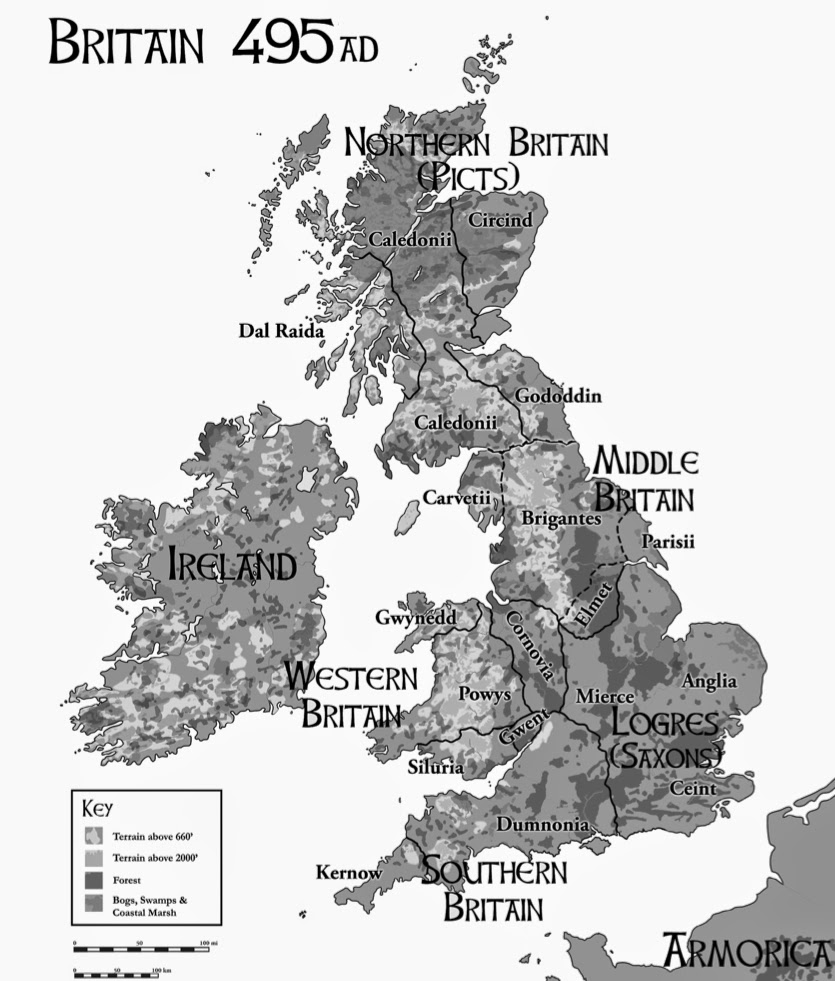
The Mythic Britain series for Mythras has a new instalment: Mythic Armorica. (I first mentioned this supplement – and included a preview of its maps – back in December.)

Here’s the description from the Design Mechanism site:

Across the Narrow Sea separating Britain from Europe, lie the three kingdoms of Armorica: Poher, Benoic, and Broërec. And across the heartland, the mighty, enchanted Forest of Broceliande.

Settled a 150 years ago by Britons from the mainland, they displaced the native Gauls and created their own lands. But now Armorica is a land under siege. The Franks and the Visigoths fight on the eastern border and threaten to make Armorica their battleground. Meanwhile, the bishops of Armorica fight a war against pagan practice, and under their urging, Broceliande is shrinking every year. Finally, a dark force is working from within, waging a covert war of conquest against the three kingdoms.

Mythic Britain: Armorica is a campaign expansion for the Mythic Britain setting. You will need both Mythras and Mythic Britain to make full use of this book.

With Mythic Britain, Logres, Waterlands, Gwynedd, and now Armorica, Mythras has the ultimate “historical fantasy” British setting for role-playing campaigns!


26 December 2024

Mythras Miscellany

I thought that I would mention two cool things for Mythras that might be of some interest.

The first is the Unearthed Companion for Mythras Classic Fantasy. Here’s the blurb from the Design Mechanism folks: 
Delve deeper than ever before, with the Classic Fantasy: Unearthed Companion, the highly anticipated expansion for Mythras Classic Fantasy! 
Classic Fantasy has become a popular branch of the Mythras family, blending the Mythras rules with traditional dungeoneering adventure mechanics. The Classic Fantasy core book presented everything needed for Ranks 1 to 3. This volume, long in the making, expands Classic Fantasy to Ranks 4 and 5, with updates and expansions to certain rules, but more importantly providing the additional magic, monsters and treasure for higher Rank characters and adventures. 
Unearthed Companion is compatible with Classic Fantasy core, and Classic Fantasy Imperative.  
More information here.


Classic Fantasy provides rules and guidelines for running Mythras games with the flavour of “Gygaxian” Dungeons & Dragons (i.e., first edition AD&D). Why do this? Perhaps you like the ethos and adventures of early TSR-era D&D/AD&D – but like combat to be interesting.

I have yet to play Classic Fantasy myself. But I’d be interested in running a short campaign using it someday, perhaps focused on an adapted version of a classic AD&D or D&D module (like Tom Moldvay’s The Lost City or the Saltmarsh series).

The second item is something that hopefully will be coming out in 2025: Mythic Armorica.


I assume that this will be a supplement for Mythic Britain (but am not certain about that).

Anyhow, Happy Boxing Day!

16 February 2024

My RPG Foci: Fantasy and Eldritch Horror

Recently someone over at the RPG Pub asked what genres people preferred in their gaming. Reflecting on this question, I realized that over the past twenty-five years or so, almost all of my role-playing activity has been focused in two genres: fantasy and horror. 

Fantasy

Perhaps unsurprisingly, the vast majority of my gaming has involved various flavours of fantasy, especially the following sub-genres.

High Fantasy

By “high fantasy” I mean the kind of fantasy that you find in the writings of J.R.R. Tolkien and the like. High fantasy worlds have a clear distinction between “good” and “evil” – even if there are morally ambiguous characters and difficult situations between the two extremes. 

I’ve mentioned before here that I was an avid player of Middle-earth Roleplaying back during the 1980s. Indeed, I probably played as much MERP as I did AD&D during my high-school days (it eventually became my group’s “main game”). And when I first started playing RPGs semi-regularly again, around 1999, I naturally started with MERP (before, unfortunately, moving to the Rolemaster Standard System, which despite its obvious mechanical relation to MERP [MERP was derived from an earlier version of Rolemaster], was not nearly as smooth or fun to use in practice).

A lot of the games that I’ve run over the years have been in this subgenre, including past and present Middle-earth games. My current “Court of Urdor” also falls within this category. 

The brilliant Against the Darkmaster FRPG – which is heavily inspired by MERP – is designed for precisely this kind of fantasy campaign. Indeed, it builds the “Darkmaster” conceit into some of its core mechanics. As the name indicates, the struggle against the Darkmaster is assumed to be a central feature of any campaign, even if only in the background. 

Swords and Sorcery 

Another familiar sub-genre. Robert E Howard’s Hyborea and Atlantis, Michael Moorcock’s Young Kingdoms (and “multiverse” more generally), Fritz Leiber’s Nehwon, Karl Edward Wagner’s “Kane,” and the like, are all exemplars of this sub-genre. I would include Jack Vance’s Dying Earth corpus, and many of Clark Ashton Smith’s stories (especially those set in Zothique, Averoigne, and Hyperborea), as members of this family as well.

After rereading REH’s Conan stories – and reading for the first time his Kull and Bran Mac Morn tales – fifteen years ago (when they were republished in nice volumes by Ballantine), I came up with a number of house rules for Swords & Wizardy in order to run some “swords and sorcery” flavoured games. Those house rules are still available here – and seem to attract regular visits to this day. Many of them were later integrated into D101 Games’ Crypts & Things role-playing game, which I highly recommend. 


In addition to running my modified version of S&W (and later C&T), I also was a player in a wonderful campaign set in the Young Kingdoms (of Moorcock’s Elric tales), using the Mongoose Runequest II system (the grandfather of the excellent Mythras RPG). 

Dungeons & Dragons

Blend the above two sub-genres together – and add some quirky monsters (e.g., beholders, mind flayers), novel twists on old ideas (e.g., drow elves, planar cosmology), and some innovations (e.g., dungeon-delving, wandering monsters) – for the singular “Dungeons and Dragons” sub-genre. I regard “D&D fantasy” as its own thing, even though it obviously draws heavily on a wide range of sources (not just fantasy). 

However, my experience running and playing post-TSR D&D has not been that great. I ran two 3rd edition games – one 3.0e and one 3.5e – just over two decades ago. The system was new and shiny, and seemed to “fix” all the purported “problems” with the earlier versions of the game. Both campaigns lasted about a year but became quite tedious to run once the characters reached 3rd or 4th level. I came to find that being a DM for 3rd edition D&D was simply a chore. After the second campaign, I vowed to never run the game again. I subsequently ran a few sessions of Castles & Crusades, AD&D, and played a bit of the Warhammer RPG (2nd edition). All of those games I enjoyed far more than 3rd edition D&D (although I probably would only bother with AD&D again today).

I skipped 4th edition D&D altogether. After reading halfway through the Player’s Handbook in fall 2008, I realized that it was just not for me. 

Years later, I ran a few one-shots of 5th edition. At first, I thought rather highly of it – at the very least, it seemed to be a vast improvement over 3rd edition. I quite liked some of the books that were published for it (namely, Tales from the Yawning Portal, Ghosts of Saltmarsh, and Goodman Games’ updated versions of classic TSR modules – not coincidentally, books that all contained a lot of “Gygaxian" Greyhawk material). 

More recently, I ran a campaign set in the World of Greyhawk, much of which took place in the legendary area around the village of Hommlet. It was great fun! But it was fun despite the system (at least for me as the Dungeon Master). The ubiquitous, often “free” magic, and almost absurd “superhero” quality of the characters, came to grate on my nerves. I’ve explained some of my problems with 5th edition D&D before (see here and here) so I won’t say any more about that here.  
After these experiences, I conclude that I definitely prefer “old school” D&D within this genre – specifically, the more challenging and flavourful 1st edition Advanced Dungeons and Dragons and Basic/Expert Dungeons & Dragons (and related “clone” systems, like OSRIC and S&W). I like magic to be at least somewhat rare and at least somewhat costly to use. (Endless cantrips and ritual spells? No thanks!) It’s clear to me that the post-TSR versions of the game just are not my thing. I certainly have no interest in the recent offerings from the Wizards of the Coast.

There is one honourable exception regarding 5th edition D&D: the Middle-earth adaptations of the 5e system, as presented in Adventures in Middle-earth and The Lord of the Rings RPG. I thoroughly enjoyed the AiME campaign that I ran a number of years ago. But those games don’t feel like “D&D” at all – the magic system is entirely different, the classes are entirely different, etcetera. They also import a number of mechanics from The One Ring RPG. And of course, those games belong to the “high fantasy” genre discussed earlier.

Historical Fantasy

As a player, the bulk of my gaming over the past decade has been in historical fantasy settings. I suppose that this is unsurprising, given that I’ve played a lot of Mythras (and its predecessors, RuneQuest 6 and MRQII) during this time.  So, I’ve played in long-running Mythic Britain and Mythic Babylon campaigns, as well as some one-shot sessions in other settings. 

Both Mythic Britain and Mythic Babylon are excellent and highly recommended!

Horror

After fantasy, I’ve mainly run and played in “Horror” games. But in this category, it’s been exclusively “Lovecraftian” horror, that is, “Cthulhu Mythos” stuff. 

I’ve run a couple of short Call of Cthulhu campaigns set during the “classic” period, in Toronto and Massachusetts, as well as a number of one-shots. I have material for other eras (e.g., Rome, medieval, and modern, including “The Laundry”) but have never run a campaign or even a one-shot outside of the default 1920s-30s period.  

As a player, I recently took part in a long-running Mythras campaign, using the classic Beyond the Mountains of Madness sourcebook. (Our last session was today. My character survived – and was even more-or-less sane!) I’ve also taken part in one-shots of Trail of Cthulhu, Delta Green, and other related games over the years. 


Other genres?
 
I took part in a few Mythras sessions years ago set in the Luther Arkwright universe. I’m not sure how to categorize that setting (“science fantasy”?). They were fine but not the kind of thing I’d likely run myself. I also have played a few other one-shots here and there, but nothing really worthy of mention.

I haven't been remotely interested in playing in a “superheroes” game in recent decades (unless you count 5th edition D&D – I joke). It’s a genre that simply doesn't appeal to me. I’d be open to a “modern” game (say, espionage) but I have no idea how to run one myself. Likewise for science-fiction.

Back in high-school, my group tried all kinds of different games – including superheroes (Villains & Vigilantes, Marvel Superheroes), historical (Gangbusters, Bushido), and especially science fiction (Traveller, Star Frontiers, and even Space Opera – or at least I bought and tried to read Space Opera). We had a lot of time and energy back then!

Wrapping up...

These days, now that I’m an old man, I generally try to stick to what I know I like. So, I guess I’m a pretty limited gamer: I play and run almost exclusively fantasy and horror games. Maybe I’ll broaden my horizons when I retire. 

Looking back, I regret all the time I spent trying to get myself to like 3rd and 5th edition D&D. I should’ve just spent that time playing MERP or Stormbringer or Crypts and Things or whatever. At least I’ve learned my lesson: life is too short to try to force myself to like a game when there are other games available that I much prefer. So these days I’m happy to focus on Mythras and Against the Darkmaster – although, of course, I still pick up the occasional new system that catches my eye. 


Art credits (from top to bottom): Angus McBride, Andrea Piparo, Michael Whelan, Dave Trampier, David Benzal, Erol Otus, Angus McBride (again).

03 October 2022

Forthcoming Mythras loot


The wheels keep turning over at the Design Mechanism. There are some cool things coming out for Mythras later this year or early 2023. Among them:


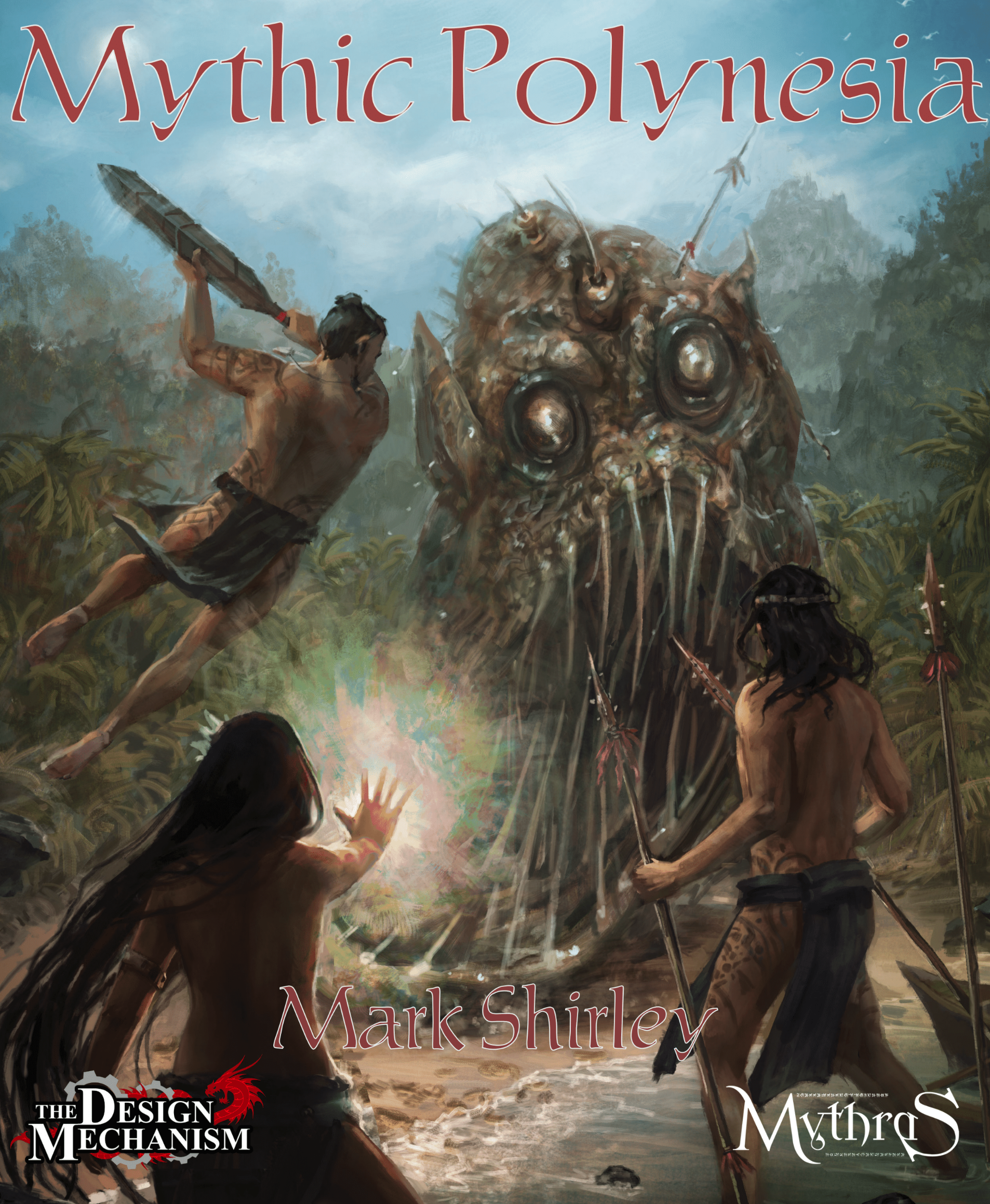
Mythic Polynesia: the latest addition to the Mythic Earth range, and a comprehensive guide to the peoples of Polynesia, their way of life, myths, unique culture, and dozens of seeds for adventure.

Mythras Factions: a short supplement dealing with factions of all kinds in Mythras. From gangs to guilds, ambitious families to multinational cartels. The supplement includes unique rules for creating your faction, and guidance on how they can achieve their goals.

Mythic Britain: Gwynedd. A supplement for Mythic Britain, this mix of short campaign setting and adventures focuses on Gwynedd and Ynys Mon, a kingdom fraught with strife, and on the edge of implosion as old scores are settled between the sprawling families and clans.

Book of Schemes (expected early 2023): Welcome to Guelden, a city-state ruled by intrigue, guilds, feuding families, and a lust for power. This complete setting is in a similar vein to the popular Fioracitta, and details both Guelden and its immediate surroundings. The city can be dropped into any existing campaign, or used as the foundation for a new one, and is highly compatible with other books in the Mythras range.


Mythras is my favourite new RPG of the current century (as I’ve said many times here before). It’s certainly the one that I’ve played the most over the past dozen years (if its immediate predecessors, Mongoose RuneQuest II and RuneQuest 6 are included). So it’s great news that more interesting material will be available for it in the near future!


Also forthcoming are some items for Lyonesse: a scenario and a supplement focusing on “Rogues, Vagabonds, Thieves, and Miscreants.”


18 April 2022

Mythras News: Supes and Polynesia

There’s a new member of the Mythras RPG family: the superhero role-playing game Destined. It’s available now at the Design Mechanism’s new home store, and will become available at Lulu and DrivethruRPG on the 23rd of April.
 

Also, another Mythic Earth setting book is in production: Mythic Polynesia. I don’t know when it’ll be available, but the cover looks rather cool:


I’ve probably played more Mythras (including its predecessors RQ6 and MRQII) than any other role-playing game over the past eleven years. (By coincidence, I vaguely recall meeting Loz in early spring 2011…) I’ve played in the Young Kingdoms (Elric’s world), Mythic Britain, the Luther Arkwright multiverse, and (currently) Mythic Babylon. Soon I’ll be taking part in a Mountains of Madness campaign (converted to Mythras). I can’t recommend the game highly enough!


05 May 2018

Mythras Bundle of Holding


Curious about Mythras (formerly RuneQuest 6)? Well, over the next two days you can get a rather impressive bundle of Mythras PDFs for a very low price!

The Starter Collection (14.95 USD [retail value 47 USD]) includes:

  • Mythras core rulebook ($15)
  • Mythras Imperative (free)
  • Classic Fantasy ($20)
  • Three Mythras adventures:
  • A Gift From Shamash ($4)
  • Xamoxis' Cleansing ($4)
  • Madness & Other Colours ($4)
If you want more, you can get the Bonus Collection (threshold starts at 24.95 USD  [retail value 52 USD]):

  • Mythic Britain ($18)
  • Mythic Britain Companion ($5)
  • Mythic Rome ($14)
  • Mythic Rome Maps (PWYW)
  • Three Classic Fantasy adventures:
  • M1 The Terror of Ettinmarsh ($5)
  • G1 These Violent Delights ($5)
  • N1 Tomb of the Mad Wizard ($5)
Design Mechanism's nominated charity is the Electronic Frontier Foundation. 

More information on this Bundle of Holding can be found here.

And Newt Newport (of D101 Games) recently reviewed Mythras at his 'Sorcerer Under Mountain' blog. 


05 September 2015

A Year of Great Gaming Comes to an End

[Spinoza with his huge d20 in Amsterdam]

I spent the 2014-2015 academic year (roughly, September 2014 to August 2015) on sabbatical in Toronto.  Amazingly, I managed to get some research and writing done while at the Centre for Ethics at the University of Toronto.  More importantly, though, I managed to get some great gaming done!

Here is what I did:

1. I played in roughly 15 (I can’t recall the precise number) sessions of RuneQuest 6 within the Mythic Britain setting (GM: Lawrence Whitaker).  This was one of the finest role-playing experiences I’ve had as a player – surpassed only by the Young Kingdoms (MRQII) campaign which I played in during the spring and summer of 2011.  (The GM for that earlier campaign also was Lawrence.)

2. I played in 3 sessions of RuneQuest 6 using the Luther Arkwright setting (GM: Lawrence Whitaker).  Lawrence ran the sample scenario from the book – which, amusingly, is set in an alternative parallel version of Toronto.  Hopefully I will be able to return for the final session of this adventure sometime this autumn or winter.

3. I ran (‘keepered’?) 7 sessions of Call of Cthulhu 7e, covering 3.5 scenarios.  (My initial impressions of 7e are noted here.)  I hope to return to this campaign, on occasion, in future visits to Toronto.  At the very least, I have to finish up the current adventure, set at the famous (and infamous) Miskatonic University.  (The classic 1920s New England ‘Lovecraft county’ setting was used.)

4. I ran (‘DM-ed’) 2 sessions of Dungeons and Dragons 5e.  (The first two parts of the ‘Mines of Phandelver’ adventure included within the 5th edition ‘Starter Set.’)  I would like to continue this campaign in the future, but I’m not sure if that will be possible.

5. I played in a ‘one shot’ session of Trail of Cthulhu (GM: Chris).  (This was most definitely a one shot, as all of the PCs turned into giant worms at the end!)

6. I played in 2 sessions of … something.  It was a Cthulhu-esque adventure set in the Free Congo State during 1907.  I can’t recall the name of the system, unfortunately, but the adventure was quite compelling (very reminiscent of Joseph Conrad’s Heart of Darkness).  (GM: Chris.)

These were all live tabletop games.  (I also ran a few sessions of AD&D 1st edition online.)  That’s is pretty good, I think, at this stage in my life and career (viz., a middle-aged professor).

I plan to write up an overview of the Call of Cthulhu campaign at some point, as well as some more of my impressions of D&D 5.

In the meantime, alas, back to teaching…


27 July 2015

Praise for the Warlord Chronicles

[Mont St. Michel is Ynys Trebes in the first novel, the capital of Benoic within Armorica.]

A significant influence on the recently published RuneQuest 6 campaign book, Mythic Britain, is the Warlord Chronicles by Bernard Cornwell.  I read the series a couple of months after joining Lawrence Whitaker’s Toronto-based Mythic Britain campaign, and regret not reading it earlier.  Not only are the novels excellent in their own right, but they do a superb job of conveying the nature and feel of late fifth and early sixth century Britain, including the religious and cultural beliefs of the Britons of that time.

The trilogy consists of The Winter King, Enemy of God, and Excalibur.  The novels cover over four decades (from roughly 480 to sometime after 525), although there are some scenes that take place decades later.  The entire story is told from the perspective of Derfel Cadarn, a former Saxon slave who is raised within the household of Merlin at Ynys Wydryn (Glastonbury), and eventually becomes one of Arthur’s chief warlords in his conflicts with other Britons and, following the achievement of a fragile unity amongst the Britons, against the Saxons.

An elderly Derfel relates the story of his life and the tale of Arthur to a young Queen Igraine of Powys, who visits him regularly at the monastery in which Derfel spends his remaining days.  Derfel writes his story in Saxon since Arthur was a pagan and is not looked up favourably by the Christians who now dominate Powys and the other British (non-Saxon) lands.  (Igraine collects Derfel’s scrolls to be translated by a scribe in her houseful.)  The head of the monastery, the old and miserable Bishop Sansum, especially is not fond of Arthur – for reasons, both amusing and infuriating, that become clear as Derfel relates his story.  While Derfel is now a Christian, as he relates his tale we can discern that his conversion is not especially sincere (though he never explicitly states this), whereas his loyalty to Arthur is unwavering.  We also know that at some point in his earlier life Derfel lost one of his hands, and experienced a profound romantic love.  These things are revealed early on, and motivate the reader to find out how and why they happened to Derfel – as well as, of course, learning the details of the harrowing and tragic story of Arthur himself.

I will not reveal any further details about the story here.  While the basic characters will be familiar to most – Arthur, Merlin, Mordred, Nimue, Guinevere, Lancelot, Galahad, Tristan, and so forth – Cornwell’s presentation of them is distinctive and almost certainly will surprise most readers.  The depiction of Lancelot in particular is quite … different from the standard portrayals.

What I want to note briefly here are some things that I found especially compelling about the novels.

1. The depiction of warfare is impressive.  Cornwell describes vividly what it is like to be in a shield wall.  Other combats are described in gruesome, blow-by-blow, detail – but never get bogged down.  The mundane activities necessary for war also are described.  I would be hard pressed to think of another novel that does such a good job in this respect.

2. The depiction of the society is deeply immersive.  Reading the novels I felt like I really was there in 5th and 6th century Britain.  And, for the most part, it was not a pleasant place!  Indeed, post-Roman Britain comes across as a kind of post-apocalyptic society.  Culturally, politically, and technologically, the land is a shadow of its former self.  In one scene Arthur’s army uses a Roman bridge across the Thames, and he laments that no one in Britain could build such a structure in his day.  Such knowledge, along with order and peace, has been lost, seemingly forever.

3.  The conflict between the druids, whose religion and influence clearly are on the wane, and the Christians plays a central role in the novels.  (There also are other cults: the one of Mithras the warrior god is important in Derfel’s life; the cult of Isis plays an important role in the story as well.)  This religious conflict – including the way in which the pagans regard the Christians, and vice versa – is portrayed vividly by Cornwell.

4. Finally the treatment of magic and the gods is very interesting.  Since the entire tale is told from the perspective of Derfel – and Derfel very clearly believes in the gods and magic – he describes what he witnesses and experiences as though the gods and magic really do exist.  For the most part, though, readers can interpret the events that happen as not involving the gods or magic.  In other words, many of the events described by Derfel are open to alternative, perfectly naturalistic explanations.  This ambiguity breaks down somewhat towards the end of the series, as some of the things that happen seem quite difficult to interpret in a non-supernatural way.  But this is the case only if we assume that Derfel is accurately reporting what he saw and experienced.  After several decades his memories may not be so clear – and, moreover, invariably are coloured by his supernatural beliefs – so he may not be the most reliable of narrators.  Consequently, the question of whether magic ‘really exists’ in the world described by Cornwell is left unanswered – an aspect of the novels that I really enjoyed.

In short, the Warlord Chronicles are a great read.  I highly recommend the series to any fan of fantasy of historical fiction.

15 March 2015

New Stonehenge theory


There is a new theory concerning the function of stonehenge:
The megaliths would not have been used for ceremonies at ground level, but would instead have supported a circular wooden platform on which ceremonies were performed to the rotating heavens, the theory suggests.
Sounds interesting and not entirely implausible (at least to a non-archaeologist like myself).  (Full article here.)

After all these years, I still find thinking about stonehenge strangely magical...

19 February 2015

A Bloody Samhain!

Our indefatigable Game Master's summary of last week's Mythic Britain session, written from the perspective of the Saxon dogs:
Wotan and Thunor bless the 29 brave Saxon warriors who fell to the cowardly Parisii. Nine, captured in battle, were cruelly slaughtered by their witch who used their blood, souls and skulls to build a Ghost Fence in a pathetic attempt to protect their miserable hillfort. Thrice one thousand curses on her head! May Gullveig's Children tear her limb from limb.
Six were most foully butchered in a forest ambush as they sought to bring some lonely Celtic women and children to safety. The Parisii dogs who call themselves the Sons of Cernunnos hid like sceadunga in the shadows and would not face these loyal thanes weapon to weapon.
And fourteen fell in brave combat, although these good thanes and sons of Wotan engaged their enemy and made them bloody. The magic of the Britons was powerful; one witnessed the Screaming Warrior shrug-off spear thrusts as though clad head to toe in mail. Victory would have been theirs if the craven Britons had fought toe to toe and not broken the Saxon rank with distressed horses and more assassins who lurked in the bracken and hurled spears like pitiful womenfolk.
Lord Hengwulf and King Guercha mourn these fine warriors. Comfort is taken in knowing that their souls now feast in Valhalla and tomorrow shall battle and be victorious for all eternity!
The Parisii shall pay. Aelflas is coming, and she brings Hel in her wake like a cloak of torment.
A somewhat more objective summary:
An epic battle last night. Mass sacrifice on an almost industrial scale as Gwynneth made a Ghost Fence from Saxon prisoners. Then, rushing to protect the women and children hidden in a forest cave, the characters managed to outpace and ambush a Saxon warband, which had fortunately become splintered and disoriented in the wild woods of the Eboracum Vale. In a moment of freakish good fortune, the three characters who are the Sons of Cernnunos (Cunnen, Aild and Gawain) each rolled 05, one after the other, scoring critical successes in the ambush on the first six Saxons. This incredible feat of luck earned them a bonus Luck point and an immediate +5% increase in the Brother of Cernunnos Passion.
Later, Cunnen was impaled in the thigh by a well-aimed Saxon spear and unable to take part in the ensuing fight, but his brother in arms Aild invoked the berserker rage and hurled himself at the Saxon shield wall. The wall was broken as Gawain drove panicked horses into it and they tried to change their facing to deal with attacks from front and flank, and this allowed Aild, in another moment of blessed luck to critically avoid being tripped while his attacker fumbled his next spear thrust and impaled his colleague.
After that, the battle was over. The Saxon ranks were broken by good tactics and a huge helping of good rolls on the Parisii side, and shockingly bad ones on the Saxons.
Of course, my character, the scholarly Roman 'Lucretius', was far away from all this bloody savagery.

(Originally posted by Lawrence Whitaker here.)

09 February 2015

By Merlin’s tangled beard, Mythic Britain is here!


Mythic Britain is a campaign setting for RuneQuest 6, written by Lawrence Whitaker (co-author of the RQ6 system).  It’s been available in PDF for a few months now.  The hardcover version looks to have been unleashed at last, as well as a PDF-only supplement, the “Mythic Britain Companion.”

This is a really great product!  Not only do you receive a wonderfully gritty and evocative historical fantasy setting (post-Roman Britain, circa 495), with special RQ6 rules for that setting (covering character creation, magic, religion, and so forth), but also a complete campaign consisting of seven adventures.

My praise for the setting is based on first-hand experience.  I joined Lawrence’s Toronto-based Mythic Britain campaign in late September.  (The campaign already had been running for roughly a year before I returned to Toronto and was able to join.  Consequently, I decided to make my character a Roman ‘outsider’ who had to ingratiate himself with an established band of Celts.  This made for some very amusing role-playing!)  The adventures that Lawrence designed do a superb job of immersing players in the setting.  They are, moreover, quite novel, entertaining, and challenging.

Of course, since I’m a friend of the author, you may be inclined to take my praise with a grain (or more) of salt.  So here is a proper review of the book.

Simply put, if you are looking for an Arthurian setting much grimier, bloodier, and darker than that found in Pendragon, then Mythic Britain is for you!


(I hope to post a few more things on or related to Mythic Britain – including a mini-review of a major influence on the setting, Bernard Cornwell’s The Warlord Chronicles – over the next month or so.)

Blog Archive

About Me

My photo
I'm a Canadian political philosopher who lives primarily in Toronto but teaches in Milwaukee (sometimes in person, sometimes online).