Showing posts with label reviews. Show all posts

17 June 2025

Reflections on Middle-earth Roleplaying, Rolemaster, Against the Darkmaster, and Art

Back when I was a young lad and able to devote much of my time to role-playing games (late middle-school and high-school), I tried out a wide variety of different systems. Naturally, Dungeons and Dragons – and especially first edition AD&D – was a primary focus, given that it was the great colossus in the hobby during the 1980s, and everyone was familiar with it. But my friends and I also explored other games. We used our allowance money to try out alternatives like Dragonquest, Runequest, Thieves’ Guild, Traveller, Star Frontiers, and others. But our focus remained AD&D; it was the game with which we actually tried to play proper “campaigns” – usually failing for one reason or another, often with “total party kills” consciously or subconsciously engineered by tired or frustrated DMs. In contrast, we typically drifted away from the other systems after a couple of sessions. 

About halfway through high-school, though, my group – and especially me in my capacity as Game Master – shifted to Middle-earth Roleplaying (“MERP”). We still played other games – such as Call of Cthulhu and GURPS – but MERP became our main focus. My first “proper” campaign was one that I ran over a summer using MERP. The characters successfully completed a major quest and did some interesting things before my immaturity sadly led me to make some bad decisions that eventually caused the end of the campaign. Nonetheless, I remember it fondly, and parts of it vividly, even after all these years (almost four decades!).


Eventually we tried out Rolemaster as well. And although there were things about it that we liked, it proved less easy to use in play than the comparatively streamlined MERP. Sometimes we ‘mixed-and-matched’ things from the two systems, which was easy to do since MERP was a simplified “Tolkien-ized” version of Rolemaster (the relation between the two systems resembled that of Basic/Expert D&D and AD&D). In particular, the players used the individual weapon charts from Arms Law and spell charts from Spell Law, whereas I relied on the more general charts from MERP as GM. 

I continued to occasionally buy MERP and Rolemaster books even when I went to university and stopped playing RPGs regularly for a while. The Shadow World setting, by the highly creative Terry Amthor, especially intrigued me, although I never ran a campaign set in it. I bought the Rolemaster Companions as they were published and spent many hours daydreaming about the numerous options they provided (many of which, I recognized even at the time, were ill-conceived). However, the Middle-earth material remained my favourite. 

Given my longstanding interest in Rolemaster, I had known for many years that a new edition was in the works. This new version was ambitiously entitled “Rolemaster Unified” (“RMU”). It promised to “unite” elements of second edition Rolemaster (“RM2e”), the version that was dominant throughout the 1980s and into the early 1990s (later fixed up slightly and republished as Rolemaster Classic [“RMC”] around 2007) and Rolemaster the Standard System (“RMSS”), the even-more-complicated version that was published in the 1990s (a truncated version of which was later published in a single hardcover book, Rolemaster Fantasy Role-playing, with expansion books to cover the rest of system). I won’t delve into the edition differences here, most of which I have forgotten over the years. My perception is the RM2e/RMC remained more popular overall, but that RMSS had (and perhaps still has) strong advocates. Personally, after trying to GM some RMSS sessions about 25 years ago, I concluded that I preferred RM2e/RMC, and preferred MERP to both. 

In any case, given my gaming history, I was curious to see what the new version of Rolemaster – RMU – looked like. So, I recently checked out the products at DrivethruRPG. Alas, my curiosity was quickly extinguished. One reason was the price. Four PDFs are needed for the complete game, each of which is quite expensive. Given that I currently am quite happy with Against the Darkmaster (“VsD”) for this kind of game, and was simply curious about the new edition, my reaction was “no thanks.” (The complete rulebook for VsD in PDF is only one quarter the price of the four PDFs needed to play RMU.)

But just as much of a turn off as the price for RMU was the cover art. I would much prefer blank covers than ones graced with those pictures. I sincerely hope that the artist never reads this post, since I may come across as a bit mean here, but those covers are not ones that I would want to have to look at on a regular basis while playing a game every week.  

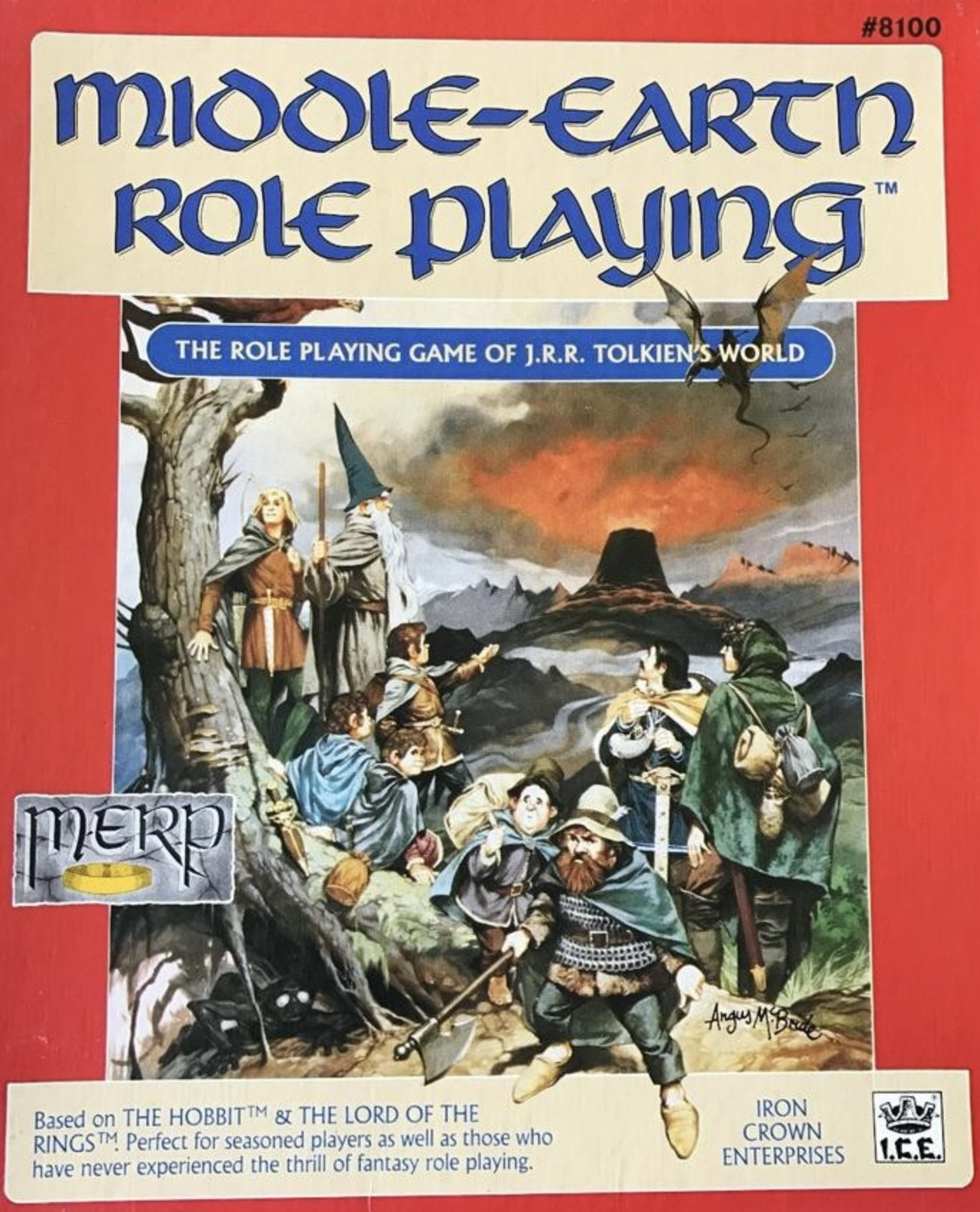
This made me reflect on the high quality of the art that characterized the main ICE (Iron Crown Enterprises) fantasy role-playing games – MERP and Rolemaster – during the company’s heyday from the mid-1980s to the early 1990s. That quality, for the most part, was due to the singular work of Angus McBride, whom I’ve praised many times at this blog in the past, including ranking him as one of the all-time greatest FRPG artists. 

That’s not to say that only McBride’s covers were excellent. The cover for the early UK edition of MERP was by Chris Achilleos and expressed a “metal” vision of Middle-earth better than anything else I’ve ever seen. (I remember seeing this cover in an advertisement in the UK gaming magazine White Dwarf back in the day and being bitter that I couldn’t purchase that version of the game in Canada.)

Also with respect to ICE’s Middle-earth line, the map artwork of Peter Fenlon was very important to me (and Fenlon is another artist whom I’ve praised here). Indeed, I spent hours just looking at Fenlon’s maps, thinking about how to detail the various locations on them (at least those that were not already described in the relevant Middle-earth setting books). I continue to cherish and use them to this day.


I actually started playing MERP before McBride started providing the covers for the line – although not before Fenlon started making the maps, as he was with the company from the start – so I don’t think my fondness for MERP was entirely due to the art. But I remember seeing McBride’s covers gracing the new MERP books and I can’t deny that they motivated me to buy a few more over the years than I would’ve otherwise. Certainly Middle-earth in my mind’s eye became infused with McBride’s vision of the world – and remains so even to this day.

I’ve mentioned before at this blog that I regard Against the Darkmaster (VsD) to be a worthy successor to MERP. It is not a “clone” – it changes too many things for it to be classified as such. But it is close enough to be readily compatible with MERP. I have had no difficulty in using elements of my MERP collection in both of my current VsD campaigns. 

In addition to its rules, VsD is also a worthy successor to MERP with respect to its art. The cover art for the core rulebook by Andrea Piparo is beautiful. 

The interior art for VsD is also of a very high quality. And I noticed an homage to one of my favourite McBride covers. (Unfortunately, I do not know which artist is responsible for the black and white picture below. The artists credited for the interior art are: Francesco Saverio Ferrara, Tommaso Galmacci, Rich Longmore, Heraldo Mussolini, Andrea Piparo, and Marcin Ściolny. The McBride picture was originally used for the Lost Realm of Cardolan module, and later used for the large Arnor book, which combined material from several earlier modules, including Cardolan.)


Well, this has been something of a rambling post. I guess that if I were to try to summarize my “key points” they would be:

  1. I liked MERP and Rolemaster (2nd edition) back in the day.
  2. Both MERP and Rolemaster, at least after the early days of ICE, benefitted from excellent cover art (primarily by Angus McBride). MERP also benefitted from amazing maps by Peter Fenlon. (The official RM setting, Shadow World, unfortunately did not enjoy as impressive cover or map art.)
  3. The cover art for the new version of Rolemaster (RMU) is not that great, in my view. The core rules also are quite expensive (even as PDFs). So I’m passing on RMU, at least for the time being.
  4. The rules for VsD are inspired heavily by MERP – and hence rock. The art for VsD is excellent as well. So I’m quite happy with the game overall – mechanically and aesthetically. 

Namárië!

20 December 2023

Second Edition Advanced Dungeons and Dragons


Over at his Mythlands of Erce blog, Anders H* has a couple of amusing polemical posts defending the honour and goodness of second edition Advanced Dungeons and Dragons (part one concerns the rules; part two addresses the ‘culture’ of the game).

Second edition AD&D was an edition that I almost entirely skipped. I say “almost” because I played very briefly in a 2e campaign one summer around 1990. However, I never owned any 2e AD&D books during its lifecycle (I bought a few books for the Greyhawk and Planescape settings years later). I had drifted away from AD&D by the late 1980s and did not play role-playing games that regularly during the 1990s. To the extent that I did, it was stuff like MERP, Rolemaster, Call of Cthulhu, Hawkmoon, GURPS, and the like.

I eventually did “play” a lot of 2e AD&D, but only via various computer RPGs, namely, the “Infinity engine” Baldur's Gate games, Icewind Dale, and Planescape: Torment (the latter game motivated me to learn more about the Planescape setting, hence my subsequent purchase of the box set and a few other things). It didn't seem that different from 1e AD&D, at least in terms of the rules (the addition of “kits” seemed to be the main difference).

The hatred directed towards 2e by adherents of 1e AD&D (primarily from grognards grumbling on the internet – not that there’s anything wrong with that!) always struck me as primarily flavour-based. And I share their irritation with 2e’s “purging” of things like assassins, half-orcs, demons, devils, etc., (all things that eventually crept back into the game, however, during the 1990s). Also contributing to this sentiment was some bitterness about TSR’s treatment of Gary Gygax, and the unavoidable fact that 2e AD&D was the first “post-Gygax” version of the game. 

There are some rules differences between the two editions, of course, and in my view some favour 2e (e.g., the way thief skills were handled), others 1e (e.g., the presence of a distinct "illusionist" class). 

I much prefer the art in the original 1e AD&D books, especially the classic Dave Trampier Player’s Handbook cover. Overall, the 1e art seems “grittier” and less “family-friendly” than the 2e stuff. Trampier’s pictures often looked like etchings from some mysterious past (as did David Sutherland’s epic “Paladin in Hell”). Erol Otus’s pictures looked like visions of an alternate reality.  

But in terms of rules, I’m fine with 2e AD&D. I certainly prefer them over 3e (which I’ll never touch again), 4e (which I never played after reading halfway through the PHB), and 5e (which, admittedly, is the “least bad” of the post-TSR versions of AD&D/D&D, but still not my cup of tea). I'd be quite happy to play in a 2e campaign. But if I ever run an “old school” AD&D campaign again, it almost certainly would be (a house-ruled version of) Gygaxian 1e AD&D.

(*Note: Anders H is the author of the excellent Into the Unknown RPG, an “old school” variant of the 5e rules. Check it out! If you’re curious, I go over some of the main differences between ItU and 5e here.) 


12 June 2023

Recommended: Swords and Wizardry Complete – Revised Edition

The kickstarter for the revised version of the Swords & Wizardry Complete rules was a great success. Backers (like myself) now have PDFs of the new core rulebook. I’ve looked it over and am very favourably impressed. The organization and layout have been improved from earlier versions. Information is presented in a direct, economical, but nonetheless aesthetically pleasing way. Kudos to Suzy Moseby on doing such a fine job on the layout. The art is solid, with a few very good pieces, and nothing objectionably unappealing. I like all three covers (the Erol Otus one [depicted below], as well as the green and blue designs by Del Teigeler). (But I do miss the original wonderful S&W cover by Pete Mullen.)

It's amazing to me how much content Matt Finch has managed to pack into such a slim package (144 pages) in a clear and accessible way. Roughly speaking, Swords & Wizardry Complete, gives you pretty much everything in the original D&D 1974 box set, and a lot (but not all) from the subsequent supplements (Greyhawk, Blackmoor, and Eldritch Wizardry). What you end up with is something very close to Advanced Dungeons & Dragons (as realized in 1979), but somewhat simpler and lower-powered. The main (or at least most noticeable) differences: in S&W there are no half-orcs, gnomes, illusionists, or bards; alignment is three-fold (Lawful, Neutral, Chaotic); hit dice are lower (e.g., fighters have d8 in S&W instead of d10 as in AD&D); and slightly lower level-limits for demi-human characters. Aside from these changes – which, of course, are easy to modify if one wishes – S&W provides a “simplified” version of AD&D, and is readily compatible with most material produced for D&D and AD&D prior to 3rd edition.


There are some minor but helpful innovations in S&W that distinguish it from "0 edition" D&D. Among them: the ‘ascending’ scale for AC is used (which I appreciate and find preferable to the older system, although the old ‘descending’ system is provided as an option as well); a single unified ‘saving throw’ is provided for each class (but with the option to use the older system, broken down into categories like “death rays and poison”); four different options for determining initiative are outlined; rules for morale are provided; and rules for two-weapon fighting are included. These are all helpful additions to the game in my view.   


Since it is a “clone” of early (0e) D&D, S&W includes elements from that system that personally I am not that keen on. For instance, the special abilities of thieves (as well as assassins and monks) are quite miserable, with very low chances for success at anything until characters achieve higher (7+) levels. If I were to run S&W again, I’d probably just use my version of the class instead. Likewise, I’ve never been a fan of the way earlier editions of D&D and AD&D implemented “level limits” on non-human characters. I think that there are better ways to “balance” non-human characters against human ones. (S&W does include an optional rule to permit non-human characters to advance beyond their level limits, but with a 50% penalty to experience points earned by those characters. I’d likely either use that option, or simply grant some additional bonus to human characters instead.) Of course, one cannot really fault a retro-clone like S&W for “cloning” such rules from earlier editions, and in any case such things are easy to house-rule.  


In short, this revised, updated version of Swords & Wizardry is excellent, the best version yet. It was the “retro-clone” that helped inspire this blog in 2009 – and for which I wrote a number of house-rules – and it remains my favourite. I highly recommend it to anyone who enjoys the spirit of old school Dungeons and Dragons!


(For a more comprehensive review, check out this one at the blog “It’s Okay; Gary Sent Us.”)

31 December 2020

Praise for Lyonesse

Mythras is my favourite FRPG of the 21st Century and Lyonesse is one of my favourite trilogies of the 20th Century—so naturally I’m a great fan of Design Mechanism’s new Lyonesse FRPG, which artfully combines these two things!

For the edification of all, I recommend the fine review of this excellent book at the blog “Reviews from R’lyeh.” Reviewer Pookie’s conclusion:

Lyonesse: Fantasy Roleplaying Based on the Novels by Jack Vance is fantastic and thorough, almost compendium-like adaptation of a classic fantastical setting, one that is likely to feel almost familiar to many gamers, because even if they have not read the novels, they will have encountered its influence on Dungeons & Dragons. This provides an opportunity for roleplayers old and new, unaware of them or not, to visit the Elder Isles, the setting of that influence, and explore it in all of its glory and grit, its whimsy and wonder, its manners and machinations, its delights and its dangers, in this well designed, well researched roleplaying game.”


Happy 2021 everyone! Hopefully things will get better in the new year.


24 June 2020

Review of Crypts and Things Remastered

There is a quite informative review of Crypts and Things Remastered at Ynas Midgard's RPG Blog. (It was posted over a year ago, but I only just recently came across it.) 

Since I’m a great fan of C&T (and contributed some rules to it) I thought that I would mention it here, in case anyone was curious about the game.


18 December 2019

Dark Rumblings for the Rise of Skywalker


Based on this review, The Rise of Skywalker sounds like a real mess.

I’ve liked—but not loved—the recent movies well enough. They’ve certainly been an improvement over the prequels! However, the intense feelings they’ve generated amongst some of the fans, especially The Last Jedi, mystify me. (And I simply don’t care enough about Star Wars to learn about the various criticisms and grievances to become ‘de-mystified’…)

I suspect that I’m somewhat unusual in this respect, but of the recent Star Wars films I’ve much preferred the ‘standalone’ films—Rogue One and Solo—to the trilogy. Rogue One in particular is excellent. I suspect that one reason for their superior quality is that they are not embedded in a trilogy that must somehow be ‘epic’ in nature. Their themes are quite different. Moreover, they take place around the time of the original series, which strikes me as a more coherent setting than that of the current trilogy.

Anyhow, perhaps Rise will turn out to be decent after all. I’ll see it eventually in any case. But I’m certainly not ‘invested’ in it. Once the Ewoks first stumbled into the Star Wars universe in The Return of the Jedi, I realized that I was really not a Star Wars fan after all. I like it but I don’t love it. I’ll take Nazgûl over Sith any day.

30 May 2019

Ghosts of Saltmarsh: some initial impressions


I obtained the Ghosts of Saltmarsh book a few days ago. I haven't had a chance to delve into it in detail, but here are a few initial impressions.

First, it includes a solid 'mini-setting': Saltmarsh and the surrounding territory (the southernmost portion of the Kingdom of Keoland, roughly 18 leagues north-south, 25 leagues east-west). The setting has a lot of potential for expansion by DMs. Regions that can be fleshed out by creative DMs include: portions of the Hool Marshes and the Dreadwood, all of the Drowned Forest, the Silverstand Forest, some settlements (Seaton and Burle), and ... the ruins of the Tower of Zenopus! Yes, the sample dungeon from the original Holmes Basic D&D Set is given a location here, although it's not described in any detail. However, the brief description does align pretty closely with Holmes' description (but with 'Saltmarsh' replacing the original 'Portown').

The town of Saltmarsh is described in some detail. Three different factions -- each of which are represented in the ruling council -- are described ('traditionalists', 'loyalists', and the secret 'Scarlet Brotherhood' [!]). It looks like a great base for a low-level campaign: it has enough going on to keep the interest the players, including NPCs with whom to interact, but not too much to overwhelm them (or the DM).

The region is clearly situated within the World of Greyhawk, which is a refreshing change from the Forgotten Realms. (I'm not a FR-hater -- and I think that the Sword Coast region is a decent area for D&D campaigns -- but I find Greyhawk to be a much better setting overall. Also, it feels 'fresher' given how much has been produced already for the FR.) The Kingdom of Keoland and the Hold of the Sea Princes, including the conflict between them, are outlined. I hope that this signals that WotC will be expanding other parts of the WoG in future products.

Seven adventures are included. I'm only familiar with the original U1-3 AD&D modules (The Sinister Secret of Saltmarsh, Danger at Dunwater, and The Final Enemy).The others are from Dungeon magazine. All have sea/coast themes. Wisely, in my view, U3 is presented as a higher-level adventure (it states that it's for 4-6 seventh-level PCs), with two of the Dungeon adventures inserted between it and U2. The first adventure (U1) is for first-level characters, and the last one is for eleventh-level characters. I'm sceptical that there are enough adventures included in the book to use them exclusively for a 1-11 level campaign -- likely the DM will need to add a few additional ones in order to fill in some of the 'gaps'. But the book includes suggestions for incorporating some of the adventures from Tales from the Yawning Portal -- which is my other favourite WotC adventure book. Indeed, Saltmarsh and Portal are the kinds of adventure books that I (very much) prefer over WotC's usual 'adventure path' books. I find collections of adventures that can be run on their own or combined as the DM sees fit to be more useful than a series of tightly connected adventures meant to cover 10+ PC levels.

Aesthetically, the art and layout are really nice overall. The cover (by Grzegorz Rutkowski) is striking and dynamic. The maps (by Dyson Logos and Mike Schley) are attractive and (more importantly) clear.

So my initial impression of Ghosts of Saltmarsh is positive -- very positive. I'd love to see more products like this one and Yawning Portal from WotC for 5e D&D...


20 May 2019

Game of Thrones concludes

Some thoughts on the ending of the Game of Thrones...

[Spoilers below!]


So that’s that. While I think that the last two seasons were the weakest of the series I also think that they were pretty solid overall (a ‘B+’ grade, in my judgement, as opposed to the ‘A+’ for seasons 1-4, and the ‘A-‘ for seasons 5-6). I certainly enjoyed watching them, and remain immensely grateful that this series was produced. (My grade 8 self, doodling warriors and wizards in the margins of his class notebooks, could never have dreamed of an eight-season television epic like this.)

Yes, seasons seven and eight felt rushed compared to the earlier seasons. There’s no denying that. Sometimes things happened too quickly, characters’ motivations were inadequately explained, and so forth.

And I’m disappointed about how the whole Night King story unfolded. An existential threat that had been built up for the past seven seasons seemed to be resolved in an overly tidy way (with Arya acting as ‘ninja Isildur’ vis-à-vis the Night King’s ‘Sauron’). We never learned anything about the Night King’s motivations, why he wanted to kill the Three-eyed Raven (Bran), and so forth. Even a little exploration of the Night King’s reasons for doing what he’s been doing for the past several millennia would’ve helped. Surely Bran (qua Three-Eyed Raven) would know—and be able to tell us—something? (At the same time, though, I don’t know how that storyline could’ve been resolved in a truly satisfying way. So at least I was surprised that the show did it in the first half of the final season—I was expecting it to happen in the final episode.)

Despite those criticisms (and other smaller ones), I think the series had a solid ending. I wasn’t perfect but it was solid.

Daenerys Targaryen’s decision to be ruthlessly destructive in the penultimate episode struck me as appropriate (though I would’ve had her attack the Red Keep directly first, had I written the episode). I think that one of the main reasons that episode has proven to be so polarizing is that many people misinterpreted her character—badly. I also think people were upset that Cersei did not receive her proper comeuppance—but that’s one of the main themes of GoT, namely, that just deserts are rarely dealt.

I also thought that it was appropriate for Jon Snow to be the one to kill Daenerys. (I was worried that it would be Arya—I’m so glad I was wrong!) And I was sure that Jon would not become king—the Targaryen dynasty had to come to an end. (I would’ve been outraged had he somehow ended up sitting on the Iron Throne.) I expected that he likely would die at the end—perhaps in retribution for having killed Daenerys—but having him rejoin the Night’s Watch was an ‘okay’ alternative. At least he finally petted poor Ghost!

Arya going off to play explorer (ach! that was supposed to be Tyrion—as I explained in my previous post) was a tad silly, perhaps, but then what else was she supposed to do? In any case, I’m glad Sansa survived and became Queen of the North. She ended up being one of my favourite characters.

The scene wherein Brienne wrote the final chapter of the life of Jaime was touching. The scene of the Small Council was entertaining. Yes, they were ‘fan services’, but I don’t think there’s anything wrong with that sometimes, especially in a final episode.

So, overall, I am fine with how the series ended. Seasons 7 and 8 suffered from being too short, and events certainly felt forced in places. But aside from Tyrion strangely losing much of his intelligence upon becoming the Hand of the Queen, the characters pretty much realized who they really were in their actions, and the ending made sense (for the most part) given the assumptions of the fictional world.

It certainly ended a million times better than Lost!

13 May 2019

Some thoughts on 'The Bells' (Game of Thrones: S8 E5)

Some reflections on tonight’s rather epic Game of Thrones episode, ‘The Bells’…
[Needless to say, spoilers below!]


I thought that some of the key relationships were wrapped up in relatively satisfying ways (given how ‘rushed’ the final season seems overall). In particular, I was not left unsatisfied by the following relationship resolutions:

1. Tyrion-Varys.
2. Tyrion-Jaime. (I thought this scene was beautiful—surprisingly touching.)
3. Sandor-Arya. (Again, really great—a small bit of redemption for the Hound.)
4. Sandor-Gregor. (‘Cleganbowl’ was never going to be able to live up to fans’ expectations, but I thought that the fight was good fun—and it ended in a fittingly poetic way.) 

I’m a bit mixed about the Jaime-Cersei ending. I was firmly convinced last week that Jaime was heading back to King’s Landing in order to kill Cersei (and that he harshly misled Brienne about his reasons in order to sever their relationship since he expected to die in his endeavour). But given that that did not go the way that I thought it would, how they died together seemed … appropriate.

The Euron-Jaime fight was terrible. (But then Euron Greyjoy is a ridiculous character in the television series. He’s pretty much as awful as the annoying-and-unmissed ‘Sand Snakes’.) It was out of character for Euron: why wouldn’t he just grab a ship and flee once the outcome of the battle was clear? Moreover, it was pointless—it did nothing to change Jaime’s ultimate fate. Blech…

Also, while I’ve never been a fan of Daenerys Targaryen—it always seemed clear to me that she had something of the ‘mad king’ in her, and so I never regarded her as the potential ‘saviour’ of Westeros—her descent into full-blown berserker madness struck me as a bit too quick to be plausible. A bit more control in her vengeance—say, going directly to destroy the Red Keep instead of strafing every neighbourhood in King’s Landing first—would’ve made more sense. But I guess the script writers felt it necessary to really (really, really) illustrate that Daenerys is the ‘bad guy’ now.
 
On a more positive note, I loved following Arya through King’s Landing as everything was being destroyed around her. Some comments that I’ve read said that it went on too long, but I thought it was great. In fact, I can’t believe how tense I felt the whole time. And it provided a much needed ‘townsfolk’ perspective on the cruel destructiveness of Daenerys’s actions (and war in general). 

Overall, I’d rank this episode as tied with the second one (“A Knight of the Seven Kingdoms”) as the best of this (otherwise somewhat disappointing) season. 


15 December 2017

The Last Jedi is solid


So I just saw The Last Jedi... Here is brief (spoiler-free) review.

It’s a fun film. Like The Force Awakens, it captures the spirit of the original trilogy. Unlike TFA, it does not retell a story we’ve seen already.

The acting is strong—especially Adam Driver as ‘Kylo Ren’. And it has some nice humourous moments in it. ‘General Hux’ (played by Domhnall Gleeson) in particular is delightful.

But it’s a little too long. The middle drags a bit. Fortunately, it ends with a bang—and has some nice twists in it.

Of the new Star Wars films, I think it’s the second best one so far. (Rogue One remains my favourite—indeed, it’s tied with The Empire Strikes Back as my favourite Star Wars episode of all time.)

In short, The Last Jedi is definitely worth seeing if you like the ‘Star Wars’ universe (even if only to moderate degree).

I give it 8.6 (out of 10).

06 October 2017

Blade Runner 2049 is very good


So I just saw Blade Runner 2049Here are some immediate reactions (no spoilers!):

·       It’s very good. I give it a 9.7 out of 10.

·       But…it’s not as good as the original (well, maybe as good as the initial theatrical release, the one with cheesy voice-over and the tacked-on happy ending, but not as good as either the ‘Director’s Cut’ or the ‘Final Cut’).

·       While not as good as the original, Blade Runner 2049 nonetheless builds interestingly on the original; it does not detract from the power of the original by ‘ruining’ elements of the world (so think ‘Aliens’ not ‘Highlander 2’).

·       It’s visually stunning. In this respect, it is equal to the original (though of course that’s not a fair comparison, given the greater budget and technical power available for the sequel). 

·       The world-creation is amazing—just as it was in the original, but the new film expands the world in interesting ways by going places (geographically, intellectually, and visually) that the original did not.

·       The acting is uniformly excellent.

·       The story is compelling. Perhaps there are some holes, but nothing leapt out at me while watching the film.

·       The music is good, but not quite the equal of the original Vangelis score. Towards the end of the film it became slightly distracting.

So overall it’s a great film. See it! As a sequel, though, it doesn’t quite capture the ‘lightning in a bottle’ of the original. But it is a very worthy follow-up. I certainly plan to watch it again soon…

14 June 2017

Dead Light (Call of Cthulhu adventure summary)

As I've mentioned before here, I've been running a sporadic Call of Cthulhu 7th edition campaign since Halloween 2014. Most of the adventures I've run have been new ones written for the 7th edition version of CoC (the only exception is "The Haunting"). One of these adventures is Dead Light. Below is my brief summary of that adventure, along with some impressions of it.


Dead Light (Massachusetts, late November 1922).

Investigators:
- Bertrand Smyth (professor)
- Max Brewster (private investigator)
- Helen Tilton (photo journalist).
(More information available here.)

Summary (warning: spoilers!)

Pleased with their job dealing with the Corbitt house, Stephen Knott hires the investigators again. In addition to owning and managing several properties within Massachusetts, Knott is a collector of rare artefacts and eldritch texts. He has learned of an unusual item owned by a Dr. Godfrey Webb of Greenapple Acre cottage (located in a rural part of Massachusetts). After some correspondence with Webb, Knott has arranged to purchase this item, and wishes the investigators to pick it up for him and return it to Boston. He gives the investigators a cheque for $1000 for the item, about which he seems to know suspiciously little.

The investigators drive to Bolton where they have dinner. A terrible storm is brewing, but they decide to press on. Continuing on their way, their car hits a woman who runs suddenly out onto the road. She seems dazed but not seriously hurt, and mumbles that her name is 'Emelia'. The investigators take her to a nearby diner. While there, the electricity goes out. The diner subsequently is attacked by … an eldritch ‘floating light’! An elderly woman is killed by the light – she is consumed from within by strange and malevolent otherworldly energies. Everyone is terrified, and the storm becomes even worse.


Eventually Amelia revives somewhat, and explains that she is Dr. Webb’s niece. She and her uncle and were robbed earlier that evening at Greenapple Acre cottage. In the process of the robbery, however, the eldritch light attacked. Terrified, Amelia fled, only to later be hit by the investigator’s car. Mary Laker, who works at the diner, is questioned by Helen at this time, and confesses that she knows about the robbers. Despite the storm, the investigators, along with Amelia and Mary, proceed to the cottage.

While at the cottage, the body of Dr. Webb is discovered. Shocked, Helen goes temporarily mad, and cannot see. Bertrand and Max rummage through Dr. Webb’s notes, and figure out that Webb has been summoning the ‘dead light’ for decades in order to eliminate ‘undesirable’ persons for clients. Horrified, they infer that Webb had summoned the dead light when the robbers invaded the house.

The dead light creature returns, and consumes Mary. Fortunately, Bertrand and Max figure out how to defeat the creature from Dr. Webb’s notes. A ritual captures the dead light, and the party spends the rest of the night at the cottage. Helen’s sight returns, and the investigators concoct a story for the police in Bolton (something involving ‘ball lightning’). Amelia (now owner of the cottage) is placed in therapy. The artefact that Knott sought to purchase has been destroyed.

Impressions:

This is the only scenario in this campaign that my group completed in a single evening (our sessions typically are 3-4 hours long). This was a good thing. Not because the adventure is bad -- I think it's quite good -- but because it is a 'survival horror' scenario, and I doubt that its intensity could've have been resurrected effectively after a significant break in play.

As my summary indicates, Dead Light is somewhat different from most CoC scenarios. The investigators are fighting against a hostile enemy under dire conditions. The 'clock is ticking,' so to speak, against them. Moreover, they are thrust into this dangerous situation unexpectedly, and with little prospect of immediate escape (as most of the roads and telephone lines are down thanks to the storm). So it likely will offer a real change of pace for most groups. The sense of relief that my players had at the end of the session was palpable.

(I should mention that I modified the 'solution' to dealing with the dead light somewhat [I can't remember precisely how, as I ran it over a year ago]. This is because I found the options offered in the text to be too difficult for my group: two of the three players were new to RPGs, having only played one previous CoC scenario so far. Perhaps I was being too nice, but the scenario seemed adequately deadly and scary nonetheless.)

The scenario would work well as either a 'one short' or an 'introductory adventure.' As an introductory adventure, the Keeper will need to come up with some reason for the characters to be travelling together, but once that is sorted, the events will force them to work together and to deal with a supernatural menace, thus giving them a connection for later scenarios. For my group, I had to contrive a way to make it follow from the previous scenario ("The Haunting"), but this was easy to do.

Overall, I think this is a fun 'single-session' adventure, and am happy to give it 8/10.

Blog Archive

About Me

My photo
I'm a Canadian political philosopher who lives primarily in Toronto but teaches in Milwaukee (sometimes in person, sometimes online).