25 August 2010

Swords & Wizardry Big News

From here:
August 24, 2010 - Poulsbo WA

Frog God Games, the successor to Necromancer Games, is pleased to announce that effective immediately, Mythmere Games, headed by award-winning author Matt Finch, will be joining up with the Frog God Publishing team to produce even more of the true old-school gaming resources that Necromancer Games and Frog God Games have always been known for.

Matt explained one of the reasons for the agreement as “"There is a large and active community of gamers playing various out-of-print editions of fantasy role-playing games. This alliance is going to be a big leap forward in terms of providing new resources and adventures to those of us who prefer an older-school type of game. It doesn't matter if you're an old-school grognard, a brand-new player, or an experienced gamer trying out this whole 'old-school' thing the internet keeps talking about. You're going to like this".

As a result of this merger, Frog God Games will be publishing the Complete version of the old school, ENnie Award-winning Swords & Wizardry™ fantasy role-playing game, which will be released in November.

“This merger is very much in line with my philosophy on game design, I play an old school game at my table, and have always written and produced books of that genre”, said Bill Webb, CEO of Frog God Games. Frog God Games and its predecessor, Necromancer Games both are known for producing d20 and Pathfinder adventures and sourcebooks with a distinctive “old school” feel. Necromancer, where Bill was partnered with Clark Peterson, produced over 50 books between 1999 and 2007, including Wilderlands of High Fantasy™ (under license to Judges Guild), Gary Gygax’s Necropolis™ and Rappan Athuk, Dungeon of Graves™.

Frog God Games is currently producing adventures to support the Pathfinder™ role-playing system. According to Bill, “This brings together the best of both worlds for me; our material is distinctly old school feel, regardless of the game system. By supporting both formats, I see an opportunity to provide high quality and exciting material to a larger audience. It’s a win for the gaming community.”

Frog God Games will now produce game supplements for both the Swords and Wizardry™ game and for the Pathfinder Game™ (published by Paizo Publishing of Bellevue WA).Swords & Wizardry builds and supports free-form role-playing games.That is to say, games where “light” rules create a framework instead of trying to cover every detail, every rule, and every situation. Over 30 books are currently in production for release in 2010 and 2011.

Matt explained , “There are a lot of gamers out there who are using out-of-print rules quite happily, or who have a vague feeling that they lost some of the game's spirit over the years and don't know how it happened. And then there's the thriving community of old-school gamers on the internet, who have been powering forward for years. I think this new development is going to take us to critical mass. With an old-school game like Swords & Wizardry breaking into the mainstream, with all the power of Frog God Games behind it, I believe that all these three gamer-communities are about to connect. This is when the thunder starts to roll.”.

The Swords & Wizardry game “clones” the original rules of the fantasy role-playing game that started it all back in 1974, when it was published by Gary Gygax and DaveArneson. Part of the reason for the merger was to expand distribution and enhance production quality by involvement of a larger company. Matt described this as, “a step that has been developing for years, as the old-school community has grown larger and larger, supported by more and more gamers, and, increasingly, even by publishers. And this is the point where it all reaches critical mass, I think. Frog God Games has the resources and the high profile to introduce this particular style of gaming back into the mainstream."
Here is the Frog God Games website. More information on the 'Swords & Wizardry Complete Rulebook' can be found here.

Exciting news! The cover of the 'Complete' rulebook (above) looks great. Here is what Matt Finch had to say about this version of S&W:
It includes the ranger from SR, the paladin, thief, druid, assassin - character classes from the supplements. Still no illusionist, though, which was disappointing, but the SR illusionist just couldn't legally be duplicated. The game still runs on the 0e rules, not 1e. It includes two optional alternative order of combat systems in addition to the standard one from the WhiteBox era: the one from the Holmes Blue Book and one that's based on the EW system. Those are the main differences, although there are little things like adding strength modifiers to the amount of weight that can be carried, ala Supplement 1, etc. Virtually all of the additions are in the player section, not the referee section. It's compatible with the Core Rules, and the Core Rules will stay in place as the archetypal "three class" system.
...
One especially nice thing is that our Druid class description is written by Dennis Sustare (the original author who invented the druid character class - think, "Chariot of").
It looks like both the Core Rules (hopefully with the excellent Pete Mullen cover unchanged) and Brave Halfling's 'White Box' rules will continue to be available.

I'll probably have more thoughts on this in a few days. Right now, I have to move...

20 August 2010

Lovecraft’s Philosophy

Today is the birthday of H. P. Lovecraft (20 August 1890).

To commemorate this day, I thought that I would quote a passage from S. T. Joshi’s “Introduction” to one of the many collections of Lovecraft stories that he has edited (The Call of Cthulhu and Other Weird Stories, Penguin Classics, 1999). The passage describes Lovecraft’s metaphysical views (“mechanistic materialism”), and their connection to his fiction.


Lovecraft’s fiction must be understood in the context of the philosophical thought that he evolved over a lifetime of study and observation. The core of that thought – derived from readings of such ancient Geek philosophers as Democritus and Epicurus as well as from absorption of the discoveries of nineteenth-century physics, chemistry, and biology – is mechanistic materialism. This is the belief that the universe is a “mechanism” operating according to fixed laws (although these may not all be known to human beings), and that there can be no immaterial substance such as a soul or spirit. Such a view necessarily necessitates agnosticism or actual atheism, and Lovecraft was not slow in expressing his adherence to the latter:

“I certainly can’t see any sensible position to assume aside from that of complete scepticism tempered by a leaning toward that which existing evidence makes most probable. All I say is that I think it is damned unlikely that anything like a central cosmic will, a spirit world, or an eternal survival of personality exist. They are the most preposterous and unjustified of all the guesses which can be made about the universe, and I am not enough of a hair-splitter to pretend that I don’t regard them as arrant and negligible moonshine. In theory I am an agnostic, but pending the appearance of rational evidence I must be classed, practically and provisionally, as an atheist. The chances of theism’s truth being to my mind so microscopically small, I would be a pendant and a hypocrite to call myself anything else.” (SL IV.57)

In the mid-1920s Lovecraft was momentarily disturbed by the implications of Einstein’s relativity theory and Planck’s quantum theory, both of which were hailed by many as spelling the downfall of mechanistic materialism; but his later adherence to the materialism of Bertrand Russell, George Santayana, and others allowed him to reconcile the findings of modern astrophysics with his fundamental views.


However, does not Lovecraft’s philosophy contradict his stated motives for writing weird fiction, as enunciated in his essay “Notes on Writing Weird Fiction” (1933)?

“I choose weird stories because they suit my inclinations best – one of my strongest and most persistent wishes being to achieve, momentarily, the illusion of some strange suspension or violation of the galling limitations of time, space, and natural law which for ever imprison us and frustrate our curiosity about the infinite cosmic spaces beyond the radius of our sight and analysis.” (MW 113)

It is important not to be led astray here. Lovecraft is not renouncing his materialism by seeking an imaginative escape from it; indeed, it is precisely because he believes that “time, space, and natural law” are uniform, and that the human mind cannot defeat or confound them, that he seeks an imaginative escape from them.


Lovecraft’s philosophical position virtually necessitated the central conception in his aesthetic of the weird – the notion of cosmicism, or the suggestion of the vast gulfs of space and time and the resultant inconsequence of the human species.

(S.T. Joshi, “Introduction,” pp. xiv-xv)

I am not surprised at all that Lovecraft was influenced by Epicurean philosophy. The Epicureans thought that the universe was composed ultimately only of ‘atoms’. The gods were made of atoms like everything else (thus essentially ‘super aliens’, and not ‘supernatural’ creatures at all). Neither willing nor able to prevent evil or suffering, the gods dwelt in the vast empty spaces between worlds. Sounds rather Lovecraftian, no?

Of course, there are some important differences between the Epicureans’ conception of the gods and Lovecraft’s Great Old Ones. The gods lived in a perfect state of complete tranquillity and happiness (ataraxiai) according to the Epicureans, a state that they thought that humans should strive to emulate. Lovecraft’s Great Old Ones and Outer Gods … do not (or rather, whatever state they exist in is completely incomprehensible to us). And striving to emulate them invariably would render one mad, not tranquil!


18 August 2010

29 July 2010

Rolemaster & MERP Nostalgia

This thread over at RPG.net – and this “necro’d” thread from three years ago – reminded me of my ancient yet resilient love for the games of Iron Crown Enterprises, specifically, Middle-earth Roleplaying (‘MERP’) and Rolemaster second edition (‘RM2’). (RM2 recently was revised and republished as ‘Rolemaster Classic’ (‘RMC’).)

I played a lot of MERP, and eventually a MERP-RM2 hybrid (essentially, MERP’s character creation and skill system, with the combat and magic systems from RM), during the peak of my role-playing activities, from the mid-1980s to the early 1990s. Like most gamers, I started with (and still like to play) TSR’s D&D and AD&D games. However, many of my fondest RPG memories, especially as a gamemaster, involved running MERP and my MERP-RM2 hybrid. And I still love, with a passion, many of ICE’s excellent Middle-earth campaign modules. I got a lot of use out of this one during one high-school summer:

The threads to which I linked above got me thinking about possibly running some Rolemaster again. In particular, I’m tempted to build my own ‘customized’ version of RMC, using the minimal Rolemaster Express (‘RMX’) rules as a base, and building on them by drawing selectively upon material from the full RMC rules, as well as the various ‘Express Additions’ that ICE has released in recent years. (More info on the relation between RMC and RMX here.)

I’m not sure whether (or when) I’ll act on this particular nostalgic impulse. If I do, though, I’ll be sure to post my ideas here.

28 July 2010

OpenQuest 'Final Edition' Now Available

The 'Final Edition' of OpenQuest is now available at d101 Games and Lulu. OpenQuest is a very nice 'light' version of RuneQuest/BRP/d100.

Essentially, OQ combines a version of the combat system from Chaosium's (now out of print) Elric!/Stormbringer RPG with a version of the magic system found in Avalon Hill's (also out of print) RuneQuest 3e. However, OQ is considerably more streamlined ("rules lite") than either of those systems, or Mongoose's recently released (and also excellent) RuneQuest II. (Indeed, OQ bears a strong family resemblance to MRQII, as OQ draws on the SRD for MRQI.)

I highly recommend OQ to anyone who digs BRP/d100 fantasy, but (a) does not want to fiddle around with 'hit locations' (as found in all versions of RQ, including MRQII), (b) wants a simpler system overall (fewer skills, less fiddly magic, etc.), and (c) wants a set of fantasy BRP/d100 rules not tied to any particular setting (in contrast to Elric!/Stormbringer).

The main changes between this edition of OQ and the previous ones are summarized by OQ's main author Newt Newport as follows:
New to this version:
Create Familiar sorcery spell by Simon Bray
Homonuclus and Golem by Simon Bray
Blood Wyrm demon by Tom Zunder
Ducks - text by me, cracking pic by Simon Bray
Nymphs (Dryads, Oenids, Hags) by Paul Mitchener.

Changes
Characters - added Ready Made Concepts to the end of this chapter.
Combat - Reorganised order of sections, to one that hopefully makes more sense (see what you think), added quick guidelines for Fumbles in combat, moved Ganging up in Combat to this chapter. Also made a montage of Simon's art work (Sorcereor, Orc, Barbarian and Troll pieces) to form a fight scene.
The Quest and Afterwards - Moved Plot Edits, Ship rules and Major Mental Damage to this chapter under spot rules.
Creatures - added the demons from Horror & Terror into this chapter.

Deletions
Appendix A : Optional rules and Appendix B: Horror & Terror - since content now moved into main text.

Also numerous layout tweaks throughout and a few bits of errata that got missed out from the Con-Quest edition..
Check it out! (In an earlier blog post I provided a general comparison of OQ versus MRQII.)

26 July 2010

The Nerdocracy Mapped Out

Just in case you were trying to figure out how you ranked in the Geek Hierarchy. (Originally found here.)

15 July 2010

Finch on the term 'Old School Renaissance'

Matt Finch sums up what the label 'OSR' ('Old School Renaissance') is really about:
Perhaps a clearer way to approach this is the question of what would happen if the term "OSR" were eliminated from the lexicon. What is that term really used for?

Here is the issue - is there now a shorthand term for what happened after 2000, when Steve and Mark founded Dragonsfoot and then Footprints (free 0e-2e materials), when TLG published Castles & Crusades (was that 2004?), the foundation of the Grognard's Tavern and K&KA (2005?), the almost-simultaneous release of OSRIC, Cairn, Pod Caverns, and a 1e module from Kenzer at GenCon (2006), the publication of Labyrinth Lord (2006 or 2007?), Swords & Wizardry in 2007 or 2008?), Fin's ODD board (2008?)and then the conventions, GaryCon and North Texas (2009). These are all steps that represented FAR more activity than in 1999 (except in 2e). How would one refer to that?

It's not a logical proof, but my point is that the term "OSR" is what's used to describe those watershed-type events and the increasing activity in between. Eliminate the term OSR, and there's no shorthand. It's more precisely described as the Internet Era of Pre-3e Gaming Communications with Concomitant Upsurge in Resource Availability. But OSR is easier to type than IEP3GCwC...

Now, there IS a movement, actually. Many people are part of the IEP3GCwC (OSR) community JUST for gaming resources and good conversation. These have no agenda, and that's absolutely, totally, completely fine. These guys are the core of the internet IEP3GCwC community. They are not a movement.

The movement is the group of people who want to spread the hobby, just as there are some model train guys who just want to talk about model trains and some who want to spread that hobby. Our particular movement on that is NOT the OSR; it is not organized (indeed, the TARGA attempt to organize it in order to provide resources for such folks fell apart). It's purely a set of individuals doing their own thing. Most of the publishers (esp. the retro-clone publishers) chose to publish because they fall into this group. They aren't members of this group because they are publishers. (why retro-clones are a good tool for spreading the hobby is a discussion for some other day). Your folks in Wisconsin, if they aren't on the internet, aren't part of the IEP3GCwC because they aren't on the internet - the IEP3GCwC (or OSR) is a phenomenon based on the internet's increase of communication speed and community and the products it has spawned.

The grow-the-hobby movement has absolutely no coherent ideology beyond grow-the-hobby. One group focuses on spreading the use of original books, despite the hurdles. Another group uses retro-clones because of the zero buy-in cost for new players. Everyone uses his chosen edition for introducing new players at cons or expo games (another reason for the clone-proliferation is to provide zero-cost resources for more members of this group). All these guys differ - sometimes quite violently - about how to accomplish the goal and what the goal is. Even though the grow-the-hobby movement is truly a movement, it is a grass-roots and utterly individualist one. I'm proud to be involved in that, but I certainly don't claim that all gamers have this responsibility. It's almost like a separate hobby from the gaming itself. Merely the joy of seeing a new gamer suddenly "click" to a different style of gaming.

And yes, there are plenty of gamers who have VERY strongly held subset-views about how to play. Edition wars, sneering, or (in a much more productive vein) discussing what the different ways of gaming ARE. But this is a third group, and even if they represent "movements," they are nowhere NEAR monolithic - in fact, they are almost by definition at each others' throats all the time.

The OSR, or IEP3GCwC, isn't the "movement" part of our community.
Originally posted in the comments here.

09 July 2010

One Reason to Avoid 'Live-Action Role-Playing'

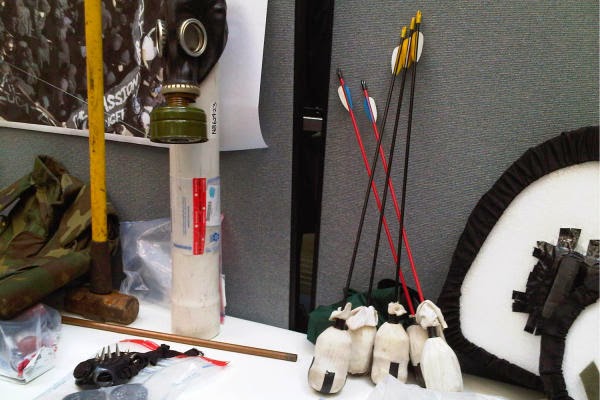
Toronto Police staged a display of weaponry to demonstrate “the extent of the criminal conspiracy” among hard-line G20 protesters, but several of the items had nothing to do with the summit....

Chief Bill Blair, who told reporters the items were evidence of the protesters’ intent, singled out arrows covered in sports socks, which he said were designed to be dipped in a flammable liquid and set ablaze.

However, the arrows belong to Brian Barrett, a 25-year-old landscaper who was heading to a role-playing fantasy game when he was stopped at Union Station on Saturday morning. Police took his jousting gear but let Mr. Barrett go, saying it was a case of bad timing.

In addition to the arrows – which Mr. Barrett made safe for live-action role playing by cutting off the pointy ends and attaching a bit of pool noodle covered in socks – police displayed his metal body armour, foam shields and several clubs made of plastic tubing covered with foam and fabric.

Full story here.

08 July 2010

Great News, by Arioch!

Chaosium's excellent Strombringer (1e and 4e versions) and Elric! role-playing games are now available for sale at DriveThruRPG and RPGNow! Most of the support material for those games are also now available in PDF, as is the 1e version of Chaosium's Hawkmoon RPG.

Strangely, Stormbringer 5e is not available. However, since SB5 is essentially identical to Elric!, this is no big deal.

Far more unfortunate, in my opinion, is unavailability of Darcsyde's excellent supplement for SB5/Elric!, Corum. The Corum supplement provides some very cool twists to the Elric! system (including an intriguing alternative 'magic' system for Law). And, personally, I find Moorcock's 'Corum' stories to be far superior to his 'Elric' ones.

Nonetheless, this is great news for fans of BRP.

Here is the official blurb from Mongoose Games:
Mongoose Publishing is happy to announce an agreement with Chaosium to publish classic Michael Moorcock RPG materials as PDFs on Drivethru. You can find them under 'Classic Moorcock' at: http://rpg.drivethrustuff.com/index.php?manufacturers_id=45
There are lots of classic books now available again, such as Atlas of the Young Kingdoms, Stormbringer, The Shattered Isle and much more. Whether you are a player of the older games or looking for more source material for Mongoose's own forthcoming and updated Elric of Melnibone (due for release next month), you can bag some handy bargains that are bound to enthrall any Moorcock fan.
I would recommend Elric! for fantasy role-playing games outside of Moorcock's 'Young Kingdoms'. Stripped of its setting-specific details, Elric! is a superior fantasy version of BRP, suitable for play in almost any 'swords and sorcery' setting. Indeed, I've often been tempted to use it for a 'Wilderlands' campaign.

It's reassuring to realize that sometimes 'good things' do happen out of the blue.

01 July 2010

Are the Nazgûl the Ultimate Fantasy Antagonists?

I’m inclined to think so. I have a hard time imagining a more dramatic or thrilling kind of foe. The Ring-wraiths are intelligent, relentless, and terrifying.

I still vividly recall watching the animated Lord of the Rings film as a wee lad. The scenes with the Nazgûl were amazing … and very frightening. In particular, the scene in which Frodo and Sam are hiding from one shortly after leaving the Shire, and the Ring-wraith starts ‘sniffing’ for the one ring, especially struck me. Bakshi’s film (although I realize now that it is deeply flawed) ignited my lifetime love of fantasy, and the portrayal of the Úlairi played a huge role in that.

The Ring-wraiths also have a tragic element. Once they were men, powerful sorcerers, kings, and princes. But their desire for power and immortality led to their entrapment. One can understand the temptation. Humanity’s fear of death – and the tragic things that it will do to avoid that fate – is a common theme in Tolkien’s Middle-earth (the fall of Númenor being the most vivid example). Consequently, I feel as much pity as I do fear for the Nine.

Above are three pictures portraying the Nazgûl by one of my favourite fantasy artists, Angus McBride.

(Oh yeah, Happy Canada Day! I’ll be back in the Great White North tomorrow.)

Blog Archive

About Me

My photo
I'm a Canadian political philosopher who lives primarily in Toronto but teaches in Milwaukee (sometimes in person, sometimes online).