01 January 2022

My three favourite RPG books from 2021

I’ve cut back way back on my RPG purchases in recent years. For the most part I try to buy only products that I think I’ll likely actually use at some point in the near-ish future, or products that I have a strong intrinsic interest in (as, say, they concern a setting, subject, or game of which I’ve long been a fan). Nonetheless, I still buy more RPGs products than I should. But there are a few every year that do not fall into the “taking-up-space-on-my-shelf-until-I-donate-them-or-retire” category. Here are three from 2021 (in no particular order):


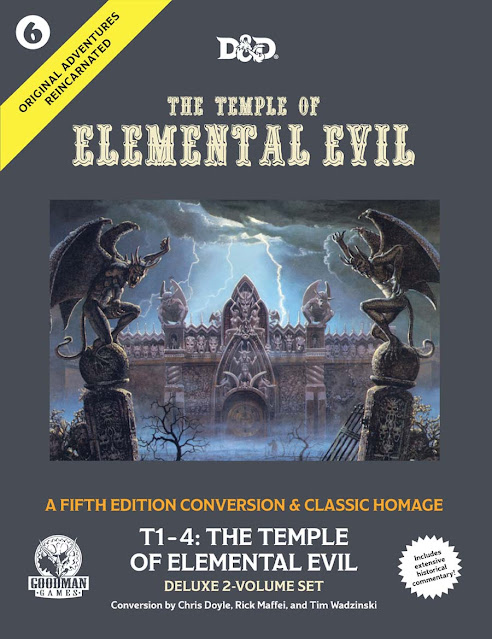
I’ll start with something I haven’t mentioned before at this blog: Goodman Games’ Original Adventures Reincarnated #6: The Temple of Elemental Evil. In addition to including scans of multiple printings of the original 1st edition AD&D Village of Hommlet module, as well as the subsequent Temple of Elemental Evil mega-module, this two-volume set provides an expanded version of the module with 5th edition D&D stats. I rank the original Village of Hommlet module as one of the all-time classics for AD&D.


I hope to resurrect my (sadly-still-on-hiatus) Greyhawk campaign (which uses 5e D&D with Gygax’s version of the World of Greyhawk) in the new year. Once the characters wrap up their current adventure, I hope to have them travel to Hommlet and go through this campaign. Afterwards, I plan to run some more classic modules in Greyhawk for my players, including White Plume Mountain (converted to 5e in Tales from the Yawning Portal), Expedition to the Barrier Peaks (another member of Goodman Games’ “Original Adventures Reincarnated” series), the “Against the Giants” trilogy (also in Tales), and perhaps even the Tomb of Horrors (yet another one in Tales). At least that’s my tentative plan for the future. (Heh ... hope springs eternal.)


Then there’s Against the Darkmaster. (I’m cheating a bit here as I got the PDF in 2020. But I don’t feel like I “really” own a book or game until I get the physical version.) I’ve mentioned this excellent game before here. I really want to run this sometime – perhaps using it with a heavily modified version of the amazing classic campaign module Ardor by Terry Amthor (RIP). Even if I don’t use Against the Darkmaster in the near future, though, my long-abiding love for MERP makes this a purchase that I don’t regret at all. I thrill just flipping through this massive, gorgeous book, appreciating the wonderful art, and reading bits of the rules.


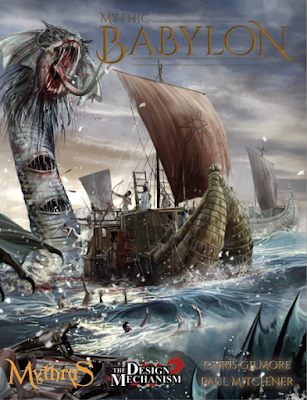
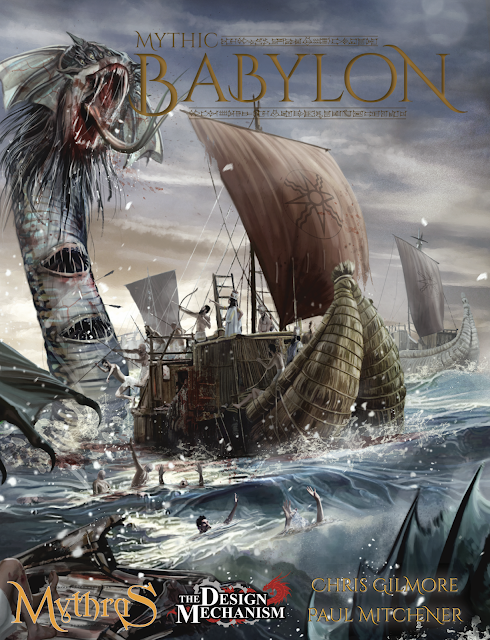
Last – but certainly not least – there’s Mythic Babylon, which I’ve also mentioned previously here. Since I’ve been playing in a Mythic Babylon campaign since summer 2020 (run by the book’s co-author, Chris Gilmore), in a way I’ve been using this book for even longer than I’ve owned it! It’s a really wonderful work from the always excellent Design Mechanism.


Okay, that's it for 2021. Best wishes, gentle readers, for 2022!

26 December 2021

Happy Boxing Day

A cheery holiday message from H.P. Lovecraft:

"Glad to hear that you had a pleasant Christmas, & the coming year may prove a fruitful and congenial one for you … All religious or other systems assigning mankind an important place in the universe are obviously primitive myths – no matter how widely & persistently perpetuated. So far as any real evidence goes, the cosmos is simply a perpetual field of interacting streams of force amidst which the galactic universe, the solar system, this tiny earth, the principle of animal life, & the human species are nothing more than momentary accidents."

- HPL (in a letter, 16 January 1935).


Here's hoping that 2022 will be a better one for the accidental human species on this tiny earth! 


16 December 2021

Mythic Babylon: 2nd best-selling historical RPG of 2021

Yesterday I mentioned that the Design Mechanism’s Mythic Babylon was the 20th best-selling "other fantasy" RPG product at DriveThruRPG for 2021. I noted that this was especially impressive given that it is something of a “niche” product.


Well today I learned that within this niche—that of “historical” RPG products—it was the second best-selling RPG product of 2021 at DriveThruRPG.


I have no doubt that within the “hyper-niche” of Mesopotamia-based RPGs, it ranks number one!

Mythic Babylon: number 20 in sales, number 1 in my heart

I’ve mentioned Mythic Babylon before here. It’s a great book: impressively researched yet not overwhelming (or dryly “academic”), and full of game-usable content (for the Mythras system). The setting is flavourful and exotic: it’s somewhat alien to most players, yet not so alien as to be incomprehensible (most players probably know who Gilgamesh and Hammurabi were – the setting takes place during Hammurabi’s time, 18th century BC). In addition to the amazing content, the writing is accessible, the maps are clear, and the art is evocative. It’s an informative, useful, and aesthetically striking work.


Despite being what I would call a “niche” product (a historical, albeit “mythical,” setting) Mythic Babylon managed to be the 20th best-selling “other” fantasy role-playing product at DriveThruRPG last year!


Kudos to the authors, Paul Mitchener and Chris Gilmore! (Disclosure: the latter is the GM for the Mythic Babylon campaign I’m currently struggling to survive in.) And kudos to the Design Mechanism for continually turning out top-notch products.


09 December 2021

How B2 became part of Basic Dungeons and Dragons

As I’ve mentioned before, my “gateway drug” into this hobby was the “Holmes” Dungeons and Dragons Basic Set, a gift from my parents over four decades ago. My version included the infamous “chits” instead of dice, and the classic Gary Gygax module B2: Keep on the Borderlands.

 [Erol Otus's evocative picture of the keep on the back of B2]


I later learned that earlier versions of the Holmes box set included Mike Carr’s module, B1: In Search of the Unknown. I always had been puzzled as to why this change was made. (At the time I also was confused as to why my box had irritating chits and others had dice, but I later learned that that was because TSR couldn’t obtain enough dice to include in all their fast-selling sets.)


Both modules (B1 and B2) include lots of helpful advice for neophyte DMs. And while B2 is, I think, the superior module overall—it includes a fleshed-out “safe haven,” a “mini-wilderness,” and a complex “dungeon” environment that, in addition to providing a variety of different kinds of monsters and challenges, can enable the players to engage in some role-playing (e.g., allying with some groups against others). Nonetheless, for starting DMs, I think B1 is a better option. It is a classic, straightforward “dungeon crawl.” Also, I thought at the time, shouldn’t B1 be included in the Basic Set?


The explanation for this change, it turns out, was Gygax’s avarice. Jon Peterson explains:

“With the Basic Set carrying In Search of the Unknown now bringing in nearly 100,000 sales per quarter and rising, the 11 cents per copy due to Mike Carr started to amount to real money, especially in pre-1980 dollars.

[…]

It was then that Gygax apparently grasped that […] perhaps TSR could try substituting in a different module to the Basic Set — one of Gygax’s own creation, Keep on the Borderlands (B2), which began to ship early in 1980.”

The full story involves TSR’s legal dispute with Dave Arneson and is explained by Peterson in his Polygon article, “How a pending lawsuit changed the original Dungeons & Dragons Basic Set.” (The article was posted two months ago—alas, I’ve been pretty “out of it” over the past few months and only read it today.)


This is hardly the biggest story in the history of role-playing games. But it’s something I distinctly remember wondering about back in the day. It’s nice to know the answer, some forty years later.

15 October 2021

Kiwi Gandalf

News from Middle-earth:

"New Zealand council ends contract with wizard after two decades of service"

"The official Wizard of New Zealand, perhaps the only state-appointed wizard in the world, has been cast from the public payroll, spelling the end to a 23-year legacy.

The Wizard, whose real name is Ian Brackenbury Channell, 88, had been contracted to Christchurch city council for the past two decades to promote the city through 'acts of wizardry and other wizard-like services', at a cost of $16,000 a year. He has been paid a total of $368,000."

Off to the Grey Havens and then Valinor, I guess?

13 October 2021

Terry Amthor RIP

At this blog I recently praised Terry Amthor’s amazing campaign module, The Court of Ardor. That module is one of my all-time favourites. While set in Middle-earth, it has a distinctive (not-really-Tolkien-ish) character, and hence I think is better treated as an independent setting. In any case, it’s really quite an amazing work, one bursting with ideas and creativity. After reading it in the mid-1980s, it forever influenced how I designed fantasy campaign settings, including especially evil ‘secret’ organizations. It inspired me in countless ways over the years, and I borrowed heavily from it in many of my games, even though I never ran it myself (although that is something I hope to correct someday).


While Ardor is Amthor’s work that most affected me, I also was greatly impressed by his Shadow World fantasy setting, and especially his campaign module, Jaiman: Land of Twilight. In many ways, Jaiman captured much of the same spirit, ethos, and energy that had infused Ardor. Like its predecessor, Jaiman included a detailed history with elaborate and distinctive organizations. It also featured a grand campaign that would enable the characters potentially to shape the history of the continent. Over the subsequent years, I purchased the additional material that Amthor published for the continent of Jaiman, and drew inspiration from it (even though, like Ardor, I never used the setting in my own games).


I also greatly appreciated Amthor’s other Middle-earth books, such as Rivendell and Lórien & The Halls of the Elven Smiths (Amthor was quite a fan of elves!), and his contributions to Rolemaster. I played his solo “Middle-earth Quest” book A Spy in Isengard a couple of times and greatly enjoyed it.

 
[Angus McBride's amazing cover for ICE's Rivendell]


Overall, Terry Amthor was one of the role-playing authors who most inspired and influenced me over the past four decades. (I’ve only mentioned his contributions with which I am familiar here. He did a lot more, as summarized by his Wikipedia profile.)


So, I was quite saddened to learn recently that Amthor had passed away. I don’t know exactly when, but the announcement from Iron Crown Enterprises was published on October 1st. I almost can’t believe it, given his age (only 62), and my complacent assumption that additional Shadow World material would appear every so often indefinitely into the future.


Rest in peace, Loremaster Amthor.


13 September 2021

MERP resurrected? Against the Darkmaster!

MERP (Middle-earth Role-playing) by ICE (Iron Crown Enterprises) is one of my favourite games of all time. It was the second game I played regularly (after D&D/AD&D). I must have spent 50% of my spare time during the mid- to late-1980s reading, thinking about, and playing MERP. I feel much the same nostalgia for the MERP core book and some early campaign books that I do for the first edition AD&D manuals and classic Gygax modules. 

[Chris Achilleos's rather "metal" cover for the 1985 UK edition of MERP.]

I fondly recall running an extensive campaign set during the early Fourth Age that involved the characters journeying to the far north—the Bay of Forochel—in order to recover the lost Palantíri of Arthedain. One of the characters was the son of Eowyn and Faramir, another the son of Samwise Gamgee. I made a lot of mistakes in running that campaign (in my defence, I was only a teenager). But I learned as it went on, and I think everyone had a great time. (This campaign was based upon a brief outline included in the Rangers of the North campaign book. Most of that book focused on Arthedain in the middle of the Third Age, around 1640, when it was the last kingdom of the north standing against the dark realm of Angmar and its Witch-King. However, the book did include some suggestions for adventurers during different eras, including a couple for the early Fourth Age. The adventure outline later would be developed by ICE into 1994’s epic Palantír Quest.) 

Over time I developed something like 600 years of history for the Fourth Age for my various MERP adventures. (I did not like the default 1640-1700 Third Age setting at the time, as I didn’t like the idea that my games would be bound by a particular “future history.” These days such a thing would not bother me at all, although I still think that that era is too unfamiliar to fans of The Lord of the Rings, as, for instance, Rohan does not exist yet and Moria has not fallen to the Balrog. The choice by the designers of The One Ring and Adventures in Middle-earth to set their adventures in the period between The Hobbit and The Lord of the Rings makes more sense in this respect. But I digress…)

I loved the ICE campaign and adventure modules—even the ones like The Court of Ardor and Greater Harad that strayed away from Tolkien’s Middle-earth, both geographically and thematically. In fact, I was fascinated by the ways in which ICE’s writers developed Middle-earth beyond the areas described by Tolkien. Even as a teenager, though, I could tell that some of these developments were not fully consistent—in either detail or spirit—with Tolkien’s writings. Nonetheless, I didn’t care that much, as the material (usually) was cool, exciting, and full of flavour. Ardor in particular remains a favourite. (If I were to use it today, though, I would sever it from Middle-earth and place it in its own setting.)

The Peter Fenlon maps and Angus McBride covers were pure magic as well. I love them to this day—indeed, I rank Fenlon and McBride among my favourite FRPG artists of all time.

The system, for the most part, was not crafted to emulate Tolkien’s world. It was a simplified version of Rolemaster (RM), a version that, I think, kept what was good about the RM system (namely, its critical hit and fumble charts, and its novel—for the time—combined character class, level, and skill system) while helpfully streamlining the system overall. Eventually the game’s designer, S. Coleman Charlton, added a couple of subsystems to try to rein in MERP’s magic system (namely, a system for determining whether Sauron or his minions detect the use of powerful magic by the characters, and a ‘corruption’ system for the misuse of magic). These subsystems were meant to encourage keeping the use of “flashy” magic (e.g., fire bolts and the like) rare, and thus more closely resemble the way in which magic is portrayed in Tolkien’s books. I doubt that many groups in fact used these rules (we didn’t). Overall, the MERP rules were, I think, a poor fit for Middle-earth in many respects, magic in particular. But casting spells was fun, and we didn’t care that we were playing a rather D&D-ish game in an ersatz Endor. 

In short, despite its various shortcomings, I was—and remain—quite fond of the MERP system. It was a faster, more playable—and I think more fun—version of Rolemaster. 

Over the past dozen years or so, with the rise of “retro-clones” and “quasi-clones” for various editions of D&D and AD&D (and other games), including the quasi-clone Crypts and Things, I had been wondering about the feasibility of a “quasi-clone” of MERP. Just over a decade ago ICE produced something kind of like this with Rolemaster Express (RMX). However, RMX disappeared for some reason when ICE changed ownership, and it wasn’t really MERP in any case (but rather a very stripped-down version of second edition or “Classic” Rolemaster).  

[Against the Darkmaster's awesome cover.]

Now there is Against the Darkmaster (VsD for short). This game is clearly inspired by, and draws heavily on, MERP. But it’s not a retro-clone (i.e., it’s not the MERP version of OSRIC). Rather it’s what I would call a quasi-clone (a game that draws heavily on an earlier one, and retains broad compatibility with its predecessor, but also deviates from it in some important ways). VsD looks like it’s compatible with MERP, in the sense that it should not be difficult to use MERP material with the system. But VsD introduces some new elements. For instance, VsD separates “races” from “cultures”: both humans and halflings, for instance, can have the “pastoral” or “urban” backgrounds. These elements of characters were not distinguished in MERP. 

It goes without saying that VsD is stripped of any specific references to Tolkien’s Middle-earth. It is easy to find equivalent races and cultures, though, if you want to use the game in that setting, say, if you want to use VsD with some of ICE’s old MERP campaign and adventure modules. Dúnedain Rangers of the North, for instance, would be High Men with the “Weald” culture (or perhaps the “Fey” culture for those raised in Rivendell).   

I’m very impressed that the Against the Darkmaster core book includes a small setting and set of connected adventures—an entire mini-campaign—called “Shadows of the Northern Woods” (almost 50 pages of material). Running these adventures could easily take a group 10+ sessions. I think it’s important for games to include starter adventures, as they provide an easy way for groups to test out new systems. But to include a small but rich setting with three adventures is exemplary. The plot of the campaign also strikes me as quite intriguing. I’d love to run “Shadows” sometime. 

The book is incredibly thick (565 pages!). The rules strike me as well considered and potentially a lot of fun (although I’ll need to go through them more carefully once I find the time). The MERP foundation is clearly there, but with many interesting refinements and improvements. VsD fixes some of the main problems with the MERP system, I think, while keeping all the good stuff (critical hits, the solid class-with-skills system, the core d100 'higher-is-always-better' mechanic, etc.), and making the system setting-neutral. It adds options while at the same time making the system overall more coherent and straightforward. It’s an impressive accomplishment!

The art is top notch as well (though not quite McBride caliber, of course).

[A couple of "Noldor" ... er, "Star Elves."]

In short, my impression of Against the Darkmaster is very positive. This may be my favourite new FRPG since Mythras!

[Angus McBride's original cover for MERP. Note the family resemblance?] 


23 August 2021

Steve Perrin, RIP


Influential game designer Steve Perrin passed away recently at the age of seventy-five.

In addition to RuneQuest, Perrin authored or contributed to numerous other role-playing games, including two of my all-time favourites: Stormbringer and Call of Cthulhu. And RQ's system, of course, informed all subsequent Basic Roleplaying (BRP, or “d100”) games. He also authored the influential AD&D module, Under Ilefarn, which was the first original adventure for TSR’s Forgotten Realms setting. 

Arguably, Perrin’s influence on RPG design was second only to that of the genre’s creators, Gary Gygax and Dave Arneson.

Shannon Appelcline provides a nice overview of Perrin’s work here.


15 July 2021

I cast magic missile

I was walking along Queen Street East in my neighbourhood this morning when I came upon a television or movie crew working outside of a coffee shop. This is not an uncommon occurrence in Toronto (at least once a month I encounter some filming happening during my various urban ramblings). It was not clear to me, though, whether I should cross the street to avoid them, and so I hesitated.

I was wearing a dark t-shirt that had “I cast magic missile!” emblazoned upon it. The guy in charge (who had been telling people to move things hither and thither) noticed me and said: “You can pass, no worries –- so long as you don’t cast any second-level spells!”

I had a good laugh at that. Nerds: we’re everywhere.

P.S. This is the shirt (but not me modelling it): 


Blog Archive

About Me

My photo
I'm a Canadian political philosopher who lives primarily in Toronto but teaches in Milwaukee (sometimes in person, sometimes online).