12 June 2023

Recommended: Swords and Wizardry Complete – Revised Edition

The kickstarter for the revised version of the Swords & Wizardry Complete rules was a great success. Backers (like myself) now have PDFs of the new core rulebook. I’ve looked it over and am very favourably impressed. The organization and layout have been improved from earlier versions. Information is presented in a direct, economical, but nonetheless aesthetically pleasing way. Kudos to Suzy Moseby on doing such a fine job on the layout. The art is solid, with a few very good pieces, and nothing objectionably unappealing. I like all three covers (the Erol Otus one [depicted below], as well as the green and blue designs by Del Teigeler). (But I do miss the original wonderful S&W cover by Pete Mullen.)

It's amazing to me how much content Matt Finch has managed to pack into such a slim package (144 pages) in a clear and accessible way. Roughly speaking, Swords & Wizardry Complete, gives you pretty much everything in the original D&D 1974 box set, and a lot (but not all) from the subsequent supplements (Greyhawk, Blackmoor, and Eldritch Wizardry). What you end up with is something very close to Advanced Dungeons & Dragons (as realized in 1979), but somewhat simpler and lower-powered. The main (or at least most noticeable) differences: in S&W there are no half-orcs, gnomes, illusionists, or bards; alignment is three-fold (Lawful, Neutral, Chaotic); hit dice are lower (e.g., fighters have d8 in S&W instead of d10 as in AD&D); and slightly lower level-limits for demi-human characters. Aside from these changes – which, of course, are easy to modify if one wishes – S&W provides a “simplified” version of AD&D, and is readily compatible with most material produced for D&D and AD&D prior to 3rd edition.


There are some minor but helpful innovations in S&W that distinguish it from "0 edition" D&D. Among them: the ‘ascending’ scale for AC is used (which I appreciate and find preferable to the older system, although the old ‘descending’ system is provided as an option as well); a single unified ‘saving throw’ is provided for each class (but with the option to use the older system, broken down into categories like “death rays and poison”); four different options for determining initiative are outlined; rules for morale are provided; and rules for two-weapon fighting are included. These are all helpful additions to the game in my view.   


Since it is a “clone” of early (0e) D&D, S&W includes elements from that system that personally I am not that keen on. For instance, the special abilities of thieves (as well as assassins and monks) are quite miserable, with very low chances for success at anything until characters achieve higher (7+) levels. If I were to run S&W again, I’d probably just use my version of the class instead. Likewise, I’ve never been a fan of the way earlier editions of D&D and AD&D implemented “level limits” on non-human characters. I think that there are better ways to “balance” non-human characters against human ones. (S&W does include an optional rule to permit non-human characters to advance beyond their level limits, but with a 50% penalty to experience points earned by those characters. I’d likely either use that option, or simply grant some additional bonus to human characters instead.) Of course, one cannot really fault a retro-clone like S&W for “cloning” such rules from earlier editions, and in any case such things are easy to house-rule.  


In short, this revised, updated version of Swords & Wizardry is excellent, the best version yet. It was the “retro-clone” that helped inspire this blog in 2009 – and for which I wrote a number of house-rules – and it remains my favourite. I highly recommend it to anyone who enjoys the spirit of old school Dungeons and Dragons!


(For a more comprehensive review, check out this one at the blog “It’s Okay; Gary Sent Us.”)

09 June 2023

Rest and Recovery in Into the Unknown versus 5e D&D

One of the things that I dislike the most about the standard 5th edition Dungeons & Dragons rules is its system of “rests.” Even if adventurers have been in the savage wildlands for several weeks, so long as they can manage to camp for eight hours, i.e., take a “long rest,” all of them will be (almost) as good as new. After a long rest, characters recover all their hit points, spells, abilities, and so forth. The only minimal kind of attrition that they experience is that they can recover only half of their hit dice (but another long rest a day later can get them back to full).


The potency of long rests greatly reduces the roles of attrition and resource management in adventuring, things that were very important in earlier (TSR era) versions of the game. Attrition and resource management make the game more interesting and challenging, in my view. And while D&D has never been very good with respect to “simulation” (to say the least), completely “recharging” after a nap in a sleeping bag is “video-gamey” at its worst. 


Now there are options that DMs can use alter the unfortunate nature of rests and recovery in 5e D&D. The Dungeon Master’s Guide mentions a few decent ones in Chapter 9. One is “Healer’s Kit Dependency,” which requires the use of a healing kit in order for a character to spend any hit dice (healer’s kits come with 10 ‘uses’ each). Another is “Slow Natural Healing,” which eliminates the automatic recovery of hit points after a long rest (characters have to spend hit dice in order to recover any hit points, whether after long rests or short rests). And then there is the “Gritty Realism” rest variant, according to which a short rest is eight hours, and a long rest one week. A version of the latter option is used in Adventures in Middle-earth (now Lord of the Rings Role-playing), with “long rests” possible only in ‘safe’ locations (e.g., Rivendell or Lake-town), which perhaps explains why I was so thrown off by the standard 5e rules after having run an AiME campaign in the past.


The Into the Unknown rules make rest and recovery somewhat less easy than do the standard 5e rules, although they don’t go as far as AiME or the “Gritty Realism” variant. Below I’ve summarized them. I also added “safe rest,” although I think that it just makes explicit what is already implicit in the rules. Obviously, these rules could be used in any 5e D&D game (given the compatibility of ItU with 5e). 


Short rests: One segment (10 minutes) with no strenuous activity (e.g., combat).


·       No more than one short rest can be completed in any given hour. (Characters can “rest” for longer than one segment if they choose, of course, but they will gain the benefits for only one short rest in doing so.)

·       Characters must consume rations (one-third of one day’s worth) in order to gain any benefits from a short rest.


·       During a short rest, a PC can:


o       Spend one hit die to recover hit points (only once/PC).

o       Use a healing kit to spend one additional hit die to recover hit points (only once/PC).

o       Regain “Second Wind” (fighters).

o       Regain “Mighty Deeds” (fighting style – fighters).

o       Regain “Action Surge” (fighters).

o       Regain “Indomitable” (fighters).

o       Regain “Channel Divinity” (priests).

o       Use “Arcane Recovery” (magic-users).

o       Regain “Arcane Study” (magic-users).

o       Regain “Spellcraft” (magic-users).


Long rests: Two watches (8 hours) with no significant disruptions (e.g., combat, strenuous actions, chases, etc.).


·       No more than one long rest can be completed every 24 hours. (Characters can “rest” for up to 24 hours if they choose, but they will gain the benefits for only one long rest in doing so.)


·       After a long rest, a PC:


o       Recovers one used hit die.

o       Can spend multiple hit dice to recover hit points (these rolls are made with advantage, unlike rolls after short rests).

o       Recover one level of exhaustion.

o       Prepare spells.

o       Regain spell slots.

o       Regain “Arcane Recovery” (magic-users).

o       Regain any abilities that would be regained after a short rest (see above).


Safe rests: At least one full day (24 hours) of rest in a safe, civilized location (e.g., a well-protected keep, an inn within a friendly town, an elf-lord’s haven, etc.).


·       After a safe rest, PCs recover all lost hit points, hit dice, spells, class abilities, etc. 

o       Certain unusual conditions (e.g., specific diseases) may require multiple safe rests or special treatments (e.g., potions, spells, rituals, divine intervention, etc.) to remove.


05 June 2023

Against the Darkmaster – June sale


To celebrate its 5th anniversary, for the month of June Open Ended Games is offering the PDF of the Against the Darkmaster rulebook at 50 percent off.

I'm not sure if this is part of the same sale, but physical versions of the core rules and GM screen are available as a "bundle" for 75 USD (instead of 90 USD) here.


I’m a big fan of this game – indeed, I wish I was running it right now! 


If you’d like to learn more about VsD, the quick start rules are available for free ("pay what you want") here. In addition, here is a review, and here is another, and here is one more. 


(The illustration above is a draft of the cover, found at the artist’s website.)

04 June 2023

Victory in the Moathouse (Greyhawk campaign)

PART 7: Victory in the Moathouse and an Unpleasant Ambush
(Flocktime 578 CY)
 

7.1 Confrontation with Lareth the Beautiful (Flocktime 12th)
 
Our doughty adventurers — Erik (the mountain dwarf fighter from the Lortmils), Althaea (the high elf wizard from the city of Tringlee), and the brothers Godric (the human rogue from the Barony of Shiboleth) and Cedric (the human cleric of St. Cuthbert) – find themselves within the lair of Lareth, the “Master” of the ruined Moathouse. The party is accompanied by Spugnoir (a scrawny and squeaky Suel wizard). But they no longer are accompanied by the traitorous Zert (who lies lifeless, with a thoroughly pulped head, among the bodies of many black-clad followers of Iuz). 
 
The party leaves the area that had been occupied by Lareth and his followers. They explore further into the underground complex beneath the Moathouse. Eventually, the party confronts Lareth again – this time, the foul champion of Chaotic Evil is accompanied by a horde of zombies and a terrible ogre (whom Althaea recognizes from her earlier encounter when first exploring the Moathouse ruins). Lareth laughs maniacally as the shambling undead and hulking humanoid assault the adventurers.


Things look quite bleak initially, as the ogre smashes its club onto Erik’s head, knocking the dwarf out in a single blow. Althaea retaliates with several magic missiles. Astonishingly, it is Spugnoir who manages to finish off the ogre, with a couple of well-placed thrusts with his dagger. Cedric calls upon the holy might of St. Cuthbert and manages to repel some of the zombies. At the same time, though, Lareth calls upon the unholy wrath of Iuz, and compels Althaea and Godric to drop what they’re doing and grovel before him. The situation looks dire, but Cedric blasts Lareth with a divine bolt. Althaea and Godric recover their wits. The elf then hits Lareth with some magic missiles and the rogue follows up by slicing open Lareth’s jugular. The golden “Master” of the Moathouse is no more! Ultimately, it is the adventurers who have the last laugh.
 
The remaining zombies collapse with the death of their master. Cedric quickly heals Erik, returning the dwarf to consciousness.
 
The party loots Lareth’s body and returns to his lair. There, the adventurers assemble the various items they’ve found, and Althaea casts detect magic. Lareth’s black plate mail, ring, and staff all radiate arcane energy, as does Zert’s sword “Betty.” The party rests for the remainder of the day (about eight hours). Later, the ring is discerned to grant “free movement” to its wearer. It is given to Godric. The staff is of “striking” power, and “Betty” is unusually sharp. 
 
7.2 The Rescue of Knarf and Departure from the Moathouse (Flocktime 13th)
 
After recovering some of their strength, the party explores much of the remaining complex beneath the Moathouse. While doing so, Erik, full of bitterness, smashes in Lareth’s head with the sword “Betty.” Eventually, the party triggers a trap that releases a portcullis in a passageway, preventing further investigation of the western area. 
 
After some further exploration, the party returns to the secret exit located to the east of the main complex, the place where they had first entered the tunnels. As they had noted earlier, the rope ladder had been cut and the trapdoor closed. Althaea uses her mage hand to secure a rope and grappling hook to an iron rung just beneath the trapdoor above them. Erick climbs up the rope and (after several attempts) manages to prod open the trapdoor with “Betty.” He clambers onto the surface, only to be hit immediately with a frosty orb cast at his head by a nearby fiendish gnome. Despite this icy shock, and with a surge of energy, Erik scrambles toward the gnome and hits him with his sword. The gnome squeals in agony and subsequently disappears in a puff of mist. Given the fogginess of the night, and the pounding of his head, Erik cannot locate where the gnome has gone. By the time the rest of the party reach the surface, the vile gnome appears to have fled the area.
 
The party re-enters the underground complex via the other secret entrance, the one within the bandits’ headquarters within the Moathouse itself. They find the ogre’s lair. While exploring, Erik thrusts his sword into a pile of rugs and mats, accidentally tearing a finely made cloak buried within the pile. The party opens a barred door, revealing an imprisoned, emaciated gnome, and two dead humans. Cedric aids the poor gnome.
 
After gulping down some much-needed liquid, the gnome creakily introduces himself as Knarfallan of Gneissvale – or “Knarf” for short. He explains that he, and his two guards (the dead humans), were captured days ago while travelling from Gneissvale to Hommlet. Knarf reveals that there were three “evil” gnomes in league with the bandits, along with the ogre, Lareth, and the cultists. In gratitude for being rescued, Knarf gives Althaea an iron ring that indicates that the bearer is a “gnome friend.” 
 
The party returns to the bandit lair and rests for a few hours. Erik attunes himself to the staff of striking, while Althaea discerns that the torn cloak is in fact a “Cloak of Elvenkind.” She hopes that it will be easy to repair, and asks Spugnoir to use his prestidigitation cantrip to clean it of the ogre’s foul stench and lice.
 
The party conducts a final investigation of the underground complex. They find the gnomes’ dwelling place. There they uncover three scrolls (“Disguise Self,” “Hold Person,” and “Misty Step”), and a letter written in gnomish. Spugnoir is delighted with the scrolls – finally his participation in this adventure is paying off! Knarf translates the letter, informing the party that it is addressed to an unnamed “friend” in Nulb, and that it concerns the activities of the brigands over the past few weeks, including some trouble with “meddlesome adventurers” – no doubt the party! The letter is signed “Moth-Gar” – presumably one of the evil gnomes.
 

Exploring a bit further, the party defeats a few ghouls, and then decides to abandon the damnable place. They go to the above ground ruins in order to recover an ivory box that they had left within a ruined tower days ago. Erik enters the tower to pick up the box, but is immediately attacked by a giant spider. However, the spider is instantly pulverized by a number of magic missiles launched by Althaea. The party then loads their mule Vick up with recovered loot (including two suits of black plate mail, one of which is Lareth’s enchanted armour). After a short rest, the party begins their march back to Hommlet.
 
7.3 Ambush! (Flocktime 13th)
 
It is a grey, dreary morning as the party trudges back to Hommlet. The bleak weather matches the adventurers’ sense of exhaustion. After a couple of hours of slow progress, Godric spies something ahead. It is a wagon behind a dead horse, slain by several arrows, with a rather frustrated gnome looking on. Althaea casts invisibility on the Godric. Scouting unseen, the rogue spots a dead archer to the east. It looks as though the archer slew the horse before being himself slain. A quick search of the body reveals it to be wearing a “Burne’s Badger” tunic.
 

The party cautiously approach the gnome, who gestures at them for help. Alas, it is an ambush! Appearing out of nowhere – presumably previously invisible – the malevolent “traders” Rannos Davl and Gremag attack, along with a couple of warriors who burst out of the back of the wagon. Spugnoir is badly wounded by a deadly thrust from one of Gremag’s daggers. The gnome tries to cast a spell, but it fizzles. Enraged, Erik smashes in Rannos Davl’s fat head, and kills the gnome in a gory explosion with his deadly staff of striking. The two warriors also are slain with little difficulty, but the surprisingly deft Gremag disappears in a dusty cloud, managing to escape the wrath of the party.

The adventurers take the body of the dead archer, placing it on the back of poor Vick, in order to return it to Burne’s Badgers. Althaea examines the loot recovered from the ambush. She finds that Rannos Davl’s shortsword and dagger both radiate magic. The dagger is given to the shaken Spugnoir.
 
7.4 Return to Hommlet (Flocktime 13th)
 
As evening approaches, the party arrives back at Hommlet. There they meet immediately with Canon Terjon at the Church of St. Cuthbert. Cedric updates the priest on the events that took place at the Moathouse, as well as the treason of Rannos Davl and Gremag. Canon Terjon is astonished and worried. He tells the party that there will be an emergency town council meeting the next day, at which the party can convey their news to the other council members. 
 
The party returns to the Inn of the Welcome Wench. They collapse in exhaustion. 

 [Cedric, warrior priest of St. Cuthbert]

[For other instalments and more information about this campaign, check out the Index.]

31 May 2023

Tales of the Variants

As I noted back in February, following the great “OGL Crisis” of Janurary 2023, a couple of companies that produce materials for 5th edition Dungeons and Dragons decided to produce their own versions of the game in order to avoid being subject to any future deleterious decisions by the Wizards of the Coast (even after WotC backed down on scrapping the old OGL).


One of those companies, Kobold Press, recently announced a kickstarter for its 5e variant, Tales of the Valiant. If you’re curious about it, there is a free preview PDF that you can download from the kickstarter page (available even if you don’t want to be a backer).


The name is terrible in my opinion (I think I preferred its previous name, “Project Black Flag”), but the company is solid. I'm mixed on what I’ve seen of the system so far. (I mean, it’s 5e with tweaks, but I'd rather have something more stripped down.) Nonetheless, I’m more likely to use it as a resource in the future than the revised 2024 version ("5.5e") of D&D that WotC is currently working on. 


Cubicle 7 is also coming out with its version of 5e later this year. C7 did very good work on Adventures in Middle-earth – indeed, in terms of the rules, I liked running it a lot more than standard 5e. And I’m going through C7’s Uncharted Journeys book now (which adapts the AiME travel rules to standard 5e fantasy). It also is very good, and I’m thinking of using it in future games. So I’ll be interested in checking out “C7d20” whenever it’s released.


(Regarding AiME: as mentioned last year, the game is now the Lord of the Rings 5e. The system has been revised and is now published by the Free League, just as the Free League also has taken over publishing The One Ring 2nd edition. I just got my "physical" version of the LotR 5e core book, and it looks excellent. AiME/LotR shows how 5e can be used to create something better than the original WotC 5e game. But I digress…) 


For 5e D&D, I remain very happy with my version of it: Into the Unknown with some houserules. However, I do sometimes wish that ItU had similar production values to TotV and the like. But, well, it's only an “indie” game. The kids these days sadly prefer fantasy super-heroes to gritty old-school dungeon delving.


17 May 2023

Russ Nicholson RIP

Some sad news: the amazing artist Russ Nicholson has passed away. 


Nicholson probably is best known for his art in the Fiend Folio (1e AD&D), as well as his work in many of the classic “Fighting Fantasy” gamebooks, including the first one, The Warlock of Firetop Mountain. 


Fellow fans of Mythras may recognize his work from Monster Isle. 
One brilliantly disturbing example:


Back in 2011, I identified Nicholson as my 5th favourite FRPG artist of all time – and Nicholson was kind enough to post a “thank you” comment.

Many great works by Nicholson can found at his blog, The Gallery: Art of Russ Nicholson. (All of the illustrations in this post, except for the one of the Githyanki [which is from my PDF of the Fiend Folio], were taken from Nicholson's blog.)


RIP.


12 April 2023

The Hedge Knight: Dunk and Egg coming to HBO


The first four seasons of The Game of Thrones HBO series are among the best ever produced for television. (The later seasons were weaker, especially the last two, although I didn’t loathe the final season.)

The recent House of the Dragon series was fine. But it lacked any especially sympathetic or engaging characters in the mould of Arya, Tyrion, of even Jon Snow. 

Fortunately, some stories written by G.R.R. Martin in the world of Westeros that do include a couple of sympathetic and charming characters — “Dunk” (Ser Duncan the Tall) and “Egg” (Aegon V Targaryen) — will be made into a series: A Knight of the Seven Kingdoms: The Hedge Knight. 

I’m cautiously looking forward to this. 


08 April 2023

Into the Unknown – The Akratic House Rules

As promised, here are my house rules for the Into the Unknown role-playing game. 

My overall aim with these house rules is to help ItU resemble more closely first edition Advanced Dungeons & Dragons, especially as realized within the World of Greyhawk setting. But since the campaign started out using the standard 5e D&D rules, I kept a few additional things from 5e for the sake of continuity (things that I probably would not bother with if I were starting a new campaign).


Races


General Notes:


·       Races and classes are distinguished from each other (in contrast to the core ItU rules).

·       Only humans, half-elves, and half-orcs select backgrounds (e.g., academic, acolyte, etc.).

o       Other races receive background benefits as part of their race (along with special traits).

·       The special “race classes” in Into the Unknown (ItU) are available, but only to members of the relevant races (see below for more information).

·       Only humans receive the ability score increases due to their classes (e.g., +1 dexterity and +1 to any other ability score for rogues).

o       These class bonuses are in addition to the ability score bonuses all humans receive (see below).  


Dwarf


·       The base “Dwarf” class (from ItU) is renamed Dwarven Defender.

·       At level 1, dwarves (any class) may choose to increase their Wisdom by 1 instead of their Strength. (All dwarves gain +2 to their Constitution at level 1.)

·       There is no mechanical difference between “Hill” and “Mountain” dwarves.

·       In addition to the Dwarven Defender, dwarves may belong to any of the core classes: fighter, rogue, magic-user (wizard), priest. 

o       However, they may not be druids and dwarven magic-users are extremely rare. 

·       All dwarves receive the dwarf background and traits listed below.


Dwarf Background and Traits:


o       Ability Modifiers: +2 to Constitution and +1 to Strength or Wisdom.

o       Claim to Hospitality (from other dwarves).

o       Proficiency Area: Dwarves are learned in the lore of the underworld, its creatures, stonework, mining, basic engineering, precious metals, and stones of all sorts.

o       Languages: Common, Dwarven, and one humanoid language (e.g., Goblin or Orcish). 

o       Weapon Proficiencies: battleaxe, handaxe, light hammer, warhammer. 

o       Tool Proficiencies: proficiency with one of:

§  Smith’s tools 

§  Brewer’s supplies

§  Mason’s tools.

o       Speed: 25 feet.

o       Special Abilities: Darkvision, Dwarven Resilience, Stonecutting.


Elf


·       The base “Elf” class (from ItU) is renamed Elven Mystic.

·       At level 1, elves may choose to be High Elves and increase their Intelligence by 1 (instead of their Charisma), or they may choose to be Wood Elves and increase their Wisdom by 1 (instead of their Charisma).

o       Elves who opt to stick with the Charisma increase may be either High or Wood Elves (or of mixed heritage).

·       In addition to the Elven Mystic, elves may belong to any of the core classes: fighter, rogue, magic-user (wizard only), priest. 

o       However, high elf priests must be clerics whereas wood elf priests must be druids. 

·       All elves receive the elf background and traits listed below.


Elf Background and Traits:


o       Ability Modifiers: +2 to Dexterity and +1 to Intelligence (High Elves only) or +1 to Wisdom (Wood Elves only) or +1 to Charisma (all Elves).

o       Claim to Hospitality (from other elves).

o       Proficiency Area: Elves are skilled in poetry, guile and wit, faerie lore, and woodland lore. They have knowledge both arcane and druidic. 

o       Languages: Common and Elvish.

o       Weapon Proficiencies: longsword, shortsword, longbow, shortbow.

o       Speed: 30 feet.

o       Special Abilities: Darkvision, Fey Ancestry, Trance.

§  High Elf Abilities: Bonus Magic-User Cantrip; Extra Language (standard or exotic).

§  Wood Elf Abilities: Fleet of foot (speed 35 feet); Mask of the Wild (hiding is possible even when the elf is only lightly obscured by foliage, heavy rain, falling snow, mist, and other natural phenomena).


Half-Elf


·       Half-Elves are of mixed elvish and human ancestry. They enjoy life spans more than twice that of humans but nonetheless are short-lived in comparison to elves. Most half-elves feel more comfortable in human societies where they can blend in more easily than they can within elvish settlements.

·       Half-elves may be fighters, rogues, magic-users (wizards only), or priests.

·       Half-elves may select any Background (like humans). 


Half-Elf Traits:


o       At first level a half-elf adds 1 to any two ability scores (but they do not receive the class-based ability score increases that humans do). 

o       Darkvision (as Elves).

o       Fey Ancestry (as Elves).

o       Languages: Common and Elvish.


Gnome


·       All surface gnomes are forest gnomes, including those who dwell in hilly areas and tunnels. They are simply called ‘gnomes’. (‘Deep gnomes’ [‘Svirfneblin’] dwell deep beneath the earth and are not available as player characters. Rock ‘tinker’ gnomes do not exist.)

·       At level 1, gnomes gain +1 Dexterity and +2 Intelligence. 

·       Gnomes may be fighters, rogues, magic-users (wizards), priests. 

·       All gnomes receive the gnome background and traits listed below. 


Gnome Background Traits:


o       Ability Modifiers: +2 to Intelligence and +1 to Dexterity.

o       Claim to Hospitality (from other gnomes).

o       Proficiency Area: All gnomes possess knowledge of the natural world (forests, hills, and tunnels) and basic (‘exoteric’) arcane lore.     

o       Languages: Common and Gnomish.

o       Speed: 25 feet.

o       Special Abilities: Darkvision, Gnome Cunning (advantage on Intelligence, Wisdom, and Charisma saving throws versus magic), Natural Illusionist (knowledge of the minor illusion cantrip [uses Intelligence for spellcasting]), Speak with Small Beasts (through sounds and gestures, can communicate simple ideas with small or smaller beasts, e.g., squirrels, badgers, rabbits, moles, woodpeckers, robins, crows, etc.).


Half-Orc


·       Half-Orcs are of mixed orcish and human ancestry. They have life spans even briefer than humans, rarely living beyond 75 years. Most half-orc characters are from human societies and try their best to blend in.  Half-orcs often can pass themselves off as humans.

·       Half-orcs may be fighters, rogues, or priests (clerics only).

·       Half-orcs may select a Background (like humans). 


Half-Orc Traits:


o       Ability modifiers: +2 to Strength and +1 to Constitution; -1 to Charisma. (Half-orcs do not receive the class-based ability score increases that humans do.) 

o       Darkvision (from their orcish heritage).

o       Orcish Endurance: When reduced to 0 hit points but not killed outright, the half-orc can drop to 1 hit point instead. This feature can only be used once per long rest.

o       Languages: Common and Orcish.


Halfling


·       The base “Halfling” class (from ItU) is renamed Halfling Wanderer.

·       At level 1, halflings may choose to be of Hairfoot heritage (and gain +1 Charisma) or of Stout heritage (and gain +1 Constitution) or of Tallfellow heritage (+1 Wisdom). (All halflings gain +2 Dexterity.) 

·       In addition to the Halfling Wanderer, halflings may be fighters, rogues, or priests. 

o       Halflings may not be magic-users.

·       All halflings receive the halfling background and traits listed below. 


Halfling Background Traits:


o       Ability Modifiers: +2 to Dexterity and +1 to Charisma (Hairfoot) or Constitution (Stout) or Wisdom (Tallfellow).

o       Claim to Hospitality (from other halflings).

o       Proficiency Area: You are skilled in farming, leisure, cooking, herbalism and knowledgeable in cartography, the lore of the land in woodlands, hill country, plains and farmland. You excel at hiding and not bringing attention on yourself and naturally make an amiable yet unassuming impression on others. 

o       Languages: Common and Halfling.  

o       Speed: 25 feet.

o       Special Abilities: Lucky, Brave, Nimble. 

§  Hairfoot Ability: Stealthy.

§  Stout Ability: Resilience.

§  Tallfellow Ability: Stealthy.


Human


·       Humans may be fighters, rogues, magic-users (wizards only), or priests.

·       Humans, and only humans, receive the ability score bonuses for whichever class they choose. 

·       In addition to selecting a Background, humans receive the following traits:


Human Traits:


o       At first level a human character receives +1 to two separate ability scores (player’s choice; these bonuses must be applied to different ability scores) in addition to that character’s class-based bonuses (these bonuses may overlap with the selected ones).

§  No single ability score can be improved by more than +2 at first level (+1 from the human trait and +1 from the character’s class).

o       Languages: Common and a standard language of the player’s choice.


Classes


For the sake of continuity, I am allowing the “battle master” subclass for fighters, the “arcane trickster” subclass for rogues, the “abjurer” specialization for wizards, and the “war” domain for clerics in my current Greyhawk campaign. (If I were to start a new Into the Unknown campaign, I probably would allow only the “war” domain cleric.)


Fighter


Battle Master (variant Fighter)


Battle Masters forego the following fighter class (ItU version) features:


·       Improved Critical (3rd level)

·       Remarkable Athlete (7th level)

·       Additional Fighting Style (10th level)


Battle Master do not select a fighting style like regular fighters but instead gain the following ability at 1st level:


·       Defence: when wearing armour, the battle master gains +1 to AC.


Other abilities as per the standard 5e version of the battle master subclass.


Rogue


Arcane Trickster (alternative Rogue’s Scheme).


Arcane Tricksters forgo the following rogue class (ItU version) features:


·       Fast Hands (3rd level)

·       Second-Story Work (3rd level)

·       Supreme Sneak (9th level)


Additional special abilities are as per the standard 5e version of the arcane trickster subclass.


Priest – Cleric


War Cleric (alternative Divine Order).


·       War clerics are proficient with heavy armour and all martial weapons.

·       War clerics have the ‘martial caster’ ability (like other clerics).


War clerics forego the following cleric class (standard ItU version) features:


·       Disciple of Life (1st level)

·       Preserve Life (2nd level)

·       Blessed Healer (6th level)


The War Domain spells (5e version) replace those listed as always prepared for the cleric (see ItU, p. 14).


War clerics gain the standard 5e abilities for the “war” domain. 


Magic-user


§  The only Arcane Origin available is Wizard.


Magic-user – Alternative Wizard 


Abjurer (variant Wizard) [Restricted to humans, high elves, and half-elves.]


Abjurers forego the following class features (ItU version of wizard):


·       Loremaster (2nd level)

·       Signature Focus (6th level)

·       Spellcraft (10th level)


Abjurers gain the standard (5e version) abilities for this wizard subclass.  


Alignment


The standard nine alignments will be used (e.g., Chaotic Good, Lawful Evil, etc.).


Experience


The “milestone” system for advancing levels will be used (i.e., not the “gold = experience” system).


Initiative


Initiative = 10 + Dexterity modifier + Proficiency bonus (if applicable).


Travel Pace and Perception (clarifications from the ItU rules): 


Scouting pace: The ‘scout’ PC makes a Perception roll (WIS + proficiency if applicable) during each travel phase (watch or day). (Helping is possible – if so, the scout PC rolls with advantage.)


Exploration pace (in adventure areas): Slow (1200 ft/segment) – includes scouting and skulking.

-        Scouting: One PC rolls perception per segment (WIS + proficiency if applicable). (Helping is possible – if so, the scout PC rolls with advantage.)

-        Skulking: If there is an encounter the party makes a group stealth roll to determine if they surprise the other group (the scouting roll determines if the party is surprised). Parties using light normally cannot surprise other groups (unless the area already is lit up, e.g., with wall torches). (Note that it is possible for both groups to be surprised.)


Proficiencies (clarifications):


All characters have two ability scores with respect to which they apply their proficiency bonus. 

The proficiencies are determined by the characters’ classes.

Proficiencies by class:


-       Fighter: strength and either dexterity or constitution.

-       Rogue: dexterity and either intelligence or charisma.

o       Note: rogues get an additional ability score proficiency at level one (“Mastery” class feature). This may be any ability score. 

-       Magic-user: intelligence and either wisdom or dexterity.

-       Priest: wisdom and charisma.

-       Dwarven Defender: constitution and either strength or wisdom.

-       Elven Mystic: charisma and either intelligence or wisdom.

-       Halfling Wanderer: dexterity and either constitution or charisma.


Characters add their proficiency bonus to all saving rolls.


The proficiency bonus also applies to the following rolls involving the ability scores in question:


-       Ability checks (if the character’s class, race, or background indicate the relevant training or knowledge).

-       Attack rolls (if the character is proficient in the weapon being used).

-       Spell attack rolls.

-       Spell difficulty DC (for the saving throws of the spells’ targets).


The proficiency bonus does not apply to:


-       Hit point rolls.

-       Damage rolls.


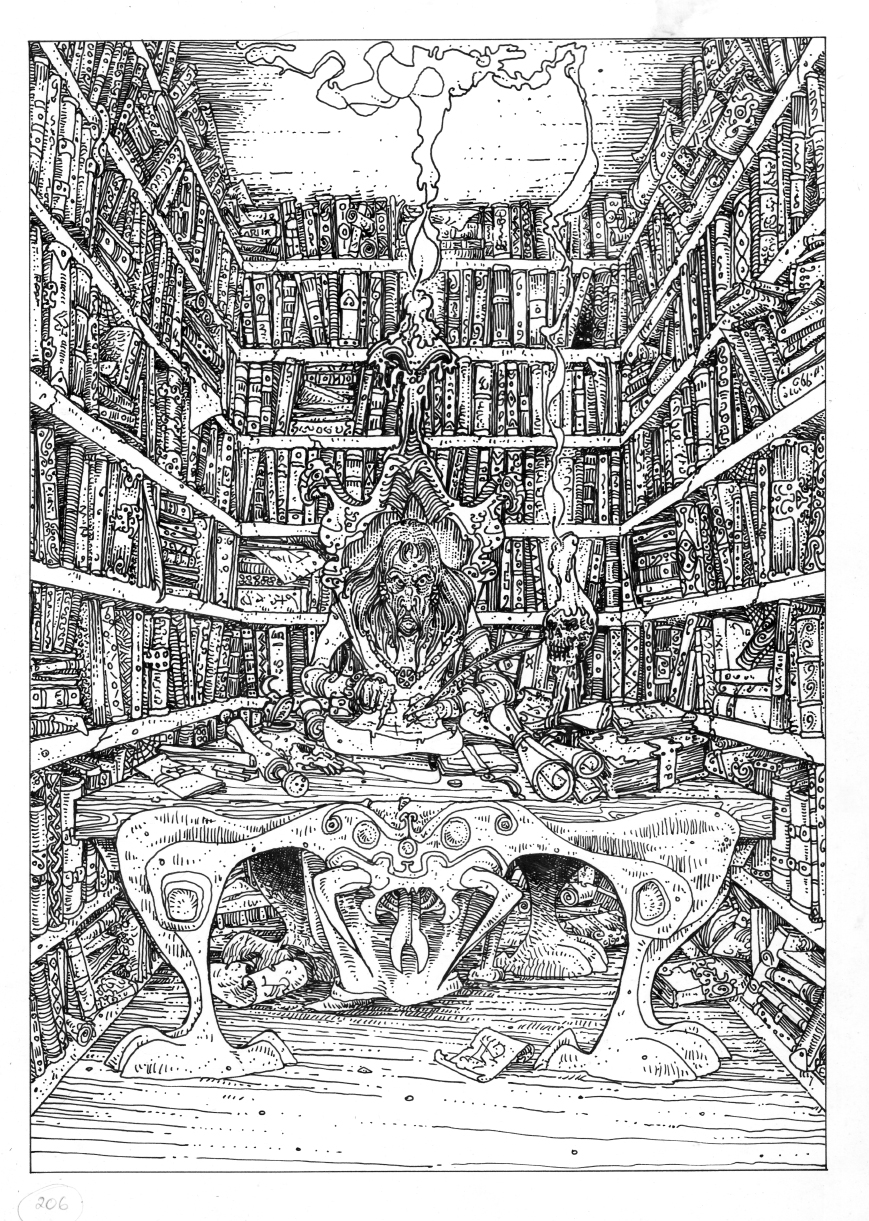
Credits: The pictures of the sage (top), elf, human fighter, and wizard are by Erol Otus. The pictures of the dwarves and troll (bottom) are by David Trampier. The picture of the halflings and human is by Jeff Dee.

Some small parts of the text above may have been copied from the 5e SRD and the ItU rules.


Blog Archive

About Me

My photo
I'm a Canadian political philosopher who lives primarily in Toronto but teaches in Milwaukee (sometimes in person, sometimes online).