Showing posts sorted by date for query mythic babylon. Sort by relevance Show all posts

23 July 2026

My Top-5 Roleplaying Games of All Time

Over at the “RPG Pub” there is a thread asking people to post their top-five favourite role-playing games of all time.

Here’s my list. Reflecting on the role-playing games that I’ve played over the past forty-five years or so, I’d say that my top five have to be the following:

Middle-earth Roleplaying (MERP)/Against the Darkmaster (VsD)


My first “real” campaign involved MERP and ICE’s beautiful maps and detailed campaign modules. MERP – and its descendant VsD – captures what I like the most about Rolemaster – the flexible class-based character development system; the detailed, vivid critical hit charts; the overall coherent rules framework – but without the large volume of charts and details that (IME) bogged down RM in actual play.

Some of my fondest memories of playing RPGs involve MERP and my two favourite campaigns of all time as GM (one still ongoing) use VsD.

Mythras 


I started playing this in 2011 – back when it was still being published by Mongoose and was called RuneQuest II (i.e., MRQII) – and haven’t stopped since. I’ve played in campaigns set in the Young Kingdoms (“Elric”), Mythic Britain, Mythic Babylon, Beyond the Mountains of Madness (the CoC campaign adapted to Mythras), and now Lyonesse, as well as in several “one-shots” or short campaigns (Mythic Greece, Luther Arkwright, Meeros, etc.). A really excellent system overall.

Call of Cthulhu


I haven’t played CoC since 2017 and I’m in no rush to do so again soon. But I’ve run a lot of CoC over the years – almost always as GM (er, “Keeper”) – and I’ve always really enjoyed it. I’m pretty sure it’s the game I’ve run the third most often (after MERP/VsD and AD&D). The scenarios are generally excellent (although some needed work). My only regret is that I have yet to run one of the “classic” campaigns for it (although I did play through BMoM using Mythras).

Dungeons & Dragons/Advanced Dungeons & Dragons (TSR era)


Like most RPGers, I started with D&D and spent a lot of my early gaming days (the early 1980s) playing and running AD&D (and I’ve returned to it from time to time since then). Reading Gygax’s hardbound volumes not only improved my vocabulary as a wee lad, but also sparked my imagination. They were the works of a disorganized creative genius. I still treasure the classic modules from that era as well. Although aspects of the system never failed to frustrate me, the game will always have a special place in my heart.

Stormbringer/Elric!/Hawkmoon/Corum 
(i.e., BRP “Eternal Champions” games)


I don’t really have any interest in running these BRP RPGs now – Mythras has largely filled that space for me – but I still have these books and really enjoyed these (closely related) games back in the day. 

There are other games that I like and other games I hope to try – but these are the games that I consider my all-time favourites.

Feel free to post your "top-5" lists in the comments, if you like. I'd be curious to learn what games have stood "the test of time" for you.


16 February 2024

My RPG Foci: Fantasy and Eldritch Horror

Recently someone over at the RPG Pub asked what genres people preferred in their gaming. Reflecting on this question, I realized that over the past twenty-five years or so, almost all of my role-playing activity has been focused in two genres: fantasy and horror. 

Fantasy

Perhaps unsurprisingly, the vast majority of my gaming has involved various flavours of fantasy, especially the following sub-genres.

High Fantasy

By “high fantasy” I mean the kind of fantasy that you find in the writings of J.R.R. Tolkien and the like. High fantasy worlds have a clear distinction between “good” and “evil” – even if there are morally ambiguous characters and difficult situations between the two extremes. 

I’ve mentioned before here that I was an avid player of Middle-earth Roleplaying back during the 1980s. Indeed, I probably played as much MERP as I did AD&D during my high-school days (it eventually became my group’s “main game”). And when I first started playing RPGs semi-regularly again, around 1999, I naturally started with MERP (before, unfortunately, moving to the Rolemaster Standard System, which despite its obvious mechanical relation to MERP [MERP was derived from an earlier version of Rolemaster], was not nearly as smooth or fun to use in practice).

A lot of the games that I’ve run over the years have been in this subgenre, including past and present Middle-earth games. My current “Court of Urdor” also falls within this category. 

The brilliant Against the Darkmaster FRPG – which is heavily inspired by MERP – is designed for precisely this kind of fantasy campaign. Indeed, it builds the “Darkmaster” conceit into some of its core mechanics. As the name indicates, the struggle against the Darkmaster is assumed to be a central feature of any campaign, even if only in the background. 

Swords and Sorcery 

Another familiar sub-genre. Robert E Howard’s Hyborea and Atlantis, Michael Moorcock’s Young Kingdoms (and “multiverse” more generally), Fritz Leiber’s Nehwon, Karl Edward Wagner’s “Kane,” and the like, are all exemplars of this sub-genre. I would include Jack Vance’s Dying Earth corpus, and many of Clark Ashton Smith’s stories (especially those set in Zothique, Averoigne, and Hyperborea), as members of this family as well.

After rereading REH’s Conan stories – and reading for the first time his Kull and Bran Mac Morn tales – fifteen years ago (when they were republished in nice volumes by Ballantine), I came up with a number of house rules for Swords & Wizardy in order to run some “swords and sorcery” flavoured games. Those house rules are still available here – and seem to attract regular visits to this day. Many of them were later integrated into D101 Games’ Crypts & Things role-playing game, which I highly recommend. 


In addition to running my modified version of S&W (and later C&T), I also was a player in a wonderful campaign set in the Young Kingdoms (of Moorcock’s Elric tales), using the Mongoose Runequest II system (the grandfather of the excellent Mythras RPG). 

Dungeons & Dragons

Blend the above two sub-genres together – and add some quirky monsters (e.g., beholders, mind flayers), novel twists on old ideas (e.g., drow elves, planar cosmology), and some innovations (e.g., dungeon-delving, wandering monsters) – for the singular “Dungeons and Dragons” sub-genre. I regard “D&D fantasy” as its own thing, even though it obviously draws heavily on a wide range of sources (not just fantasy). 

However, my experience running and playing post-TSR D&D has not been that great. I ran two 3rd edition games – one 3.0e and one 3.5e – just over two decades ago. The system was new and shiny, and seemed to “fix” all the purported “problems” with the earlier versions of the game. Both campaigns lasted about a year but became quite tedious to run once the characters reached 3rd or 4th level. I came to find that being a DM for 3rd edition D&D was simply a chore. After the second campaign, I vowed to never run the game again. I subsequently ran a few sessions of Castles & Crusades, AD&D, and played a bit of the Warhammer RPG (2nd edition). All of those games I enjoyed far more than 3rd edition D&D (although I probably would only bother with AD&D again today).

I skipped 4th edition D&D altogether. After reading halfway through the Player’s Handbook in fall 2008, I realized that it was just not for me. 

Years later, I ran a few one-shots of 5th edition. At first, I thought rather highly of it – at the very least, it seemed to be a vast improvement over 3rd edition. I quite liked some of the books that were published for it (namely, Tales from the Yawning Portal, Ghosts of Saltmarsh, and Goodman Games’ updated versions of classic TSR modules – not coincidentally, books that all contained a lot of “Gygaxian" Greyhawk material). 

More recently, I ran a campaign set in the World of Greyhawk, much of which took place in the legendary area around the village of Hommlet. It was great fun! But it was fun despite the system (at least for me as the Dungeon Master). The ubiquitous, often “free” magic, and almost absurd “superhero” quality of the characters, came to grate on my nerves. I’ve explained some of my problems with 5th edition D&D before (see here and here) so I won’t say any more about that here.  
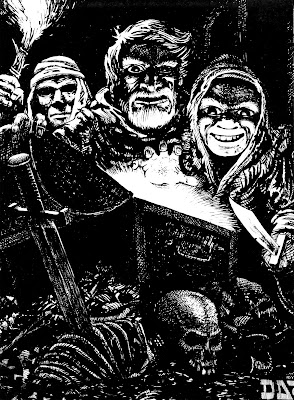
After these experiences, I conclude that I definitely prefer “old school” D&D within this genre – specifically, the more challenging and flavourful 1st edition Advanced Dungeons and Dragons and Basic/Expert Dungeons & Dragons (and related “clone” systems, like OSRIC and S&W). I like magic to be at least somewhat rare and at least somewhat costly to use. (Endless cantrips and ritual spells? No thanks!) It’s clear to me that the post-TSR versions of the game just are not my thing. I certainly have no interest in the recent offerings from the Wizards of the Coast.

There is one honourable exception regarding 5th edition D&D: the Middle-earth adaptations of the 5e system, as presented in Adventures in Middle-earth and The Lord of the Rings RPG. I thoroughly enjoyed the AiME campaign that I ran a number of years ago. But those games don’t feel like “D&D” at all – the magic system is entirely different, the classes are entirely different, etcetera. They also import a number of mechanics from The One Ring RPG. And of course, those games belong to the “high fantasy” genre discussed earlier.

Historical Fantasy

As a player, the bulk of my gaming over the past decade has been in historical fantasy settings. I suppose that this is unsurprising, given that I’ve played a lot of Mythras (and its predecessors, RuneQuest 6 and MRQII) during this time.  So, I’ve played in long-running Mythic Britain and Mythic Babylon campaigns, as well as some one-shot sessions in other settings. 

Both Mythic Britain and Mythic Babylon are excellent and highly recommended!

Horror

After fantasy, I’ve mainly run and played in “Horror” games. But in this category, it’s been exclusively “Lovecraftian” horror, that is, “Cthulhu Mythos” stuff. 

I’ve run a couple of short Call of Cthulhu campaigns set during the “classic” period, in Toronto and Massachusetts, as well as a number of one-shots. I have material for other eras (e.g., Rome, medieval, and modern, including “The Laundry”) but have never run a campaign or even a one-shot outside of the default 1920s-30s period.  

As a player, I recently took part in a long-running Mythras campaign, using the classic Beyond the Mountains of Madness sourcebook. (Our last session was today. My character survived – and was even more-or-less sane!) I’ve also taken part in one-shots of Trail of Cthulhu, Delta Green, and other related games over the years. 


Other genres?
 
I took part in a few Mythras sessions years ago set in the Luther Arkwright universe. I’m not sure how to categorize that setting (“science fantasy”?). They were fine but not the kind of thing I’d likely run myself. I also have played a few other one-shots here and there, but nothing really worthy of mention.

I haven't been remotely interested in playing in a “superheroes” game in recent decades (unless you count 5th edition D&D – I joke). It’s a genre that simply doesn't appeal to me. I’d be open to a “modern” game (say, espionage) but I have no idea how to run one myself. Likewise for science-fiction.

Back in high-school, my group tried all kinds of different games – including superheroes (Villains & Vigilantes, Marvel Superheroes), historical (Gangbusters, Bushido), and especially science fiction (Traveller, Star Frontiers, and even Space Opera – or at least I bought and tried to read Space Opera). We had a lot of time and energy back then!

Wrapping up...

These days, now that I’m an old man, I generally try to stick to what I know I like. So, I guess I’m a pretty limited gamer: I play and run almost exclusively fantasy and horror games. Maybe I’ll broaden my horizons when I retire. 

Looking back, I regret all the time I spent trying to get myself to like 3rd and 5th edition D&D. I should’ve just spent that time playing MERP or Stormbringer or Crypts and Things or whatever. At least I’ve learned my lesson: life is too short to try to force myself to like a game when there are other games available that I much prefer. So these days I’m happy to focus on Mythras and Against the Darkmaster – although, of course, I still pick up the occasional new system that catches my eye. 


Art credits (from top to bottom): Angus McBride, Andrea Piparo, Michael Whelan, Dave Trampier, David Benzal, Erol Otus, Angus McBride (again).

09 December 2023

The new Mythras Imperative is now available!

I recently mentioned that a new version of Mythras Imperative was in the works. Well … it’s here!

The Design Mechanism’s announcement (at the RPG Pub):


The new, revised, expanded, ORC-licensed edition of Mythras Imperative is now available – just in time for Christmas.

While the game and mechanics are fundamentally the same, we've tweaked a few rules, made errata corrections, and fully integrated rules for firearms, vehicles, new character creation options, and sample creatures (with a complete list of traits to make them worthy opponents).

Most important of all, Mythras Imperative is licensed under ORC, meaning that 3rd party creators can freely use, adapt and build upon the Mythras Imperative foundation for their own unique d100 games, supplements and adventures. Combine Mythras Imperative with its sister book, Classic Fantasy Imperative, or any other ORC-licensed open gaming system.

So whether you want gritty fantasy or mythic historical, Pulp-era spies or cinematic superheroes, Mythras Imperative has you covered. Simple to learn, simple to play, but with a surprising depth that is the result of many, many years of refinement.

The PDF version is free to download. The Print on Demand version is $24.99 (black and white, softcover, 80 pages). A POD version for Drivethru customers will follow later.


As I’ve mentioned many times before at this blog, Mythras is the game that I’ve played the most over the past dozen years (I include its immediate ancestors, RuneQuest 6 and Mongoose Runequest II, within the ‘Mythras’ category, as they’re all essentially the same game, written by the same people). I don’t write about it as much as I do some other games, primarily because I don’t run (“Game Master”) Mythras. I tend to write more about games that I’ve run in the past, am running currently, or plan to run in the future. But if I wasn’t so fortunate as to belong to a group with a couple of excellent Mythras GMs – one of whom is the co-author of the system, the other the co-author of the Mythic Babylon book – I’d definitely be running Mythras myself. 

Anyhow, if you’re still unfamiliar with Mythras, I recommend checking out Mythras Imperative, as it’s a nice, lean presentation of the system, easily readable within an afternoon.


11 January 2023

OGL Apocalypse: WotC goes full Chaotic Evil

By now I assume that most people who visit this blog are aware of the raging storm over the changes that the Wizards of the Coast (part of Hasbro) are seeking to make to the Open Game License (OGL).
 
The current OGL (v. 1.0a) has been around for over two decades now and has facilitated a number of important developments in the role-playing hobby. In addition to all the material produced for Dungeons & Dragons by third-party publishers (mainly for 3e, 3.5e, and 5e), it enabled the creation of a number of role-playing games that draw upon some of the core mechanics of D&D (e.g., Mutants and Masterminds). The Old School Renaissance (OSR) probably would not have happened (at least not in the way that it did) without the OGL. The original retro-clone, OSRIC, restated the 1e AD&D rules, using the OGL for cover. (It was a brilliant insight on the part of Matt Finch, aka “Mythmere,” that this was possible.) Likewise, the first edition of Pathfinder used the OGL to repackage (with some tweaks) the 3.5 edition D&D rules in order to cater to gamers dissatisfied with 4th edition. No doubt WotC was not happy about that! But ultimately it pressured WotC to rethink 4e D&D (as did, I think, the OSR to some extent) and produce a far superior product, 5e D&D.
 
Anyhow, it looks like WotC aims to try to revoke OGL 1.0a and replace it with a new one (v. 1.1) with rather draconian conditions. For a helpful (and brief) overview, see this Inverse article, or this Forbes (!) one, or this Ars Technica one.
 
As a side note, legally speaking (but keep in mind that I am not a lawyer) the OGL was never actually necessary and in fact imposes conditions stricter than those imposed by standard US copyright law (let alone the laws of other countries, which tend to be more generous with “fair use” than the US). The reason for this is that game rules cannot be copyrighted. So a product that dryly restated the rules of AD&D, for instance, would be perfectly legal. However, artistic and literary expression can be copyrighted. Given the literary nature of role-playing games, a lot of the specific descriptions of classes, spells, monsters, settings, and so forth can (arguably) be legitimately copyrighted (but not their underlying mechanics). So one would have to tread carefully in restating a set of rules. And of course, even if one has the legal right to do something (e.g., indicate compatibility with another company’s game), one nonetheless may be subject to legal harassment or bullying by a company with deep pockets. One thing that the OGL did was remove any uncertainty about potential legal harassment or worries about whether some element of the game was copyright-protected or not. (For an excellent overview of this matter, see this Electronic Frontier Foundation article.)
 
A lot of RPG publishers are now abandoning the OGL. Even if WotC backs down and allows OGL 1.0a to continue (or modifies 1.1 so that it is far less restrictive) many gaming companies are sensibly deciding that they do not want to be vulnerable to future Hasbro corporate whims. (And it very well may be the case that WotC does not back down and pushes on with OGL 1.1.)
 
As a player, most of my time has been spent using Mythras over the past twelve years, with occasional forays into other systems (e.g., The One Ring, Trail of Cthulhu, Delta Green, etc.), none of which have been dependent on the OGL. Among other things, I’ve been a sorcerer in a Young Kingdoms campaign (which used Mythras’s predecessor, Mongoose’s RuneQuest II), a Roman mystic in a Mythic Britain campaign, an aristocratic messenger in a Mythic Babylon campaign, and a paleontologist in a Return to the Mountains of Madness campaign.
 
But as a creator and gamemaster, I’ve been heavily involved with Dungeons & Dragons and related systems. Years ago, I got into the OSR in a big way and developed a set of house rules for modifying Swords and Wizardry (the 0e retro-clone) to give it more of a “swords and sorcery” flavour. Many of those rules appeared in articles in Knockspell and Fight On! All of those rules remain available at this blog (and were never offered here under the OGL). Many of those rules were incorporated into D101’s Crypts and Things game (which does use the OGL). (I hope that C&T rides out this storm and continues to be available. It’s a great system!)
 
Also, despite some problems here and there, overall, I like 5e D&D. It’s not perfect – it still has too many fiddly (“exception-based’) rules for my taste – but it’s the first “official” version of D&D since the TSR era that I’ve been happy to run. (Making feats optional was huge improvement over 3e.) I’ve been using it for my current Greyhawk campaign. And I thought that the 5e-derived Adventures in Middle-earth game was quite good. The Mirkwood campaign that I ran using AiME a few years ago remains one of my all-time favourites.
 
But this latest action by WotC has left a foul taste in my mouth. I already was put off by the movement toward “D&D One” (or is it “One D&D”?), which struck me as undermining some of the strengths of 5e D&D – among other things, by “hardwiring” certain elements that I prefer to keep optional, e.g., feats and inspiration, into the core game. Changing the OGL and wreaking havoc with 3rd party publishers is just plain malevolent.
 
So … I’ve had it with WotC. I won’t be buying anything from them for the foreseeable future. (Not that I was buying much anyway – it’s been almost two years since I last purchased a book from WotC. Most of my recent 5e purchases have been from 3rd party publishers like Goodman Games.) 
 
I’m not going to abandon my current Greyhawk campaign. It’s been too much fun – and the characters just made it to level 4! But I think I’ll be using Into the Unknown as the rules base going forward (supplemented with a few 5e options for the sake of continuity).
 
Aside from my current Greyhawk campaign, my focus (as a GM) lately has been on the Against the Darkmaster system. I hope to run a sporadic VsD campaign set in Eriador (Middle-earth) over the next few months. Aside from that, I plan to develop my own setting over the coming year. We’ll see how that goes. (Of course, VsD never used the OGL – and has a generous license for other publishers.)
 
Well that’s all for now. It’ll be interesting to see what happens once OGL 1.1 is unleashed on the world. 


01 January 2023

Best Wishes for 2023

I hope that all reading this old blog had a pleasant holiday time and that the year ahead brings them much happiness and peace.


My wife kindly got me these cookies. Obviously, she knows me well! I felt a bit guilty eating them but comforted myself in the knowledge that more could be obtained in the future.


I haven’t been too active here over the past couple of months. Hopefully my posting rate will pick up in the spring, as I thankfully will not have to travel so much for work.


In particular, I’d like to catch up on the following items:


§  Update the log for my regular “Greyhawk” (D&D 5e) campaign. A lot has happened since I last posted, some of it even a bit entertaining (I think).

o   The adventurers finally managed to defeat Lareth and clear out the Moathouse (more or less); soon they will be moving beyond Hommlet.


§  Update the status of my irregular “Against the Witch-King” (Against the Darkmaster) campaign.

o    Most of the characters have been created – and they’re an interesting mix: a Dúnadan lady of Arthedain (a champion or “ranger”); two Lossoth brothers from Forochel (one a scout, the other a shape-shifting animist or “shaman”), and a Dwarven scholar from the Ered Luin (sage).


§  Post descriptions of my characters for the Mythic Babylon campaign I played in over the past few years (which wrapped up last summer) and the Return to the Mountains of Madness campaign I’m currently playing in (using the Mythras rules).

o   I’m not keeping logs for these campaigns (I generally only do that for the games I’m running) but I think that these characters may be of some interest to others, especially people interested in the Mythras system and its associated settings.


§  Return to my top-10 list of fantasy and science-fiction films. (I’ve only covered number 10 so far!)


§  Write up some final reflections on The Rings of Power series (which I found to be very much a mixed bag).


I’m watching Andor right now and finding it to be excellent. I had skipped the two most recent Star Wars series (the Boba Fett and Obi-Wan ones) but I quite liked both seasons of The Mandalorian. This series is even better, in my view. It doesn’t really feel like a “Star Wars” show to be honest – but that’s probably a good thing, given how badly the movies degenerated in quality after The Empire Strikes Back. The notable exception in recent years is Rogue One – the best Star Wars movie since Empire in my judgement – and so perhaps it’s no surprise that Andor is of such high quality, given that it’s a Rogue One prequel. Check it out if you haven’t already!

18 April 2022

Mythras News: Supes and Polynesia

There’s a new member of the Mythras RPG family: the superhero role-playing game Destined. It’s available now at the Design Mechanism’s new home store, and will become available at Lulu and DrivethruRPG on the 23rd of April.
 

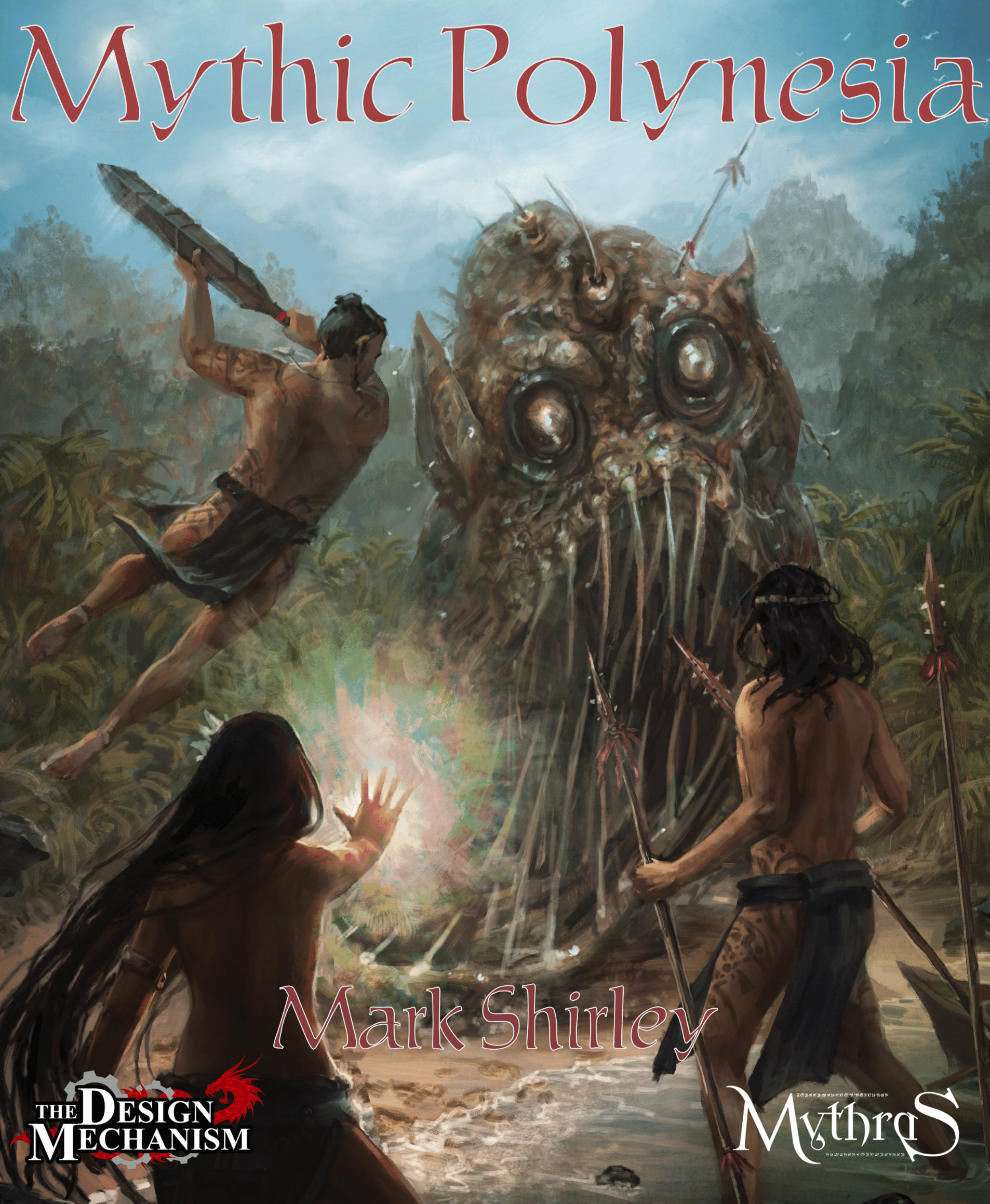
Also, another Mythic Earth setting book is in production: Mythic Polynesia. I don’t know when it’ll be available, but the cover looks rather cool:


I’ve probably played more Mythras (including its predecessors RQ6 and MRQII) than any other role-playing game over the past eleven years. (By coincidence, I vaguely recall meeting Loz in early spring 2011…) I’ve played in the Young Kingdoms (Elric’s world), Mythic Britain, the Luther Arkwright multiverse, and (currently) Mythic Babylon. Soon I’ll be taking part in a Mountains of Madness campaign (converted to Mythras). I can’t recommend the game highly enough!


01 January 2022

My three favourite RPG books from 2021

I’ve cut back way back on my RPG purchases in recent years. For the most part I try to buy only products that I think I’ll likely actually use at some point in the near-ish future, or products that I have a strong intrinsic interest in (as, say, they concern a setting, subject, or game of which I’ve long been a fan). Nonetheless, I still buy more RPGs products than I should. But there are a few every year that do not fall into the “taking-up-space-on-my-shelf-until-I-donate-them-or-retire” category. Here are three from 2021 (in no particular order):


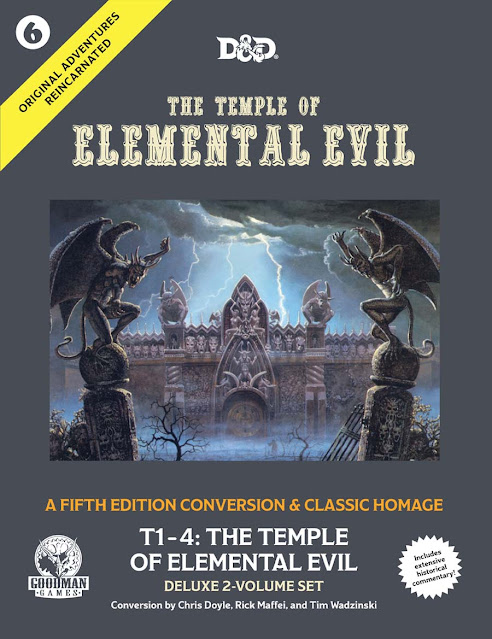
I’ll start with something I haven’t mentioned before at this blog: Goodman Games’ Original Adventures Reincarnated #6: The Temple of Elemental Evil. In addition to including scans of multiple printings of the original 1st edition AD&D Village of Hommlet module, as well as the subsequent Temple of Elemental Evil mega-module, this two-volume set provides an expanded version of the module with 5th edition D&D stats. I rank the original Village of Hommlet module as one of the all-time classics for AD&D.


I hope to resurrect my (sadly-still-on-hiatus) Greyhawk campaign (which uses 5e D&D with Gygax’s version of the World of Greyhawk) in the new year. Once the characters wrap up their current adventure, I hope to have them travel to Hommlet and go through this campaign. Afterwards, I plan to run some more classic modules in Greyhawk for my players, including White Plume Mountain (converted to 5e in Tales from the Yawning Portal), Expedition to the Barrier Peaks (another member of Goodman Games’ “Original Adventures Reincarnated” series), the “Against the Giants” trilogy (also in Tales), and perhaps even the Tomb of Horrors (yet another one in Tales). At least that’s my tentative plan for the future. (Heh ... hope springs eternal.)


Then there’s Against the Darkmaster. (I’m cheating a bit here as I got the PDF in 2020. But I don’t feel like I “really” own a book or game until I get the physical version.) I’ve mentioned this excellent game before here. I really want to run this sometime – perhaps using it with a heavily modified version of the amazing classic campaign module Ardor by Terry Amthor (RIP). Even if I don’t use Against the Darkmaster in the near future, though, my long-abiding love for MERP makes this a purchase that I don’t regret at all. I thrill just flipping through this massive, gorgeous book, appreciating the wonderful art, and reading bits of the rules.


Last – but certainly not least – there’s Mythic Babylon, which I’ve also mentioned previously here. Since I’ve been playing in a Mythic Babylon campaign since summer 2020 (run by the book’s co-author, Chris Gilmore), in a way I’ve been using this book for even longer than I’ve owned it! It’s a really wonderful work from the always excellent Design Mechanism.


Okay, that's it for 2021. Best wishes, gentle readers, for 2022!

16 December 2021

Mythic Babylon: 2nd best-selling historical RPG of 2021

Yesterday I mentioned that the Design Mechanism’s Mythic Babylon was the 20th best-selling "other fantasy" RPG product at DriveThruRPG for 2021. I noted that this was especially impressive given that it is something of a “niche” product.


Well today I learned that within this niche—that of “historical” RPG products—it was the second best-selling RPG product of 2021 at DriveThruRPG.


I have no doubt that within the “hyper-niche” of Mesopotamia-based RPGs, it ranks number one!

Mythic Babylon: number 20 in sales, number 1 in my heart

I’ve mentioned Mythic Babylon before here. It’s a great book: impressively researched yet not overwhelming (or dryly “academic”), and full of game-usable content (for the Mythras system). The setting is flavourful and exotic: it’s somewhat alien to most players, yet not so alien as to be incomprehensible (most players probably know who Gilgamesh and Hammurabi were – the setting takes place during Hammurabi’s time, 18th century BC). In addition to the amazing content, the writing is accessible, the maps are clear, and the art is evocative. It’s an informative, useful, and aesthetically striking work.


Despite being what I would call a “niche” product (a historical, albeit “mythical,” setting) Mythic Babylon managed to be the 20th best-selling “other” fantasy role-playing product at DriveThruRPG last year!


Kudos to the authors, Paul Mitchener and Chris Gilmore! (Disclosure: the latter is the GM for the Mythic Babylon campaign I’m currently struggling to survive in.) And kudos to the Design Mechanism for continually turning out top-notch products.


28 June 2021

Mythic Babylon unleashed

I’ve been part of a Mythic Babylon campaign as a play-tester for about a year now (meeting roughly twice a month). The campaign is being run by one of the book’s co-authors (Chris Gilmore). It took me a while to get myself oriented in the setting. Bronze Age Mesopotamia is far less familiar to me than, say, Dark Ages Britain or Imperial Rome. And while I certainly would not claim to have a clear grasp of the setting even now, a year later, it does not feel quite as alien as it did at first. It’s an interesting place, and I’ve been enjoying the campaign enormously in recent months. 

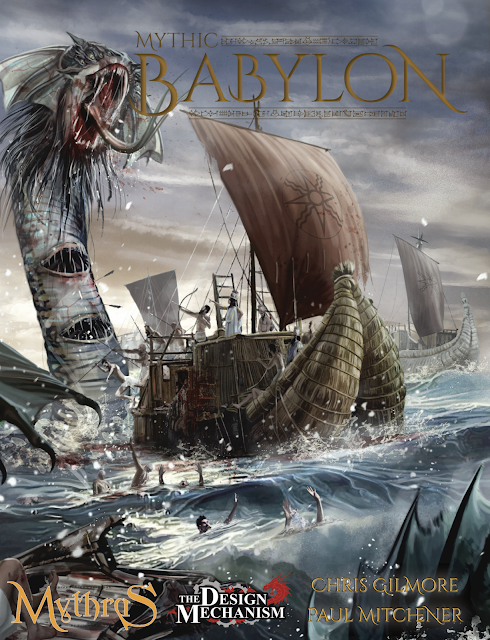
Now everyone can enjoy this excellent setting for themselves: Mythic Babylon has been on sale to the public for over a week now.

Here is the description of the setting from the Design Mechanism site:

What is Mythic Babylon?

Mythic Babylon is a role-playing supplement for the Mythras game system. It provides everything you need to take your Mythras game back to the 18th century BC and enter a world of cut-throat diplomacy, Machiavellian politics, and ecstatic prophets. Within these covers you'll find information on the society, culture, religion, trade, laws, and beliefs of Old Babylon and the surrounding lands. The setting is presented as a sand-box with a wide-ranging gazetteer of places to explore, each loaded with plot hooks. For those who like to play against the backdrop of history, we provide a timeline of past and near future events. A bestiary and a chapter for game masters rounds out the end of the book.
This book contains everything you need to create adventures in the lands of Sumer, Akkad, and Subartu from the low lying Eden to the Cedar Mountains and even into the Underworld. Follow in the steps of kings like Gilgameš, Kubaba, or Hammurabi in this mythological and historical setting that was nearly 4000 years in the making.
Where is Mythic Babylon?

Mythic Babylon is set in what will later be called Mesopotamia by the Greeks, which means 'The Land Between the Rivers', referring to the Tigris and Euphrates. At the time our book is set, there is no one name for the whole region. Instead, the southern plain is called Sumer and the central plain is called Akkad. Together, these will one day be called Babylonia after the city of Babylon. The northern plain is called Subartu, but will one day come to be called Assyria after the city of Aššur.
This book focuses on Sumer, Akkad, and Subartu. Peripheral regions such as ancient Syria, Turkey, Iran, and Bahrain are given a more cursory treatment.
Mythic Babylon is expertly illustrated by James Turpin, and is an exceptional addition to the Mythic Earth range for Mythras. It comes as a hardcover book, 322 pages, and the PDF price is included in the hardcover price, along with an additional PDF file containing additional maps.
Initial reviews are very positive. This is no surprise to me. I can confirm that it’s a great setting and that a lot of serious research went into it. My only quibble is that there is no sample scenario included. I generally think such scenarios are helpful so that players can “test out” a setting or game without too much difficulty. This especially is the case for settings that likely will be unfamiliar to many players. But this, obviously, is a very minor thing. 

What impresses me the most about this book, like the others for Mythras with which I am familiar, is how successful it is in translating a difficult setting into something suitable for a game, that is, in rendering the world playable. Hats off to Chris Gilmore and Paul Mitchner on producing such a fine work.

For an interesting discussion of the importance of lists in ancient Mesopotamia, and their application to world-building in role-playing games, check out this post by Chris at The Many Coloured House. 

After years of waiting Mythic Babylon is finally available to the masses. Praise Marduk!

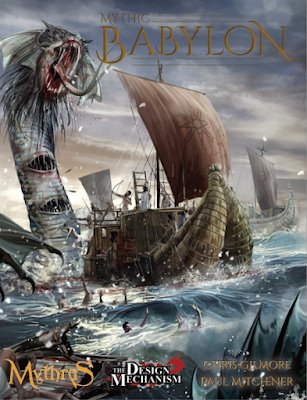
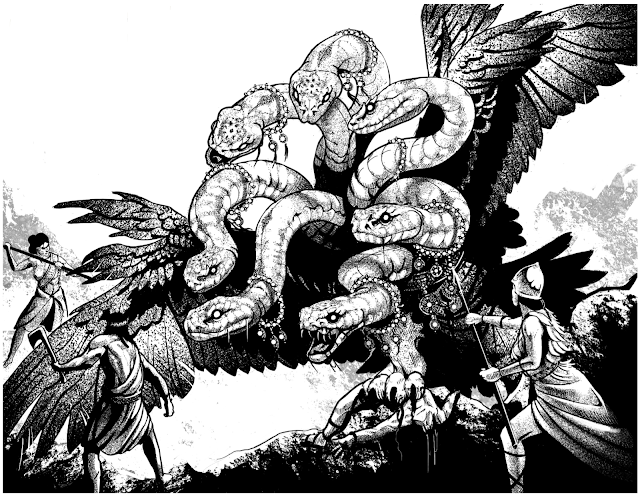
[A Mušhuššu (Babylonian dragon) – my character beheaded one of these pests!]


Blog Archive

About Me

My photo
I'm a Canadian political philosopher who lives primarily in Toronto but teaches in Milwaukee (sometimes in person, sometimes online).